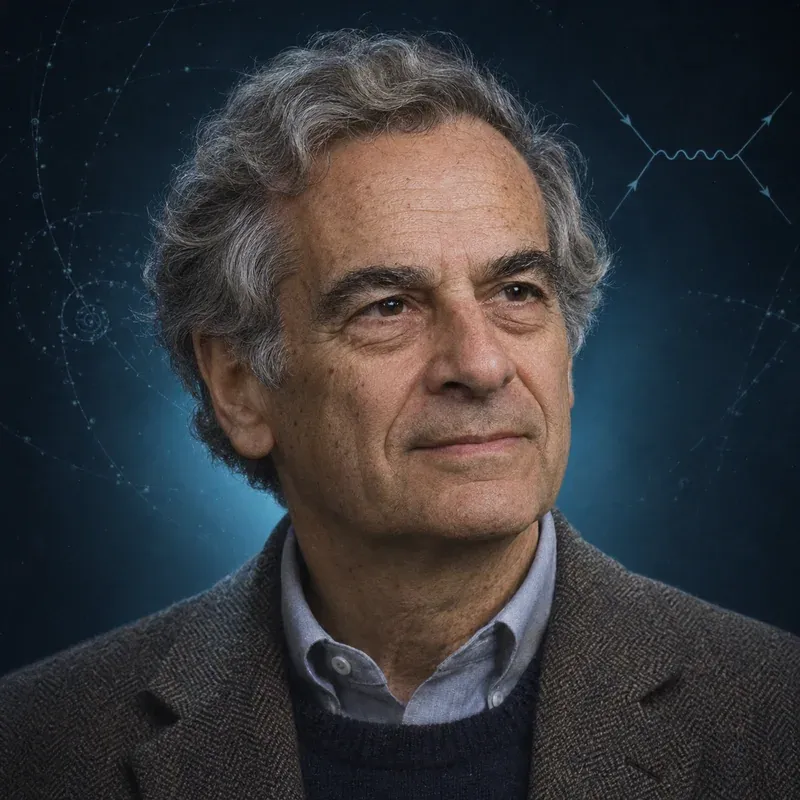
 Illustration
Frank J. Sciulli
With Barry Barish, Sciulli built the Caltech–Fermilab neutrino detector and used a narrow-band beam, whose neutrino energy is fixed by the decay kinematics, to measure absolute cross sections. In 1975 the group reported events without a final-state muon and with missing energy, independent evidence for neutral-current neutrino interactions. Continued as CCFR at Fermilab's Lab E, the programme measured nucleon structure functions and the weak mixing angle in neutrino deep-inelastic scattering, supporting the quark model, the electroweak theory and QCD. The line of experiments was completed by NuTeV.
- Born
- 22 August 1938
Philadelphia, Pennsylvania, USA - Nationality
- American
- Field
- Experimental particle physics
- Institutions
- University of Pennsylvania (BA 1960, MA 1961, PhD 1965), California Institute of Technology (to 1981), Columbia University / Nevis Laboratories (from 1981; emeritus 2004), DESY (ZEUS experiment at HERA)
Education and early research
Frank J. Sciulli was born on 22 August 1938 in Philadelphia. He studied at the University of Pennsylvania, earning bachelor's, master's and doctoral degrees between 1960 and 1965 with a thesis on K-meson decays. His early experiments studied the selection rules of weak hadron decays, results that helped establish quarks as the constituents of hadrons. He then went to Caltech as a postdoc and became assistant professor there in 1969.
The Caltech–Fermilab neutrino experiment
When Fermilab began operating in the early 1970s, Sciulli and Barry Barish built a large iron-and-scintillator neutrino detector for its high-energy beam. Their key choice was a narrow-band, or dichromatic, beam: by selecting pions and kaons of one momentum before they decay, the neutrino energy can be inferred from the angle at which it hits the detector, and the flux can be measured absolutely. That made true cross-section measurements possible.
In 1975 the group published a search for neutral-current interactions, events in which no muon leaves the target. They found a clear signal, and the missing energy in these events showed that a neutrino carried energy away, independent support for the discovery made two years earlier at Gargamelle. The team also observed events with two muons in the final state, later explained by charm production.
CCFR and after
Sciulli moved to Columbia University in 1981. The programme became the Chicago–Columbia–Fermilab–Rochester collaboration (CCFR) in Fermilab's Lab E, running from 1979 with narrow-band beams and spark chambers, later with a wide-band beam at Tevatron energies. Its deep-inelastic scattering data gave precise nucleon structure functions, tests of quantum chromodynamics and measurements of the weak mixing angle; one run searched for neutrino oscillations and found none. The series ended with NuTeV, carried forward by his Columbia colleagues Michael Shaevitz and Janet Conrad.
From 1985 Sciulli worked on the ZEUS detector at the electron–proton collider HERA at DESY. He chaired Columbia's physics department from 1988 to 1991, received the Panofsky Prize in 1995 and was elected to the National Academy of Sciences in 2009.
Known for
- Caltech–Fermilab neutrino experiment with a narrow-band beam
- Confirmation of weak neutral currents with high-energy neutrinos (1975)
- CCFR neutrino deep-inelastic scattering programme at Fermilab
- ZEUS experiment at HERA
- Panofsky Prize (1995)
Chronology
- 1965PhD, University of Pennsylvania (K-meson decays)
- 1969Assistant professor at Caltech
- 1975Caltech–Fermilab neutral-current result
- 1979CCFRR experiment E616 starts in Fermilab's Lab E
- 1981Professor at Columbia University
- 1985Begins work on ZEUS at HERA
- 1995Panofsky Prize
- 2009Elected to the National Academy of Sciences
Original papers
- B. C. Barish et al., Neutral Currents in High-Energy Neutrino Collisions: An Experimental Search, Phys. Rev. Lett. 34, 538 (1975)DOI 10.1103/PhysRevLett.34.538
Experiments
- Caltech–Fermilab neutrino experiment
- CCFR (E744/E770)
- NuTeV
- ZEUS
Connected people
Frequently asked questions
What is a narrow-band neutrino beam?
A beam made from pions and kaons of a selected momentum, so that the neutrino energy is correlated with its angle and the flux can be calculated. Sciulli's Caltech–Fermilab group used one to measure absolute neutrino cross sections.
What did Frank Sciulli's experiments find?
They confirmed neutral-current neutrino interactions in 1975 and, as CCFR, measured nucleon structure and the weak mixing angle with high-energy neutrinos.
Mentioned in 1 page
Terms 1
Last updated: · Editorial standard
Cite this page
Text
Neutrino Atlas (2026). “Frank J. Sciulli”. Retrieved 22 November 2026, from https://neutrino-atlas.com/people/frank-sciulli/BibTeX
@misc{neutrinoatlas2026peoplefranksciulli,
  title        = {Frank J. Sciulli},
  author       = {{Neutrino Atlas}},
  year         = {2026},
  url          = {https://neutrino-atlas.com/people/frank-sciulli/},
  note         = {Accessed 2026-11-22},
  language     = {english}
}