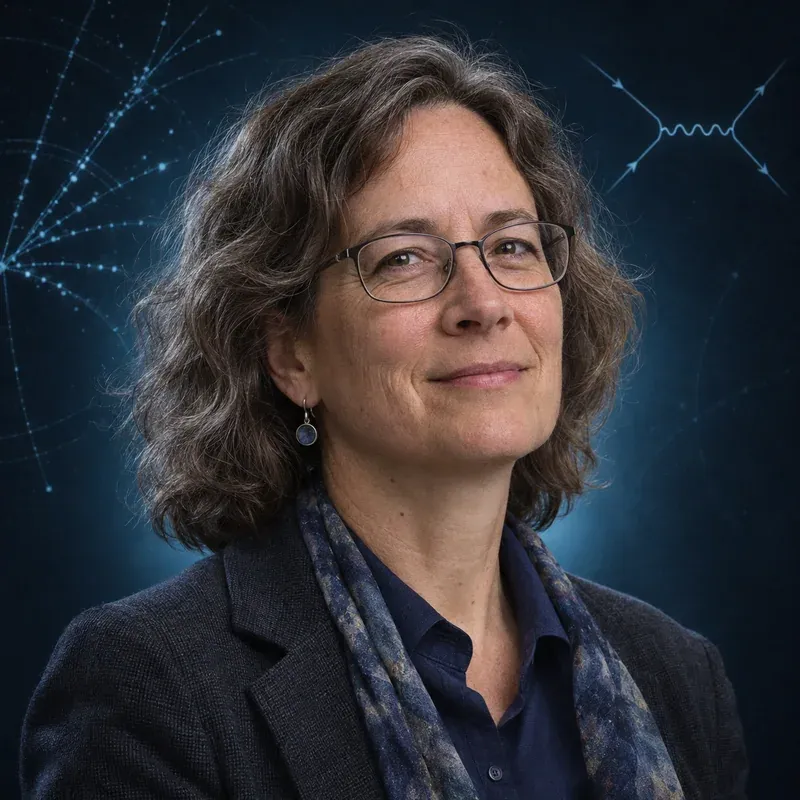
 Illustration
Janet M. Conrad
Conrad was a founding member and spokesperson (with William Louis) of MiniBooNE at Fermilab, built to test the LSND anomaly; MiniBooNE reported an excess of electron-like events at low energy. She is spokesperson of IsoDAR/DAEδALUS, which would use cyclotron-driven decay-at-rest sources for sterile-neutrino and CP-violation searches, and works on MicroBooNE and IceCube.
- Born
- 23 October 1963
Wooster, Ohio, USA - Nationality
- American
- Field
- Experimental particle physics
- Institutions
- Swarthmore College (BA 1985), University of Oxford (MSc 1987), Harvard University (PhD 1993), Columbia University / Nevis Laboratories
Education and career
Janet M. Conrad is an American experimental particle physicist and professor of physics at MIT. She took her BA at Swarthmore College in 1985, an MSc at Oxford in 1987 as a member of the European Muon Collaboration, and her PhD at Harvard in 1993. After a postdoc at Columbia University's Nevis Laboratories she joined the Columbia faculty in 1995 and was named Walter O. LeCroy Professor in 2006. She moved to MIT in 2008.
From NuTeV to MiniBooNE
Conrad's neutrino work began with the CCFR/NuTeV programme at Fermilab, where she led the NuTeV decay-channel search for new particles. Her central project became MiniBooNE, of which she was a founding member and, with William Louis, spokesperson. It was designed to test the LSND result, which had suggested oscillations with a mass splitting near 1 eV² and therefore a sterile neutrino. MiniBooNE kept a similar ratio of distance to energy but used ten times higher energy, a different beam (the Booster Neutrino Beam) and a different detector: a sphere of 800 tonnes of mineral oil seen by photomultipliers through Cherenkov light.
MiniBooNE did not see the simple LSND-like signal at higher energy, but it found an unexpected excess of electron-like events at low energy, in both neutrino and antineutrino mode. By 2018 the excess had reached a significance of 4.8σ. Its origin is still debated: oscillation, mis-identified photons, or new physics. Because a Cherenkov detector cannot easily tell an electron from a photon, Conrad joined MicroBooNE, a liquid-argon TPC in the same beam that can make that distinction, and SBND.
IsoDAR and other work
Conrad is spokesperson of IsoDAR and DAEδALUS, proposals to use high-power cyclotrons as neutrino sources. In IsoDAR, protons strike a target surrounded by lithium; the resulting lithium-8 decays and emits electron antineutrinos with a well-known spectrum, which a large scintillator detector nearby could use to look for the short oscillation wavelengths expected from sterile neutrinos. DAEδALUS would use decay-at-rest sources at several distances to measure CP violation. She is also a member of IceCube, which has searched for sterile neutrinos through matter effects on atmospheric neutrinos crossing the Earth.
Recognition
Her honours include a Presidential Early Career Award (1999), a Sloan Fellowship (2000), the APS Maria Goeppert-Mayer Award (2001), APS Fellowship (2003) and a Guggenheim Fellowship (2009).
Known for
- Founding member and spokesperson of MiniBooNE
- Sterile-neutrino searches
- Spokesperson of IsoDAR / DAEδALUS
- MicroBooNE and IceCube
Chronology
- 1993PhD, Harvard
- 1995Assistant professor, Columbia
- 2001APS Maria Goeppert-Mayer Award
- 2008Professor at MIT
- 2009Guggenheim Fellow
- 2018MiniBooNE reports significant low-energy excess
Original papers
- MiniBooNE Collaboration (A. A. Aguilar-Arevalo et al.), Significant excess of electronlike events in the MiniBooNE short-baseline neutrino experiment, Phys. Rev. Lett. 121, 221801 (2018)DOI 10.1103/PhysRevLett.121.221801
Experiments
Connected people
Frequently asked questions
What is Janet Conrad known for?
For leading MiniBooNE, which tested the LSND anomaly and found its own low-energy excess, and for searches for sterile neutrinos with MicroBooNE, IsoDAR and IceCube.
Did MiniBooNE confirm LSND?
Not directly. It found an excess of electron-like events, but at lower energy than a simple sterile-neutrino oscillation predicted; MicroBooNE has since tested the electron interpretation.
On the timeline
- 2007MiniBooNE tests LSND and finds a low-energy excess
- 2018MiniBooNE's excess grows to 4.8σ
- 2025MicroBooNE finds no evidence for a sterile neutrino
Mentioned in 13 pages
Milestones 3
Last updated: · Editorial standard
Cite this page
Text
Neutrino Atlas (2026). “Janet M. Conrad”. Retrieved 22 November 2026, from https://neutrino-atlas.com/people/janet-conrad/BibTeX
@misc{neutrinoatlas2026peoplejanetconrad,
  title        = {Janet M. Conrad},
  author       = {{Neutrino Atlas}},
  year         = {2026},
  url          = {https://neutrino-atlas.com/people/janet-conrad/},
  note         = {Accessed 2026-11-22},
  language     = {english}
}