LSND
The Los Alamos experiment whose excess of ν̄e events first hinted at a sterile neutrino.
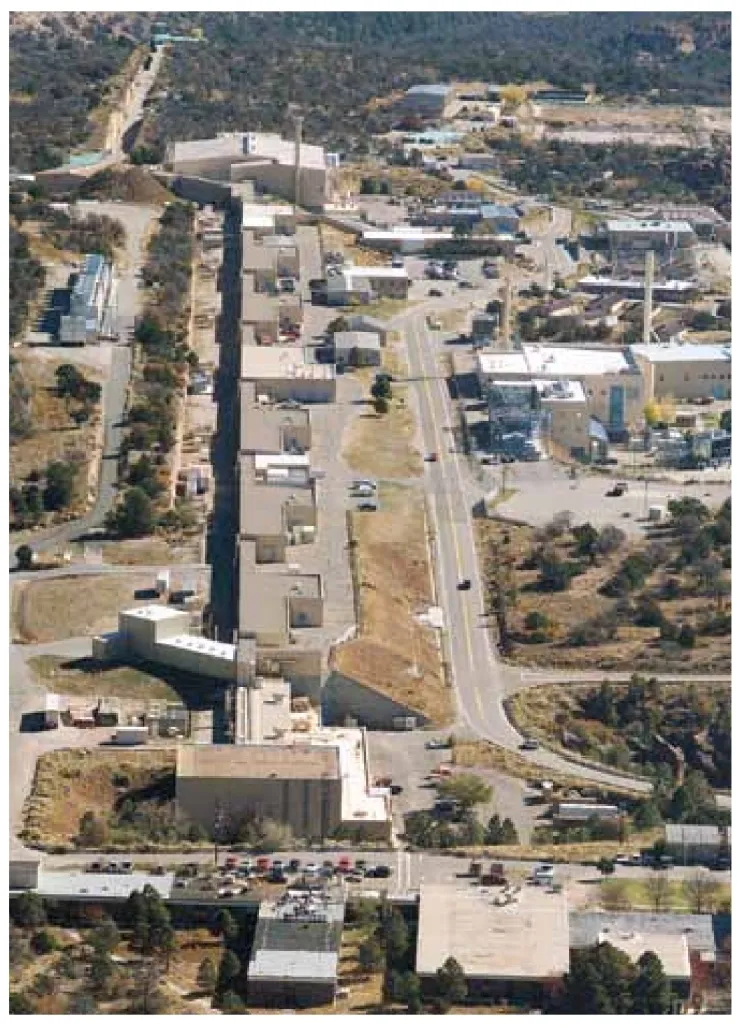
The Liquid Scintillator Neutrino Detector (167 t of mineral oil with dilute scintillator) sat 30 m from the LAMPF beam stop. It observed an excess of ν̄e appearance in a ν̄µ beam from muon decay at rest at 3.8σ, implying Δm² ~ 1 eV², which is incompatible with three-flavour oscillation.
Compare all experiments → · World map →
In plain words
LSND looked for something that, in the three-neutrino picture, should not happen at all: muon antineutrinos turning into electron antineutrinos within 30 metres. It saw a small but persistent excess of such events. Three decades of experiments have since tried to confirm or refute it, and the question of what LSND saw is still not fully closed.
How the detector works
The 800 MeV proton beam of the LAMPF accelerator at Los Alamos stopped in a beam dump, producing positive pions that came to rest and decayed. Their muons also decayed at rest, μ⁺ → e⁺ νe ν̄µ, giving a well-known flux of muon antineutrinos up to 53 MeV with almost no electron antineutrinos (decay at rest). The detector, about 30 m away, was a cylindrical tank of 167 tonnes of mineral oil with a small amount of scintillator, viewed by about 1200 photomultipliers. That mixture let it record both the directional Cherenkov ring and the isotropic scintillation light. An electron antineutrino would be identified by inverse beta decay on protons: a positron followed by a 2.2 MeV gamma from neutron capture on hydrogen.
Key results
Data were taken from 1993 to 1998. The final analysis, published in 2001, found an excess of 87.9 ± 22.4 ± 6.0 events above background, a 3.8σ effect, corresponding to an oscillation probability of about 0.26 percent. With L/E around 1 m/MeV, this implies Δm² between about 0.2 and 10 eV², far above both known mass splittings. The search was led by spokesperson William Louis, with Hywel White as project manager.
Why it matters for neutrino physics
Three distinct mass splittings require at least four neutrinos. Because the Z-boson width allows only three light active neutrinos, the fourth would have to be sterile. LSND therefore launched the entire sterile-neutrino programme: KARMEN tested part of its parameter space, MiniBooNE was built to check it at higher energy, and MicroBooNE followed. A new decay-at-rest experiment, JSNS² in Japan, is testing it with a similar method.
Frequently asked questions
Was the LSND result ever confirmed?
Not directly. MiniBooNE saw a compatible excess, but KARMEN, ICARUS, MicroBooNE and disappearance experiments exclude most explanations by a single sterile neutrino.
Could LSND have seen a background?
This has been studied extensively. No convincing mundane explanation has been found, which is one reason the result remains discussed.
Original papers
- First resultC. Athanassopoulos et al. (LSND Collaboration), Evidence for ν̄μ→ν̄e oscillations from the LSND experiment at the Los Alamos Meson Physics Facility, Phys. Rev. Lett. 77, 3082 (1996)DOI 10.1103/PhysRevLett.77.3082
- Final resultA. Aguilar et al. (LSND Collaboration), Evidence for neutrino oscillations from the observation of ν̄e appearance in a ν̄μ beam, Phys. Rev. D 64, 112007 (2001)DOI 10.1103/PhysRevD.64.112007
Related terms
People
Latest research on this topic
- Implications for new physics solutions to the LSND and MiniBooNE anomalies after MicroBooNE resultsAbdallah, Waleed, Gandhi, Raj, Roy, Samiran · 12 October 2026
- The Role of a 17 MeV Pseudoscalar in Resolving LSND, MiniBooNE, and ATOMKI AnomaliesRoy, Samiran, Abdallah, Waleed, Gandhi, Raj et al. · 2 January 2026
On the timeline
- 1995LSND reports an unexpected oscillation signal
- 2018MiniBooNE's excess grows to 4.8σ
- 2025MicroBooNE finds no evidence for a sterile neutrino
Mentioned in 35 pages
Comparisons 1
Milestones 4
Terms 23
Last updated: · Editorial standard
Cite this page
Text
Neutrino Atlas (2026). “LSND”. Retrieved 22 November 2026, from https://neutrino-atlas.com/terms/lsnd/BibTeX
@misc{neutrinoatlas2026termslsnd,
  title        = {LSND},
  author       = {{Neutrino Atlas}},
  year         = {2026},
  url          = {https://neutrino-atlas.com/terms/lsnd/},
  note         = {Accessed 2026-11-22},
  language     = {english}
}