DANSS
A movable plastic-scintillator detector under a 3.1 GW reactor in Russia that tightly constrains eV-scale sterile neutrinos.
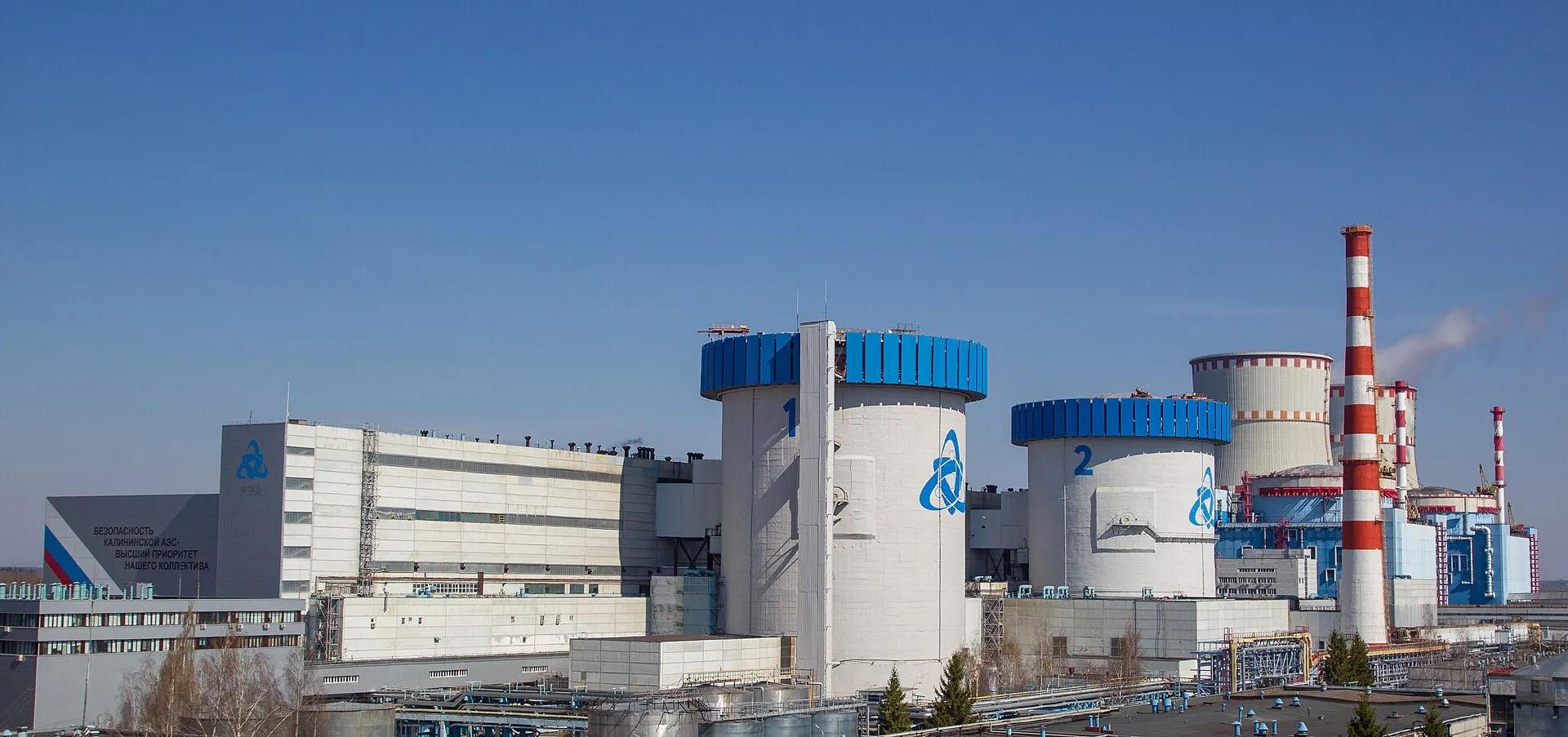
DANSS consists of about 2,500 plastic scintillator strips (1 × 4 × 100 cm³, about 1 m³ in total) with a gadolinium-containing coating, read out by silicon photomultipliers and PMTs. It sits on a lifting platform below a reactor of the Kalinin power plant and moves between 10.9, 11.9 and 12.9 m from the core. Recording about 5,000 antineutrinos per day since 2016, it excludes the reactor-anomaly best fit and the Neutrino-4 best-fit point.
Compare all experiments → · World map →
In plain words
Most reactor detectors use liquids. DANSS uses solid plastic strips instead, which are safe and compact enough to sit directly beneath an industrial reactor. The reactor building itself shields the detector from cosmic rays, and the closeness to a 3.1 GW core gives an enormous event rate. By raising and lowering the whole detector, DANSS compares antineutrino spectra at different distances without relying on predictions of the reactor flux.
How the detector works
The detector has about 2,500 polystyrene-based scintillator strips, each 1 × 4 × 100 cm³, laid in alternating directions to give a three-dimensional picture of each event. A thin coating containing gadolinium captures the neutron from inverse beta decay. Wavelength-shifting fibres carry light to individual silicon photomultipliers and, for groups of strips, to conventional PMTs. The strips are surrounded by passive shielding and a muon veto, and sit about 50 metres water equivalent below the reactor and its cooling equipment. A lifting platform moves the detector between 10.9, 11.9 and 12.9 m from the core several times a week.
Key results
From 2016 to 2024 DANSS recorded about 6.8 million antineutrinos, roughly 5,000 per day with a signal-to-background ratio above 50. Ratios of positron spectra at the three positions show no significant oscillation. That relative analysis excludes the best fit of the reactor antineutrino anomaly at more than 5σ and covers a large part of the sterile-neutrino parameter space. Adding absolute rates with conservative uncertainties also excludes the best-fit point of Neutrino-4 and much of the region preferred by BEST. The data also track how the spectrum changes as the fuel burns, which is useful for reactor monitoring.
Status today
DANSS continues to take data. An upgrade has been planned to improve the energy resolution about threefold and increase the sensitive volume, aimed at testing the remaining sterile-neutrino regions more directly.
Frequently asked questions
Why place a neutrino detector under a reactor?
Being close to a large core gives a very high event rate, and the reactor building provides shielding from cosmic rays. Moving the detector lets it compare distances directly.
Does DANSS rule out sterile neutrinos altogether?
No. It excludes the most popular eV-scale regions, but sterile neutrinos with other masses or smaller mixing remain possible.
Original papers
- ProposalI. Alekseev et al. (DANSS Collaboration), DANSS: Detector of the reactor AntiNeutrino based on Solid Scintillator, JINST 11, P11011 (2016)arXiv:1606.02896
- First resultI. Alekseev et al. (DANSS Collaboration), Search for sterile neutrinos at the DANSS experiment, Phys. Lett. B 787, 56 (2018)arXiv:1804.04046
Related terms
- Segmented scintillator tracking calorimeter
- Sterile neutrino
- Reactor antineutrino anomaly
- Neutrino-4
- Reactor monitoring
Latest research on this topic
- Nuclear Power Reactor Studies with Antineutrinos from the DANSS ExperimentSamigullin, E., Skrobova, N. · 12 November 2025
Mentioned in 5 pages
Last updated: · Editorial standard
Cite this page
Text
Neutrino Atlas (2026). “DANSS”. Retrieved 22 November 2026, from https://neutrino-atlas.com/terms/danss/BibTeX
@misc{neutrinoatlas2026termsdanss,
  title        = {DANSS},
  author       = {{Neutrino Atlas}},
  year         = {2026},
  url          = {https://neutrino-atlas.com/terms/danss/},
  note         = {Accessed 2026-11-22},
  language     = {english}
}