Bugey reactor experiments
A series of short-baseline reactor experiments in France whose Bugey-3 spectra and Bugey-4 flux measurement became standard references.
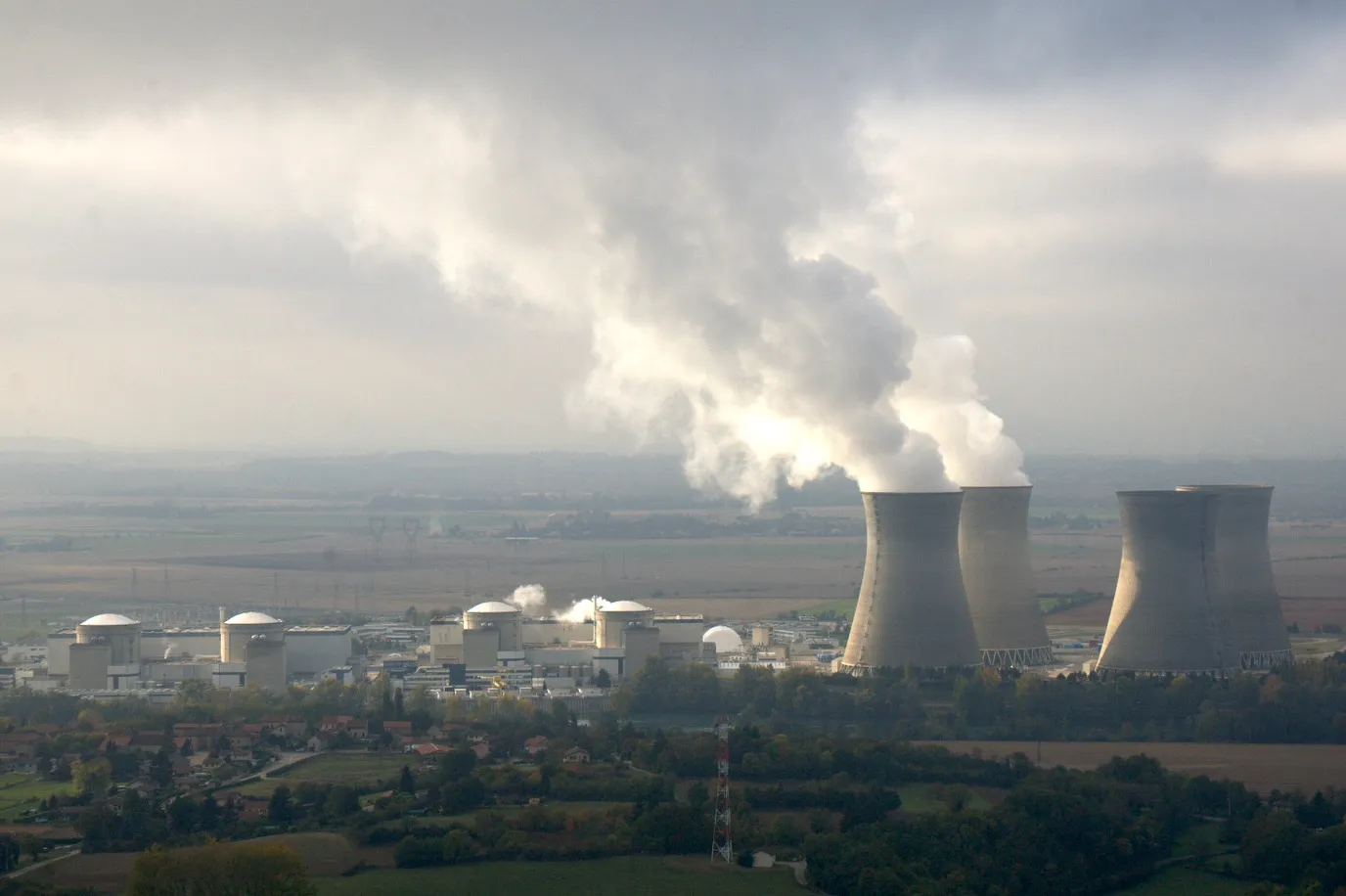
At the Bugey nuclear power plant on the Rhône, physicists studied reactor antineutrinos from the 1980s to the mid-1990s. Bugey-3 used three 600-litre ⁶Li-loaded scintillator modules at 15, 40 and 95 m and recorded about 120,000 events without an oscillation signal. Bugey-4 measured the inverse-beta-decay cross section per fission at 15 m to about 1.4%.
Compare all experiments → · World map →
In plain words
If neutrinos oscillate with a large mass difference, the effect would show up only a few tens of metres from a reactor. The Bugey experiments placed detectors at several such distances and compared both the number and the energy spectrum of antineutrinos. Because the same reactor fed all positions, many uncertainties about the reactor itself cancelled out.
How the detectors worked
The Bugey power station near Lyon had several pressurised-water reactors of about 2.8 GW thermal power each. Earlier phases in the 1980s used detectors closer to the core; an analysis from that period reported an indication of oscillation that later data did not confirm. For Bugey-3, three identical 600-litre modules of liquid scintillator loaded with lithium-6 were placed at 15, 40 and 95 m. Each event was an inverse beta decay: a prompt positron followed by neutron capture on ⁶Li, which produces a heavy, easily identified signal.
Bugey-4 took another approach. An integral detector of ³He neutron counters in water at 15 m counted only the neutrons, which made the absolute rate very well understood.
Key results
- Bugey-3 recorded about 120,000 neutrino interactions. The spectra at the three distances agreed with each other and excluded large regions of the oscillation parameter space for ν̄e disappearance, down to mixing of a few percent where the experiment was most sensitive.
- Bugey-4 measured the cross section per fission as 5.752 ± 0.081 × 10⁻⁴³ cm², a precision of about 1.4%.
- With CHOOZ, Bugey ruled out νµ → νe as the explanation of the atmospheric anomaly.
Why it still matters
When the reactor flux models were revised in 2011, the observed Bugey rates fell to about 94% of the new prediction, one of the key inputs to the reactor antineutrino anomaly. Bugey-3's exclusion contour also became the standard benchmark that every later very-short-baseline experiment, from STEREO to DANSS, compared against.
Frequently asked questions
Did Bugey find neutrino oscillation?
No. The relative comparison of distances showed no oscillation. Only after the 2011 flux re-evaluation did the absolute rates look slightly low, which fed the reactor anomaly debate.
Why use lithium-6 instead of gadolinium?
Neutron capture on ⁶Li produces an alpha particle and a triton in a very small volume. The pulse shape is distinctive, which helps reject background in a detector close to a reactor.
Original papers
- Final resultY. Declais et al., Search for neutrino oscillations at 15, 40 and 95 meters from a nuclear power reactor at Bugey, Nucl. Phys. B 434, 503 (1995)
Related terms
- Reactor antineutrinos
- Reactor antineutrino anomaly
- Inverse beta decay
- Gösgen reactor experiment
- Reactor antineutrino spectrum
Mentioned in 8 pages
Last updated: · Editorial standard
Cite this page
Text
Neutrino Atlas (2026). “Bugey reactor experiments”. Retrieved 22 November 2026, from https://neutrino-atlas.com/terms/bugey/BibTeX
@misc{neutrinoatlas2026termsbugey,
  title        = {Bugey reactor experiments},
  author       = {{Neutrino Atlas}},
  year         = {2026},
  url          = {https://neutrino-atlas.com/terms/bugey/},
  note         = {Accessed 2026-11-22},
  language     = {english}
}