WATCHMAN / AIT-NEO
A US–UK plan for a kiloton gadolinium-water detector at Boulby to show remote monitoring of reactors about 25 km away; not built.
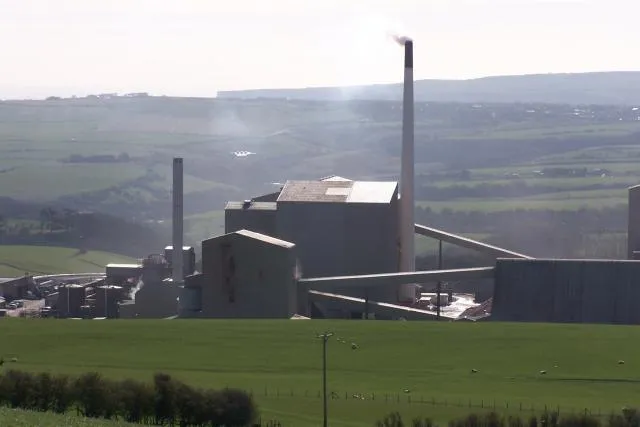
WATCHMAN (WATer CHerenkov Monitor of ANtineutrinos) was to be the first detector of the Advanced Instrumentation Testbed announced in 2018 by the US NNSA with UK partners. About 3,500 t of Gd-doped water in a 16 m tank would detect inverse beta decay from the Hartlepool reactors about 25 km away. The kiloton detector was not built; work continues with the 30 t BUTTON testbed at Boulby.
Compare all experiments → · World map →
In plain words
Every nuclear reactor emits a stream of antineutrinos that no wall can stop. In principle a large detector could therefore tell from far away whether a reactor is running, and perhaps how much power it produces, without access to the site. WATCHMAN was meant to demonstrate this kind of reactor monitoring at a distance of tens of kilometres, a step towards possible uses in nuclear non-proliferation.
The design
WATCHMAN stood for WATer CHerenkov Monitor of ANtineutrinos. In March 2018 the US National Nuclear Security Administration announced the Advanced Instrumentation Testbed (AIT), led by Lawrence Livermore National Laboratory with Adam Bernstein as principal investigator, together with Brookhaven, the UK Atomic Weapons Establishment and US and British universities. The detector was to be built in the Boulby mine in north-east England: a tank about 16 m high and 16 m wide holding about 3,500 tonnes of water loaded with gadolinium. Antineutrinos from the Hartlepool power station, about 25 km away, would be recorded through inverse beta decay: a prompt positron flash in the water Cherenkov detector followed by a gamma cascade from neutron capture on gadolinium. Operation was foreseen from around 2023. The testbed was also to host new technology such as water-based liquid scintillator and fast photosensors. The broader programme was later also referred to as AIT-NEO.
What studies showed
Sensitivity studies by the Livermore group found that a detector with a 1 kiloton fiducial mass of Gd-doped water could exclude or verify a gigawatt-scale reactor at tens of kilometres within about a year. Its energy resolution, however, would not be enough to separate the distance of a reactor from its power.
Status today
The kiloton detector was not built. The effort has continued at Boulby with BUTTON, a 30 tonne testbed for detection media such as gadolinium-doped water-based liquid scintillator, also relevant to proposals such as Theia.
Frequently asked questions
Could WATCHMAN have detected secret reactors?
It was designed as a demonstration with a known reactor at about 25 km. Studies show such detectors can confirm or exclude a large reactor at that range, but distinguishing distance from power, or seeing small reactors much farther away, requires far larger or better detectors.
Why put it at Boulby?
The mine offers deep rock shielding against cosmic rays, an existing underground laboratory and a suitable distance from the Hartlepool reactors.
Original papers
- ProposalM. Askins et al. (WATCHMAN Collaboration), The Physics and Nuclear Nonproliferation Goals of WATCHMAN: A WAter CHerenkov Monitor for ANtineutrinos (2015)arXiv:1502.01132
Related terms
People
Mentioned in 3 pages
Last updated: · Editorial standard
Cite this page
Text
Neutrino Atlas (2026). “WATCHMAN / AIT-NEO”. Retrieved 22 November 2026, from https://neutrino-atlas.com/terms/watchman-ait/BibTeX
@misc{neutrinoatlas2026termswatchmanait,
  title        = {WATCHMAN / AIT-NEO},
  author       = {{Neutrino Atlas}},
  year         = {2026},
  url          = {https://neutrino-atlas.com/terms/watchman-ait/},
  note         = {Accessed 2026-11-22},
  language     = {english}
}