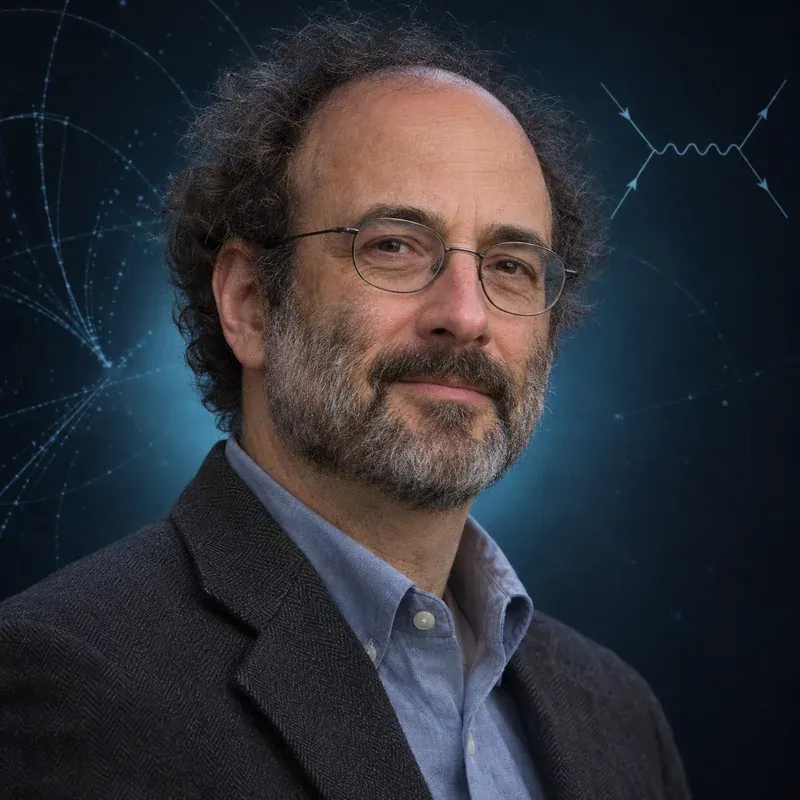
 Illustration
Adam Bernstein
Bernstein led LLNL's part of the LLNL–Sandia effort that operated the SONGS1 detector (0.64 t of Gd-doped liquid scintillator, about 25 m from the core) at the San Onofre Nuclear Generating Station from 2003 to 2006. It detected a reactor scram within hours, tracked relative power to a few per cent over days and observed fuel burn-up, demonstrating non-intrusive antineutrino monitoring for safeguards. He later led work on the WATCHMAN kiloton-scale water detector concept.
- Nationality
- American
- Field
- Applied antineutrino physics / nuclear security
- Institutions
- UC Berkeley (BA), Columbia University (PhD), Lawrence Livermore National Laboratory
Education and career
Adam Bernstein is an American experimental physicist. He earned a bachelor's degree in physics at the University of California, Berkeley, and a PhD in experimental high-energy physics at Columbia University in 1995. In 2002 he joined Lawrence Livermore National Laboratory (LLNL) as a staff physicist, and he now leads the laboratory's Rare Event Detection Group. His research connects fundamental neutrino and dark-matter physics with radiation detection for nuclear arms control and nonproliferation.
Key contributions
Bernstein's best-known work put into practice the idea of Lev Mikaelyan and A. A. Borovoi that antineutrinos can reveal what is happening inside a reactor. Inspectors of the International Atomic Energy Agency normally rely on records, seals and cameras to verify that no plutonium is diverted from civil reactors. An antineutrino detector would add an independent, continuous and tamper-resistant measurement, because the rate and spectrum of reactor antineutrinos depend on the reactor's power and on how much plutonium it contains.
Together with colleagues at Sandia National Laboratories, Bernstein's LLNL group built the SONGS1 detector and operated it from 2003 to 2006 at the San Onofre Nuclear Generating Station in California. It held about 0.64 tonnes of gadolinium-loaded liquid scintillator about 25 m from the reactor core, in a tendon gallery below the containment. Antineutrinos were recorded through inverse beta decay, identified by the delayed coincidence of a positron and a neutron capture. The detector registered a reactor shutdown within hours, tracked relative power to a few per cent over days and showed the gradual change in rate caused by fuel burn-up. The design was deliberately simple and could be run remotely by non-specialists, demonstrating that reactor monitoring is practical.
Bernstein later worked on WATCHMAN, a concept for a kiloton-scale water Cherenkov detector doped with gadolinium that would detect a reactor at a distance of tens of kilometres, and his group has developed low-background detectors for CEvNS at reactors and for dark-matter searches.
Recognition
In 2016 he was elected a Fellow of the American Physical Society for pioneering work at the intersection of nuclear science and nonproliferation, including antineutrino-based methods for monitoring the production of fissile material and large detectors for screening cargo.
Known for
- SONGS1 antineutrino detector at San Onofre (2003–2006)
- Antineutrino-based reactor safeguards
- WATCHMAN concept
- Leader of LLNL Rare Event Detection Group
Chronology
- 2002Joins LLNL as staff physicist
- 2003SONGS1 begins operation at San Onofre
- 2016APS Fellow (Division of Nuclear Physics)
Original papers
- A. Bernstein et al., Monitoring the thermal power of nuclear reactors with a prototype cubic meter antineutrino detector, J. Appl. Phys. 103, 074905 (2008)
- N. S. Bowden, Reactor monitoring and safeguards using antineutrino detectors (2008)arXiv:0809.2128
Experiments
- SONGS1
- WATCHMAN / AIT-NEO
Connected people
Frequently asked questions
What did the SONGS1 detector demonstrate?
That a cubic-metre-scale antineutrino detector next to a commercial reactor can see shutdowns within hours, follow the reactor's power and observe the effect of fuel burn-up, without interfering with plant operation.
Why are antineutrinos useful for nuclear safeguards?
They cannot be shielded or faked, and their rate and energy spectrum reflect the reactor's power and plutonium content, giving inspectors an independent check on its operation.
On the timeline
Mentioned in 8 pages
Milestones 2
Last updated: · Editorial standard
Cite this page
Text
Neutrino Atlas (2026). “Adam Bernstein”. Retrieved 22 November 2026, from https://neutrino-atlas.com/people/adam-bernstein/BibTeX
@misc{neutrinoatlas2026peopleadambernstein,
  title        = {Adam Bernstein},
  author       = {{Neutrino Atlas}},
  year         = {2026},
  url          = {https://neutrino-atlas.com/people/adam-bernstein/},
  note         = {Accessed 2026-11-22},
  language     = {english}
}