1978Application
Neutrinos proposed for reactor monitoring
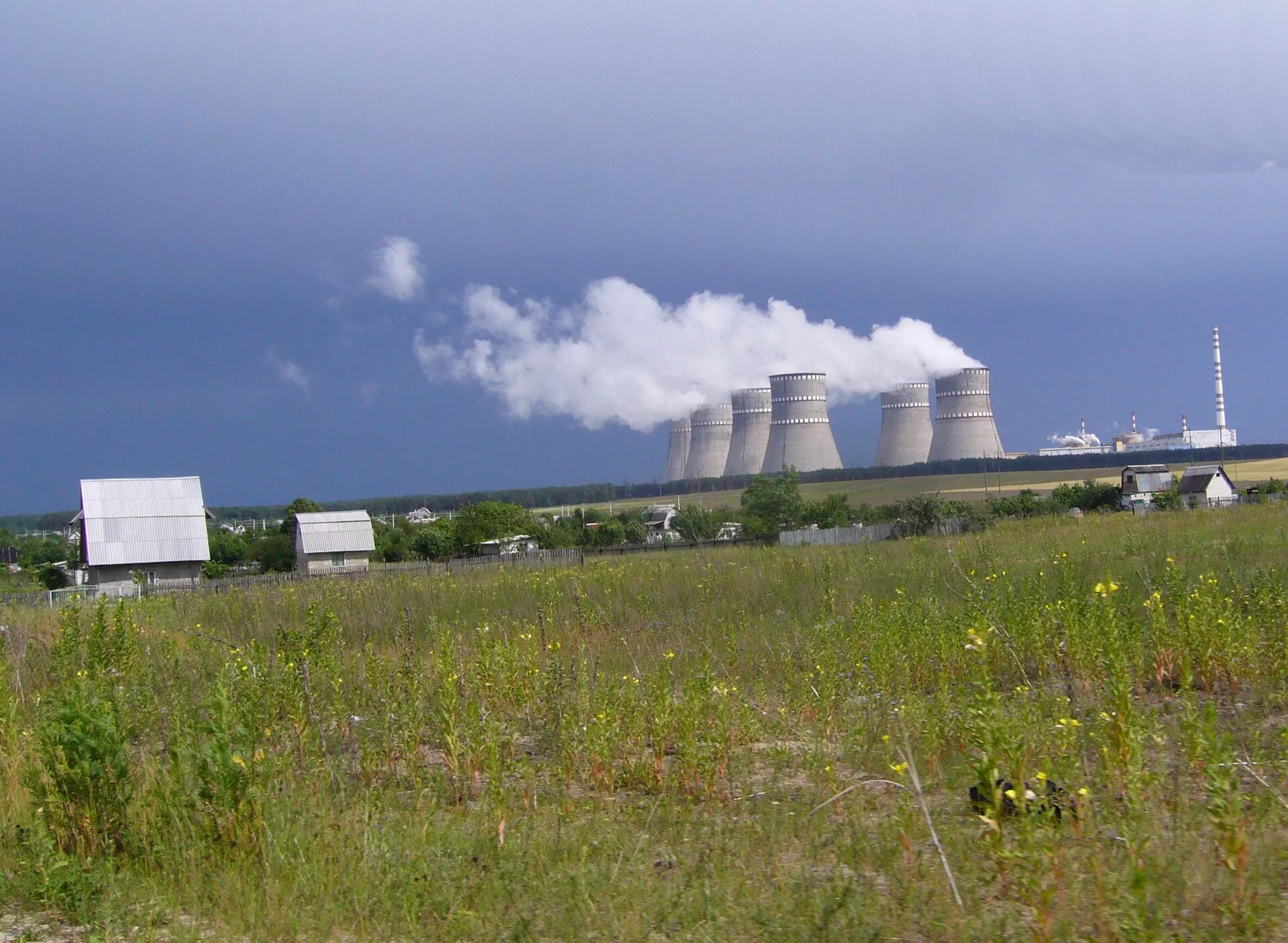
Lev Mikaelyan and Anatoly Borovoi at the Kurchatov Institute proposed using antineutrino detectors to monitor nuclear reactors remotely. Because the antineutrino rate and spectrum depend on reactor power and fuel composition, they reveal the changing ratio of uranium to plutonium during a fuel cycle. Experiments at the Rovno power plant in the 1980s demonstrated the principle. It is now studied as a possible tool for nuclear safeguards.
- Date
- 1978
- Kind of event
- Application
- People involved
- Lev A. Mikaelyan (Lev Aleksandrovich Mikaelyan)
The situation before
Since Clyde Cowan and Frederick Reines detected the neutrino at the Savannah River reactor in 1956, nuclear reactors had been the most intense controllable source of antineutrinos. A large power reactor emits about 2 × 10²⁰ antineutrinos per second per gigawatt of thermal power, produced in the beta decays of fission fragments. For two decades they served purely as a tool for physics. At the Kurchatov Institute of Atomic Energy in Moscow, a group led by Lev Mikaelyan began planning experiments at Soviet power plants in the 1970s and asked whether the flow of information could also be reversed: what could antineutrinos say about the reactor?
What happened
Mikaelyan presented the idea at the international neutrino conference held at Baksan in the North Caucasus in 1977, and with Anatoly Borovoi he published it in the Soviet journal Atomnaya Energiya in 1978. Two observations formed the core. First, the antineutrino rate is proportional to the number of fissions per second, and so to the thermal power, and it cannot be shielded or falsified from outside. Second, the different fissile isotopes produce different numbers and spectra of antineutrinos. A fresh core burns mainly uranium-235; as the fuel cycle progresses, plutonium-239 builds up and takes over a growing share of fissions. Since a plutonium-239 fission yields about a third fewer detectable antineutrinos than a uranium-235 fission above the inverse beta decay threshold, both the rate at constant power and the spectrum change with burn-up.
A detector placed a few tens of metres from the core could therefore follow the reactor's power and the evolution of its fuel composition from outside, without access to the reactor's instruments.
Demonstration
From the 1980s the Kurchatov group tested the method at the Rovno nuclear power plant in Ukraine, using detectors installed in rooms below the reactor. They showed that the measured antineutrino rate tracked the reactor's thermal power and that the rate at fixed power changed during the fuel cycle in the way expected from the growing plutonium content. Similar effects were later seen at Bugey in France and in the large reactor experiments built to measure oscillations.
Why it matters
Reactor monitoring with antineutrinos has since been studied as a possible tool for nuclear safeguards, the international system that verifies that nuclear material is not diverted to weapons. In the 2000s a team led by Adam Bernstein at Lawrence Livermore and Sandia National Laboratories operated a compact detector of under a ton of gadolinium-loaded scintillator at the San Onofre power plant in California from 2003 and demonstrated near-real-time monitoring of reactor power and refuelling. The International Atomic Energy Agency has held workshops on the method. Current development focuses on compact, segmented detectors that work at the surface with little shielding, such as PROSPECT, and on fission-sensitive measurements with CEvNS. Practical deployment still faces challenges of size, cost and background, but the principle proposed in 1977–78 is well established. The precise reactor measurements also revealed puzzles of their own, such as the reactor anomaly and the 5 MeV bump.
Frequently asked questions
Who proposed monitoring reactors with neutrinos?
Lev Mikaelyan and Anatoly Borovoi of the Kurchatov Institute, presented in 1977 and published in 1978.
What can antineutrinos reveal about a reactor?
Its thermal power and how its fuel composition, in particular the share of plutonium, changes during the fuel cycle.
Has the method been demonstrated?
Yes, at the Rovno power plant in the 1980s and at San Onofre in California in the 2000s. It is studied for nuclear safeguards but not yet routinely deployed.
Original papers
- ProposalA. A. Borovoi, L. A. Mikaelyan, Possibilities of the practical use of neutrinos, Sov. At. Energy 44, 589 (1978)
- ReviewA. Bernstein, Y. Wang, G. Gratta, T. West, Nuclear reactor safeguards and monitoring with antineutrino detectors, J. Appl. Phys. 91, 4672 (2002)arXiv:nucl-ex/0108001
Concepts
Mentioned in 2 pages
Last updated: · Editorial standard
Cite this page
Text
Neutrino Atlas (2026). “1978: Neutrinos proposed for reactor monitoring”. Retrieved 22 November 2026, from https://neutrino-atlas.com/timeline/1978-reactor-monitoring-proposal/BibTeX
@misc{neutrinoatlas2026eactormonitoringproposal,
  title        = {1978: Neutrinos proposed for reactor monitoring},
  author       = {{Neutrino Atlas}},
  year         = {2026},
  url          = {https://neutrino-atlas.com/timeline/1978-reactor-monitoring-proposal/},
  note         = {Accessed 2026-11-22},
  language     = {english}
}