PROSPECT
A segmented reactor antineutrino detector at Oak Ridge's HFIR research reactor.
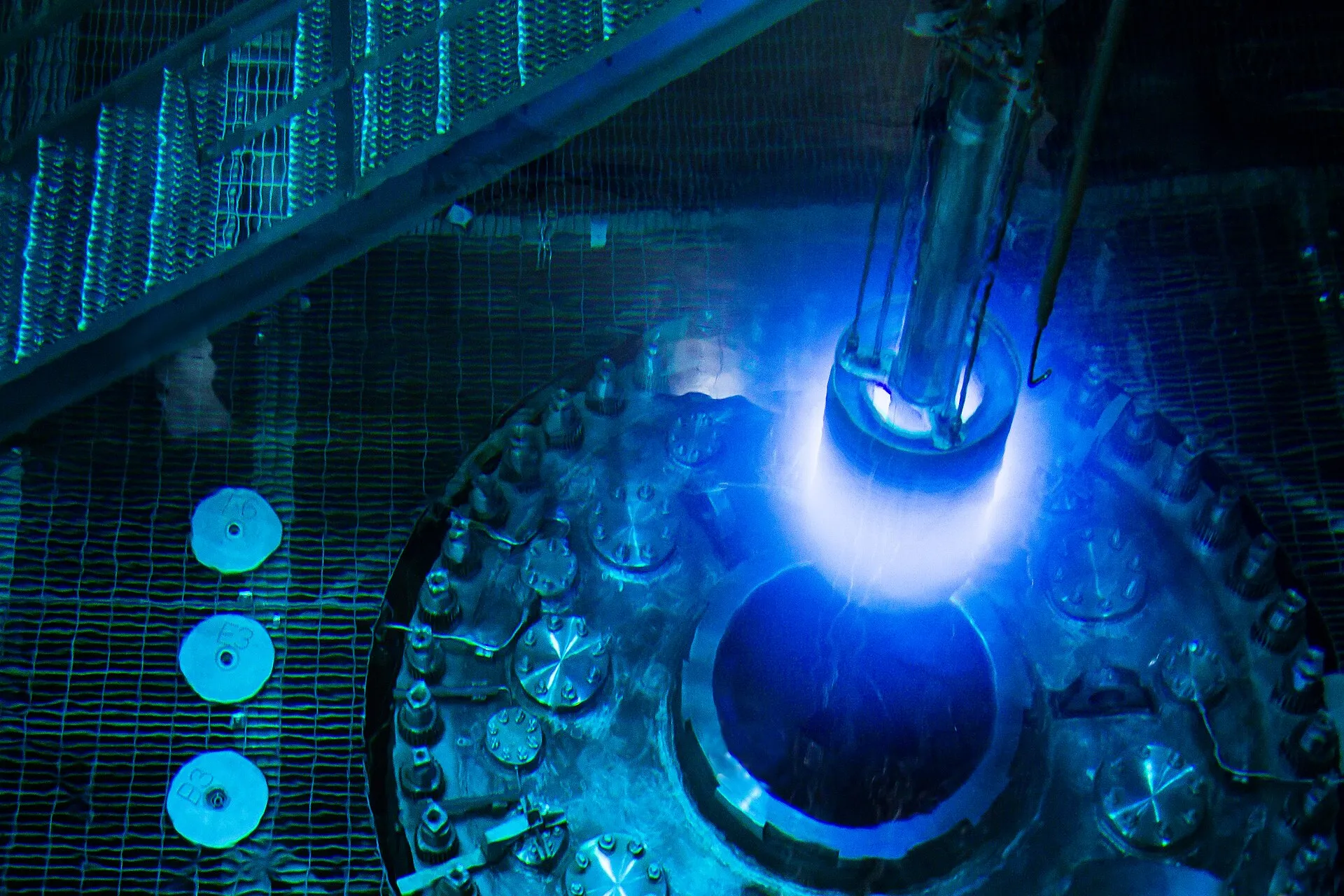
The Precision Reactor Oscillation and Spectrum Experiment used about 4 t of ⁶Li-doped scintillator segmented into optical cells 7–9 m from HFIR. It searched for eV-scale sterile oscillations and precisely measured the ²³⁵U antineutrino spectrum.
Compare all experiments → · World map →
In plain words
PROSPECT placed a detector just a few metres from a small, powerful research reactor in Tennessee to check whether reactor antineutrinos disappear and reappear over very short distances – the telltale sign of a hypothetical fourth, 'sterile' neutrino. Because the detector was split into more than a hundred long cells, it could compare the antineutrino energy spectrum at slightly different distances from the reactor core, without needing to know the reactor's exact output.
How the detector works
About 4 t of liquid scintillator doped with lithium-6 filled an array of 11 × 14 = 154 optical segments, each about 1.2 m long and read out by photomultipliers at both ends (segmented scintillator). Antineutrinos were detected by inverse beta decay: the positron gives a prompt flash, and the neutron is captured on ⁶Li a few tens of microseconds later, producing a very localised alpha and triton signal. Pulse-shape discrimination separated these heavily ionising captures from electron-like signals, which was essential because the detector sat at the surface with almost no overburden against cosmic rays.
The High Flux Isotope Reactor at Oak Ridge National Laboratory runs at 85 MW on highly enriched uranium, so practically all fissions are of ²³⁵U. Its compact core allowed baselines of 7 to 9 m.
Key results
- 2018: first results on short-baseline oscillation, published within months of the start of data taking.
- Final oscillation analysis of the 2018 data (2024): about 61,000 antineutrino events, consistent with no oscillation; the best-fit point claimed by Neutrino-4 is excluded at more than 5σ, and new regions above a few eV² are ruled out.
- Final ²³⁵U spectrum measurement: the best measurement of the antineutrino spectrum from pure ²³⁵U fission, showing a 5 MeV bump similar to that seen at commercial reactors.
- Joint analyses with STEREO and Daya Bay that further constrain the reactor antineutrino anomaly.
Status today
Data taking with PROSPECT-I ended after 2018 because of technical problems that reduced the number of working segments over time. An upgraded PROSPECT-II, with a redesigned containment that keeps the photomultipliers outside the scintillator, has been proposed for further sterile-neutrino searches and for reactor monitoring studies.
Frequently asked questions
Did PROSPECT find a sterile neutrino?
No. Its data are consistent with no short-baseline oscillation, and it excludes a large part of the parameter space suggested by earlier anomalies.
Why did PROSPECT use a research reactor?
A research reactor with highly enriched uranium has a small core and burns almost only ²³⁵U, which allows short, well-defined baselines and a clean measurement of the ²³⁵U spectrum.
Original papers
- First resultJ. Ashenfelter et al. (PROSPECT Collaboration), First Search for Short-Baseline Neutrino Oscillations at HFIR with PROSPECT, Phys. Rev. Lett. 121, 251802 (2018)DOI 10.1103/PhysRevLett.121.251802arXiv:1806.02784
- Final resultM. Andriamirado et al. (PROSPECT Collaboration), Final Search for Short-Baseline Neutrino Oscillations with the PROSPECT-I Detector at HFIR, Phys. Rev. Lett. 134, 151802 (2025)DOI 10.1103/PhysRevLett.134.151802arXiv:2406.10408
Related terms
Latest research on this topic
- Prospect for measurement of CP-violating parameters of Bs0→ \phi γ at the Tera Z factoryWang, Hengyu, Cui, Hanhua, Zhu, Yongfeng et al. · 14 October 2026
- Search prospect for electrophilic bosons at the μTRISTANAdhikary, Amit, Datta, Anindya, Ghosh, Dilip Kumar · 7 October 2026
- The muon collider: expected physics, technological challenges, and the prospects for reusing the 21 km UNK tunnelDudko, L. V. · 18 July 2026
- Prospect for Detection of Strongly Lensed Multimessenger Signals of Binary Neutron Star MergersChen, Zhiwei, Lu, Youjun, Zeng, Changwen · 8 July 2026
- Distance-ladder Measurements of the Hubble Constant: Recent Progress, Systematics, and ProspectChen, Xiaodian, Wang, Shu · 25 June 2026
- Radio eclipse of the slowest spinning Galactic-field spider pulsar PSR J1932+2121 and its X-ray emission prospectDu, Ze-Xin, Yu, Yun-Wei, Yang, Zong-Lin et al. · 23 June 2026
Mentioned in 24 pages
Lessons 3
Milestones 3
Terms 17
Last updated: · Editorial standard
Cite this page
Text
Neutrino Atlas (2026). “PROSPECT”. Retrieved 22 November 2026, from https://neutrino-atlas.com/terms/prospect/BibTeX
@misc{neutrinoatlas2026termsprospect,
  title        = {PROSPECT},
  author       = {{Neutrino Atlas}},
  year         = {2026},
  url          = {https://neutrino-atlas.com/terms/prospect/},
  note         = {Accessed 2026-11-22},
  language     = {english}
}