JSNS² / JSNS²-II
A Japanese experiment at the J-PARC spallation source that tests the LSND anomaly with the same neutrino source, target type and detection channel.
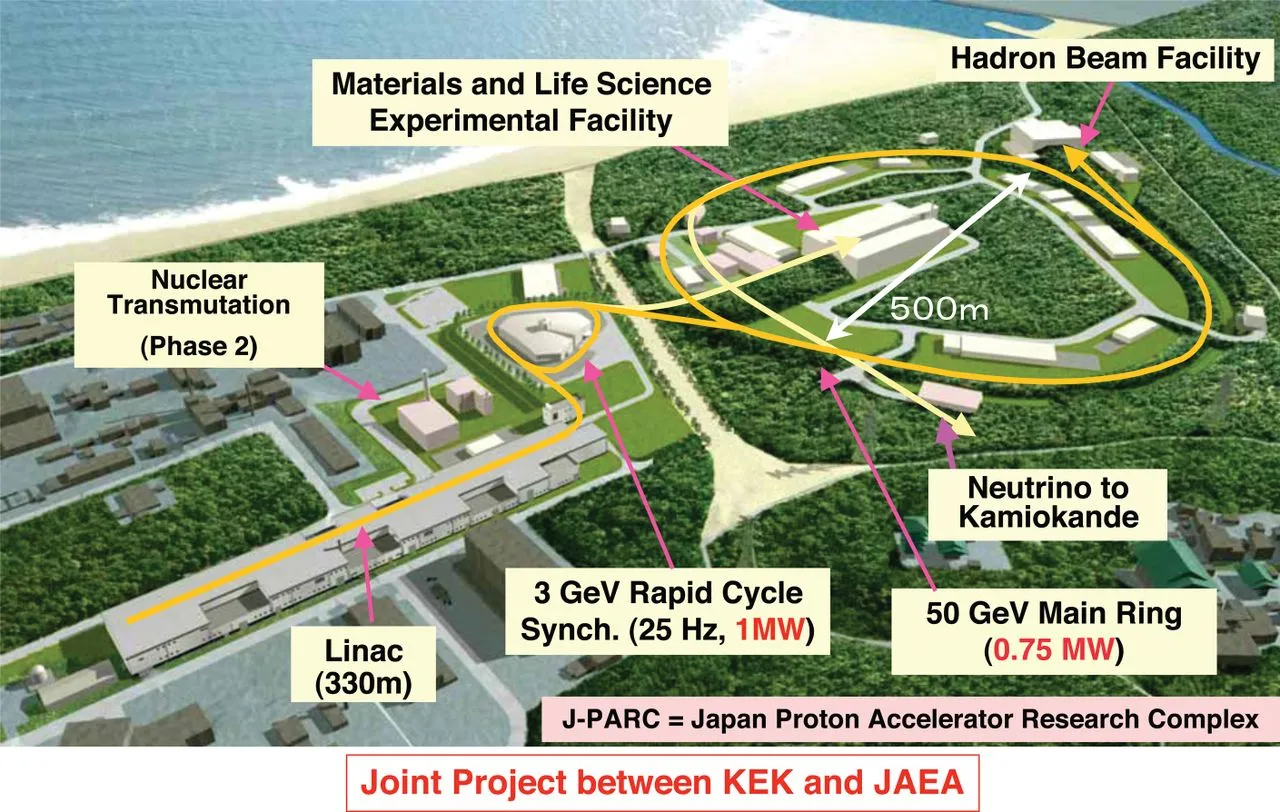
JSNS² places 17 t of gadolinium-loaded liquid scintillator 24 m from the mercury target of the J-PARC Materials and Life Science Facility, where 3 GeV protons produce muon decay at rest. It searches for ν̄µ → ν̄e appearance via inverse beta decay, as LSND did, but with a short-pulsed beam and Gd capture to reduce backgrounds. JSNS²-II adds a 32 t far detector at 48 m, filled in 2025 and being commissioned.
Compare all experiments → · World map →
In plain words
In the 1990s the LSND experiment reported more electron antineutrinos than expected near a proton beam stop, a hint of a sterile neutrino. Many later experiments tested the idea with different neutrinos, energies or detectors, which left room for arguments. JSNS² repeats the LSND measurement as closely as possible, with the same kind of source and the same detection reaction, but with a much cleaner beam.
How the detector works
At J-PARC in Tokai, a 3 GeV proton beam of up to about 1 MW strikes a mercury target to make neutrons for materials research. Pions produced in the target stop and decay, and their muons decay at rest, emitting ν̄µ with a known spectrum up to about 53 MeV. This is a decay-at-rest source like the one LSND used. The beam arrives in two short bunches 25 times per second, so neutrino events can be separated in time from slow neutrons and cosmic rays.
The detector, 24 m from the target, contains 17 t of gadolinium-loaded liquid scintillator viewed by 120 ten-inch photomultipliers, surrounded by an unloaded scintillator veto. An oscillated ν̄e would be seen through inverse beta decay with a delayed gamma cascade of about 8 MeV from neutron capture on gadolinium, a cleaner tag than LSND's capture on hydrogen.
Key results
After a commissioning run in June 2020, physics runs began in 2021. JSNS² observed a clear signal of monoenergetic 236 MeV muon neutrinos from kaon decay at rest, useful for nuclear-physics studies. A first oscillation analysis of 2022 data found two candidates against an expected background of about 2.3, too few events so far to reach the LSND-allowed region.
Status today
JSNS²-II adds a second detector of 32 t at 48 m with 228 photomultipliers. It was filled with liquid scintillator in August 2025 and is being commissioned with beam. Comparing two distances will reduce systematic uncertainties, complementing the SBN programme at Fermilab.
Frequently asked questions
How does JSNS² differ from KARMEN?
KARMEN also tested LSND with a decay-at-rest source but at a different distance and with a different detector. JSNS² matches LSND's baseline, target type and channel more closely.
When will JSNS² give a decisive answer?
That depends on collected beam exposure and on the two-detector analysis with JSNS²-II, which began commissioning in 2025.
Original papers
- ProposalM. Harada et al. (JSNS2 Collaboration), Proposal: A Search for Sterile Neutrino at J-PARC Materials and Life Science Experimental Facility (2013)arXiv:1310.1437
- MeasurementS. Ajimura et al. (JSNS2 Collaboration), The JSNS2 detector, Nucl. Instrum. Meth. A 1014, 165742 (2021)arXiv:2104.13169
Related terms
Latest research on this topic
- Relativistic distorted-wave analysis of the missing-energy spectrum measured with monochromatic <math display="inline"><msub><mi>ν</mi><mi>μ</mi></msub></math>–<math display="inline"><mrow><mmultiscripts><mrow><mi mathvariant="normal">C</mi></mrow><mprescripts/><none/><mrow><mn>12</mn></mrow></mmultiscripts></mrow></math> interactions at <math display="inline"><mrow><msup><mrow><mi>JSNS</mi></mrow><mrow><mn>2</mn></mrow></msup></mrow></math>Franco-Patino, J.M., García-Marcos, J., Belocchi, V. et al. · 3 March 2026
- First results from the search for an excess of <math display="inline"><msub><mover accent="true"><mi>ν</mi><mo stretchy="false">¯</mo></mover><mi>e</mi></msub></math> events in <math display="inline"><mrow><msup><mrow><mi>JSNS</mi></mrow><mn>2</mn></msup></mrow></math>JSNS Collaboration · 6 February 2026
- Empirical Reconstruction of the JSNS2 KDAR νμ-12C Missing-Energy Spectrum with a Two-Ex-Gaussian and Generalized-Tail ModelJoo, Kyung Kwang, Park, Jubin, Lee, Minkyu et al. · 1 November 2025
Mentioned in 4 pages
Last updated: · Editorial standard
Cite this page
Text
Neutrino Atlas (2026). “JSNS² / JSNS²-II”. Retrieved 22 November 2026, from https://neutrino-atlas.com/terms/jsns2/BibTeX
@misc{neutrinoatlas2026termsjsns2,
  title        = {JSNS² / JSNS²-II},
  author       = {{Neutrino Atlas}},
  year         = {2026},
  url          = {https://neutrino-atlas.com/terms/jsns2/},
  note         = {Accessed 2026-11-22},
  language     = {english}
}