BNL E776
A Brookhaven AGS experiment about 1 km from the neutrino source that searched for νμ→νe oscillations in the late 1980s.
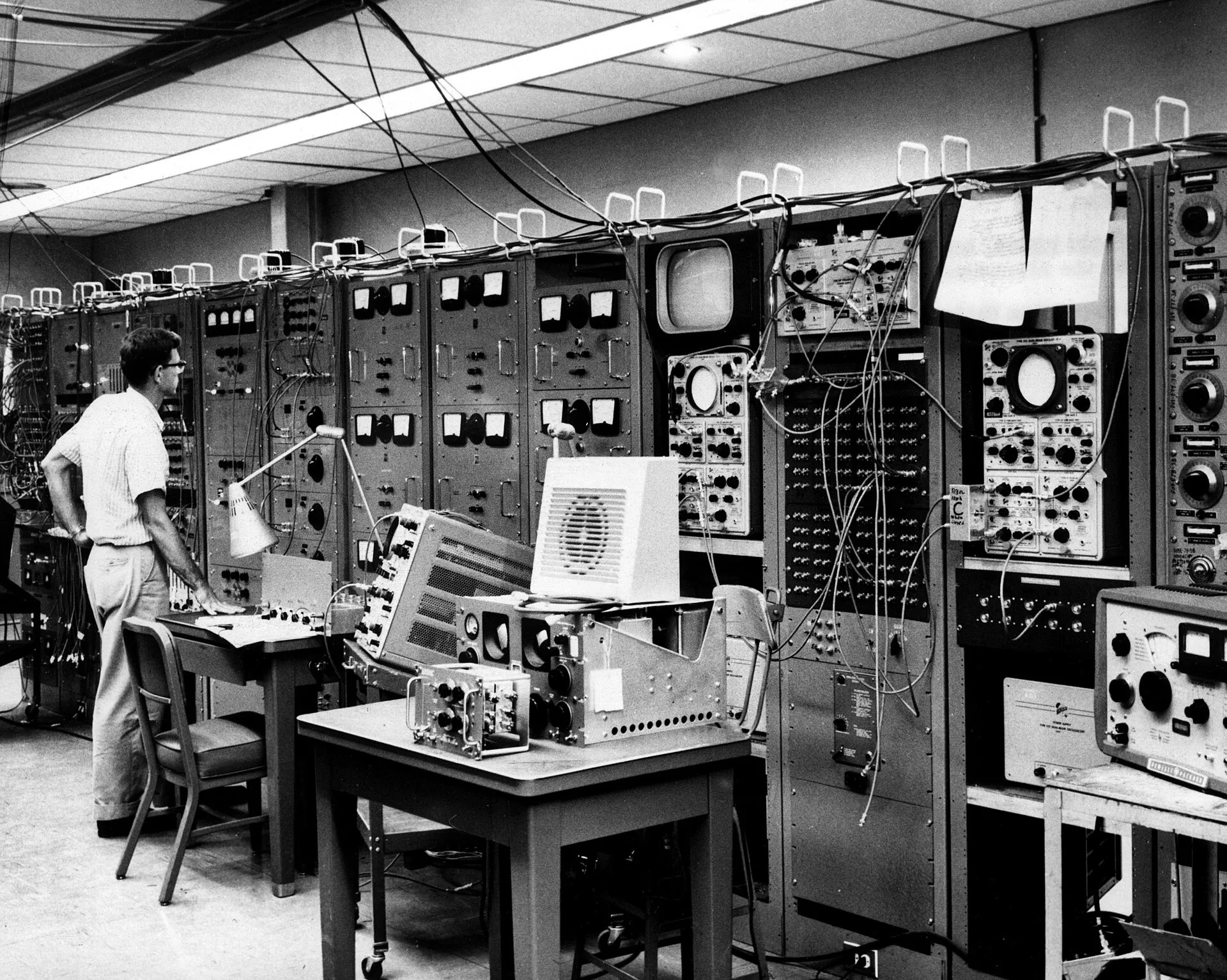
E776 used a wide-band horn-focused beam from the Alternating Gradient Synchrotron with a peak energy of about 1 GeV and a detector of about 230 t, a fine-grained electromagnetic calorimeter followed by a toroidal muon spectrometer. Running in neutrino and antineutrino modes, it found no excess of electron events and set 90% CL limits of Δm² < 0.075 eV² at maximal mixing and sin²2θ < 3 × 10⁻³ at large Δm² (1992).
Compare all experiments → · World map →
In plain words
If muon neutrinos can turn into electron neutrinos, a beam of pure muon neutrinos should contain a few electron neutrinos after travelling some distance. E776 at Brookhaven National Laboratory looked for such electron neutrinos in an accelerator beam one kilometre from where it was made. It saw none beyond the expected background, and its limits remained a reference point for later short-baseline searches.
How the experiment worked
The Alternating Gradient Synchrotron (AGS) delivered protons onto a target, and a magnetic horn focused the resulting pions into a wide-band beam peaking near 1 GeV. Changing the horn polarity selected either a neutrino or an antineutrino beam, and the data were split roughly evenly between the two. About 1 km downstream stood a detector of about 230 tonnes: a fine-grained electromagnetic calorimeter of absorber planes and tracking chambers, followed by a toroidal muon spectrometer. The calorimeter had to distinguish the electron shower of a νe charged-current event from the photons of π⁰ decays and from the intrinsic νe component of the beam, which comes from kaon and muon decays.
Key results
- A first analysis with 1.43 × 10¹⁹ protons on target set limits of Δm² < 0.13 eV² for large mixing and sin²2θ < 7.7 × 10⁻³ at large Δm² (90% CL).
- The final result, published by L. Borodovsky and colleagues in Physical Review Letters in 1992, tightened these to Δm² < 0.075 eV² for maximal mixing and sin²2θ < 3 × 10⁻³ at large Δm².
Why it matters
Appearance searches at short baselines test oscillations with Δm² around 1 eV² or more. When LSND reported an excess of electron antineutrinos in the 1990s, E776's exclusion cut away much of the high-Δm² part of the allowed region, while KARMEN and the Bugey reactor data constrained other parts. The remaining window motivated MiniBooNE and the wider debate about short-baseline anomalies and sterile neutrinos.
Frequently asked questions
Did E776 see neutrino oscillations?
No. The number of electron-like events matched the expected background, so E776 published upper limits on νμ→νe oscillations.
Why is E776 still cited?
Its limits constrain the parameter space of the LSND anomaly and appear in global fits of light sterile neutrinos.
Original papers
- Final resultL. Borodovsky et al. (E776 Collaboration), Search for muon-neutrino oscillations νμ→νe (ν̄μ→ν̄e) in a wide-band neutrino beam, Phys. Rev. Lett. 68, 274 (1992)DOI 10.1103/PhysRevLett.68.274
Related terms
Last updated: · Editorial standard
Cite this page
Text
Neutrino Atlas (2026). “BNL E776”. Retrieved 22 November 2026, from https://neutrino-atlas.com/terms/bnl-e776/BibTeX
@misc{neutrinoatlas2026termsbnle776,
  title        = {BNL E776},
  author       = {{Neutrino Atlas}},
  year         = {2026},
  url          = {https://neutrino-atlas.com/terms/bnl-e776/},
  note         = {Accessed 2026-11-22},
  language     = {english}
}