Coherent CAPTAIN-Mills (CCM)
Ten-tonne liquid-argon scintillation detector at Los Alamos that searches for sterile neutrinos and light dark matter at a stopped-pion source.
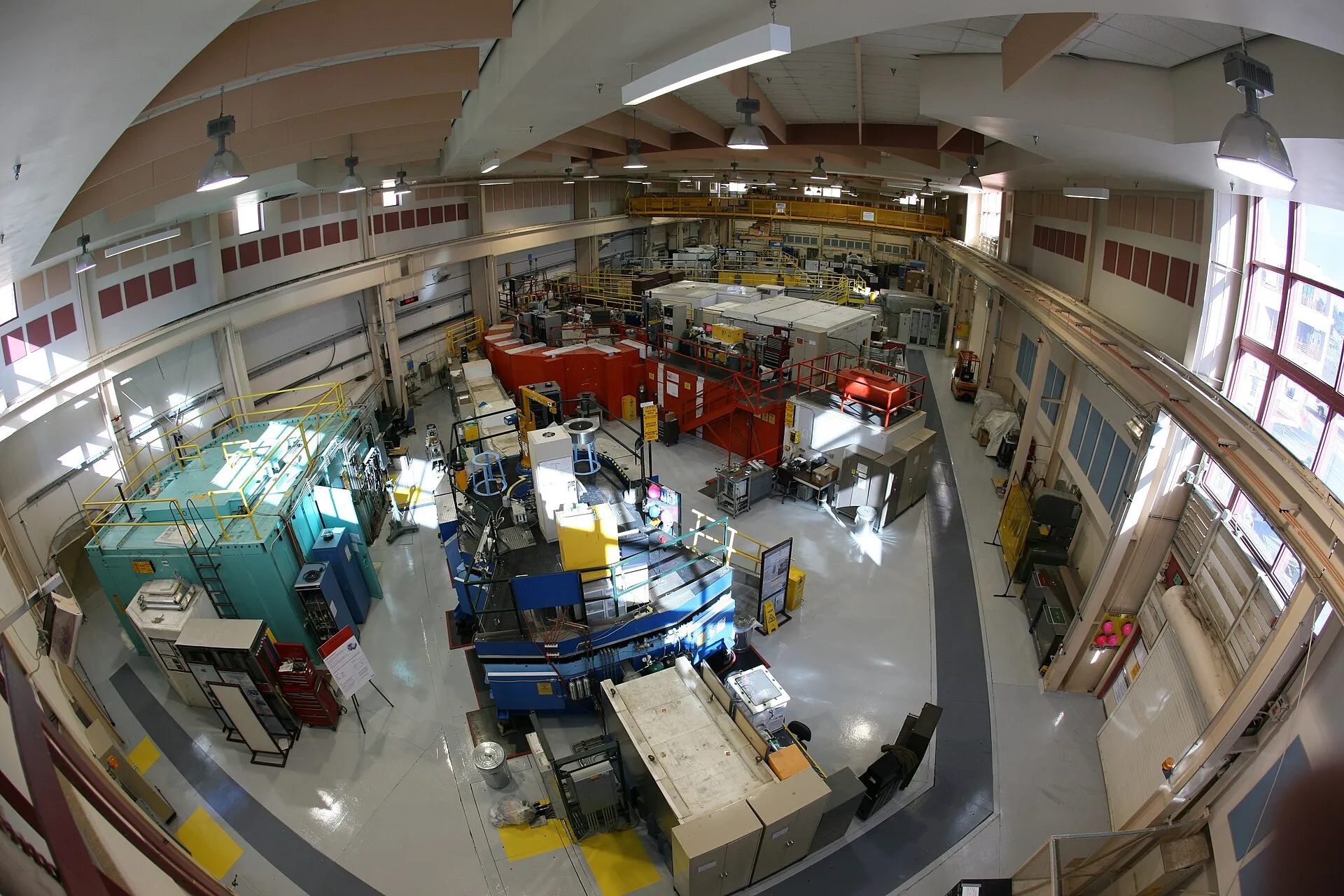
CCM sits 20 m from the tungsten spallation target of the Lujan Center at LANSCE, where 800 MeV protons produce pions that decay at rest. Its 10 t of liquid argon is viewed by photomultipliers: 120 in the 2019 engineering run (CCM120), about 200 in the upgraded CCM200. The 2019 run already excluded leptophobic dark matter between roughly 9 and 50 MeV.
Compare all experiments → · World map →
In plain words
When a proton beam hits a heavy target, it produces pions that stop and decay, sending out neutrinos with well-known energies at well-known times. Los Alamos has such a stopped-pion source, the same laboratory where LSND saw its controversial excess in the 1990s. Coherent CAPTAIN-Mills places a large tank of liquid argon next to it to look for neutrinos that vanish into sterile states and for light dark-matter particles that the beam might also produce.
How the detector works
At the Lujan Center of LANSCE, 800 MeV protons strike a tungsten target in short pulses. Positive pions stop and decay to a muon and a monoenergetic νμ of 29.8 MeV, followed by the muon decay. The detector, 20 m from the target, holds 10 t of liquid argon in a cylindrical cryostat. Argon scintillates brightly in the ultraviolet; a wavelength-shifting coating converts this light so that photomultipliers mounted on the walls can record it. The fast timing of the beam allows prompt signals to be separated from the steady background. After the 2019 engineering run with 120 PMTs, the detector was rebuilt as CCM200 with about 200 PMTs, filtered argon and improved shielding.
Key results
The 2019 run collected 17.9 × 10²⁰ protons on target in about six weeks. Searching for coherent nuclear recoils from dark-matter particles produced by meson decays, the collaboration observed 16.5 events above an expected background of about 115,000, consistent with background. This excluded leptophobic dark matter with masses between about 9 and 50 MeV for the benchmark model at 90% confidence, the first dark-sector result from LANSCE.
Status today
CCM200 is designed to collect roughly ten times more protons on target. Its programme includes a sterile-neutrino search through the disappearance of the 29.8 MeV νμ line in coherent elastic scattering on argon, which counts all active flavours equally, as well as searches for axion-like particles. Several CCM physicists, including William Louis and Janet Conrad, were involved in the earlier short-baseline anomalies.
Frequently asked questions
What does CAPTAIN stand for?
It comes from the Los Alamos liquid-argon programme CAPTAIN (Cryogenic Apparatus for Precision Tests of Argon Interactions with Neutrinos); Mills honours the late LANL physicist Geoffrey Mills.
Why does coherent scattering help a sterile search?
Coherent scattering is a neutral-current process, so a deficit cannot be explained by conversion to another active flavour.
Original papers
- First resultA. A. Aguilar-Arevalo et al. (CCM Collaboration), First dark matter search results from Coherent CAPTAIN-Mills, Phys. Rev. D 106, 012001 (2022)arXiv:2105.14020
- MeasurementA. A. Aguilar-Arevalo et al. (CCM Collaboration), First Leptophobic Dark Matter Search from the Coherent–CAPTAIN-Mills Liquid Argon Detector, Phys. Rev. Lett. 129, 021801 (2022)DOI 10.1103/PhysRevLett.129.021801arXiv:2109.14146
Related terms
- Spallation & Stopped-pion sources
- ISIS and LANSCE
- LSND
- Sterile neutrino
- Coherent elastic Neutrino-nucleus scattering
Mentioned in 1 page
Terms 1
Last updated: · Editorial standard
Cite this page
Text
Neutrino Atlas (2026). “Coherent CAPTAIN-Mills (CCM)”. Retrieved 22 November 2026, from https://neutrino-atlas.com/terms/ccm/BibTeX
@misc{neutrinoatlas2026termsccm,
  title        = {Coherent CAPTAIN-Mills (CCM)},
  author       = {{Neutrino Atlas}},
  year         = {2026},
  url          = {https://neutrino-atlas.com/terms/ccm/},
  note         = {Accessed 2026-11-22},
  language     = {english}
}