NEOS
Korean one-tonne reactor detector 24 m from a Hanbit power reactor that searched for sterile neutrinos and measured the 5 MeV bump.
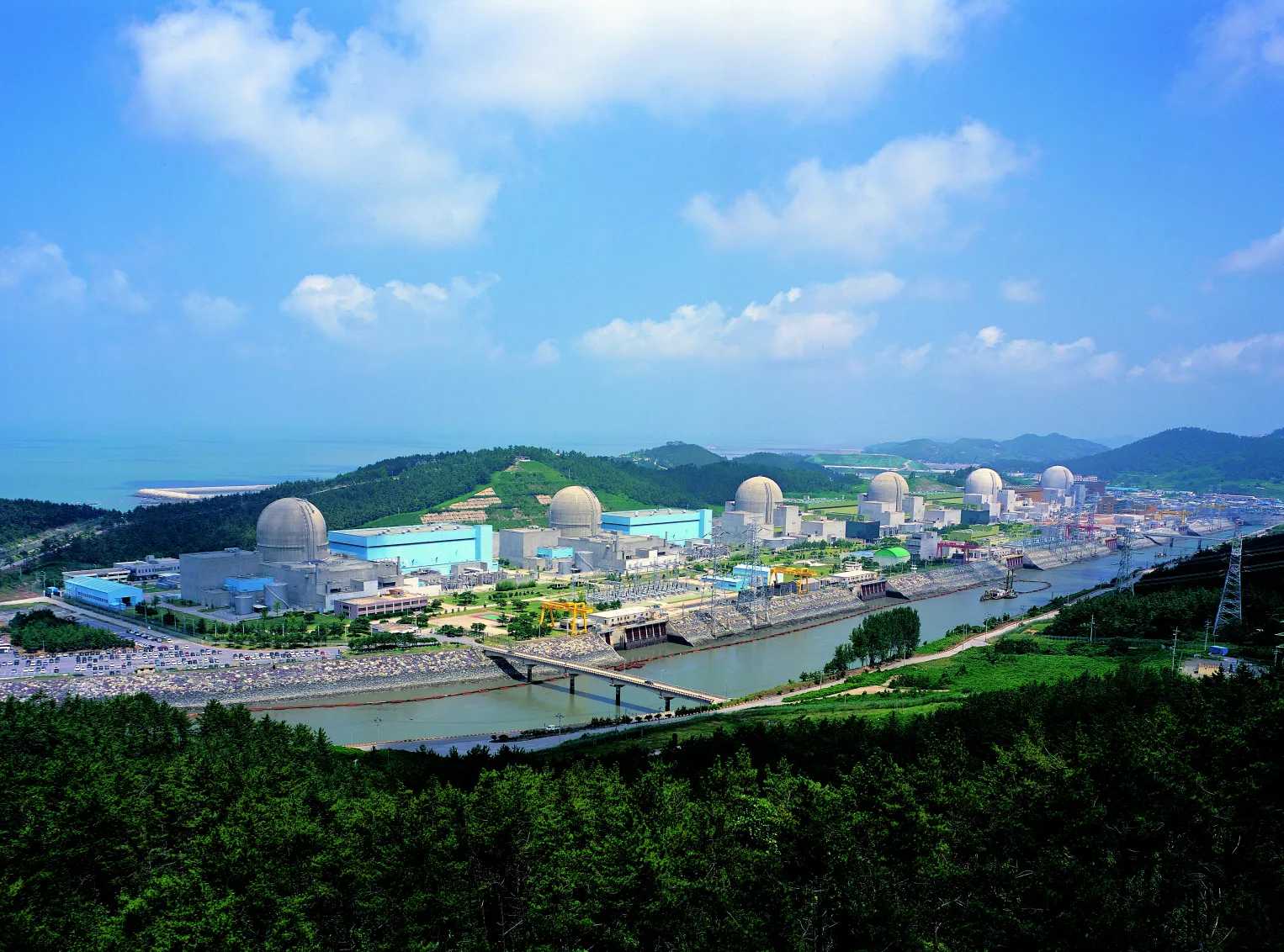
NEOS placed about 1 t (1,008 L) of gadolinium-loaded liquid scintillator in the tendon gallery of Hanbit unit 5, a 2.8 GW(th) reactor, about 24 m from the core. Eight months of data in 2015–16 gave about 2,000 antineutrino events per day with a signal-to-background ratio near 22. It limited sin²2θ₁₄ < 0.1 for Δm²₄₁ between 0.2 and 2.3 eV² (90% CL). NEOS-II followed with a full fuel cycle.
Compare all experiments → · World map →
In plain words
A light sterile neutrino with a mass splitting near 1 eV² would make reactor antineutrinos oscillate over a few metres, leaving wiggles in their energy spectrum. NEOS looked for these wiggles with a compact detector placed unusually close to a large commercial reactor. Instead of relying on a model of the reactor emission, it compared its spectrum with the one measured far away by Daya Bay, where such fast oscillations would already be averaged out.
How the detector works
The detector sat in the tendon gallery, a corridor inside the containment structure of Hanbit unit 5, about 24 m from the centre of the 2.8 GW(th) core. Its target held 1,008 litres of gadolinium-loaded liquid scintillator, viewed by photomultipliers. Antineutrinos were detected through inverse beta decay. Pulse-shape discrimination in the scintillator helped to reject fast neutrons and passive shielding together with a muon veto surrounded the detector.
Key results
In eight months of running the detector recorded 1,976 antineutrino events per day with a signal-to-background ratio of about 22, a very high rate for a one-tonne detector. The spectrum showed no clear sign of 3+1 oscillation and limited sin²2θ₁₄ below 0.1 for Δm²₄₁ between 0.2 and 2.3 eV² at 90% confidence, excluding part of the region suggested by the reactor anomaly. NEOS also confirmed the 5 MeV bump at a baseline of only 24 m, showing that it is a feature of the reactor spectrum rather than an oscillation effect.
Status today
NEOS-II returned to the same site and recorded 388 live days with the reactor on and 112 with it off, covering a full fuel cycle so that changes in the fission fractions of uranium and plutonium could be followed. Joint analyses with RENO, which shares the Hanbit site, combined the near detector's spectrum with NEOS data.
Frequently asked questions
Why compare with Daya Bay instead of a reactor model?
Flux models have uncertainties of several percent, while Daya Bay's measured spectrum comes from the same type of reactor at distances where fast oscillations average out.
Did NEOS find a sterile neutrino?
No. Its best fit showed a mild preference for oscillation that was not statistically significant.
Original papers
- First resultY. J. Ko et al. (NEOS Collaboration), Sterile Neutrino Search at the NEOS Experiment, Phys. Rev. Lett. 118, 121802 (2017)DOI 10.1103/PhysRevLett.118.121802arXiv:1610.05134
Related terms
Mentioned in 2 pages
Lessons 1
Terms 1
Last updated: · Editorial standard
Cite this page
Text
Neutrino Atlas (2026). “NEOS”. Retrieved 22 November 2026, from https://neutrino-atlas.com/terms/neos/BibTeX
@misc{neutrinoatlas2026termsneos,
  title        = {NEOS},
  author       = {{Neutrino Atlas}},
  year         = {2026},
  url          = {https://neutrino-atlas.com/terms/neos/},
  note         = {Accessed 2026-11-22},
  language     = {english}
}