KARMEN
A UK-based experiment at ISIS that did not confirm LSND, excluding part of its parameter space.
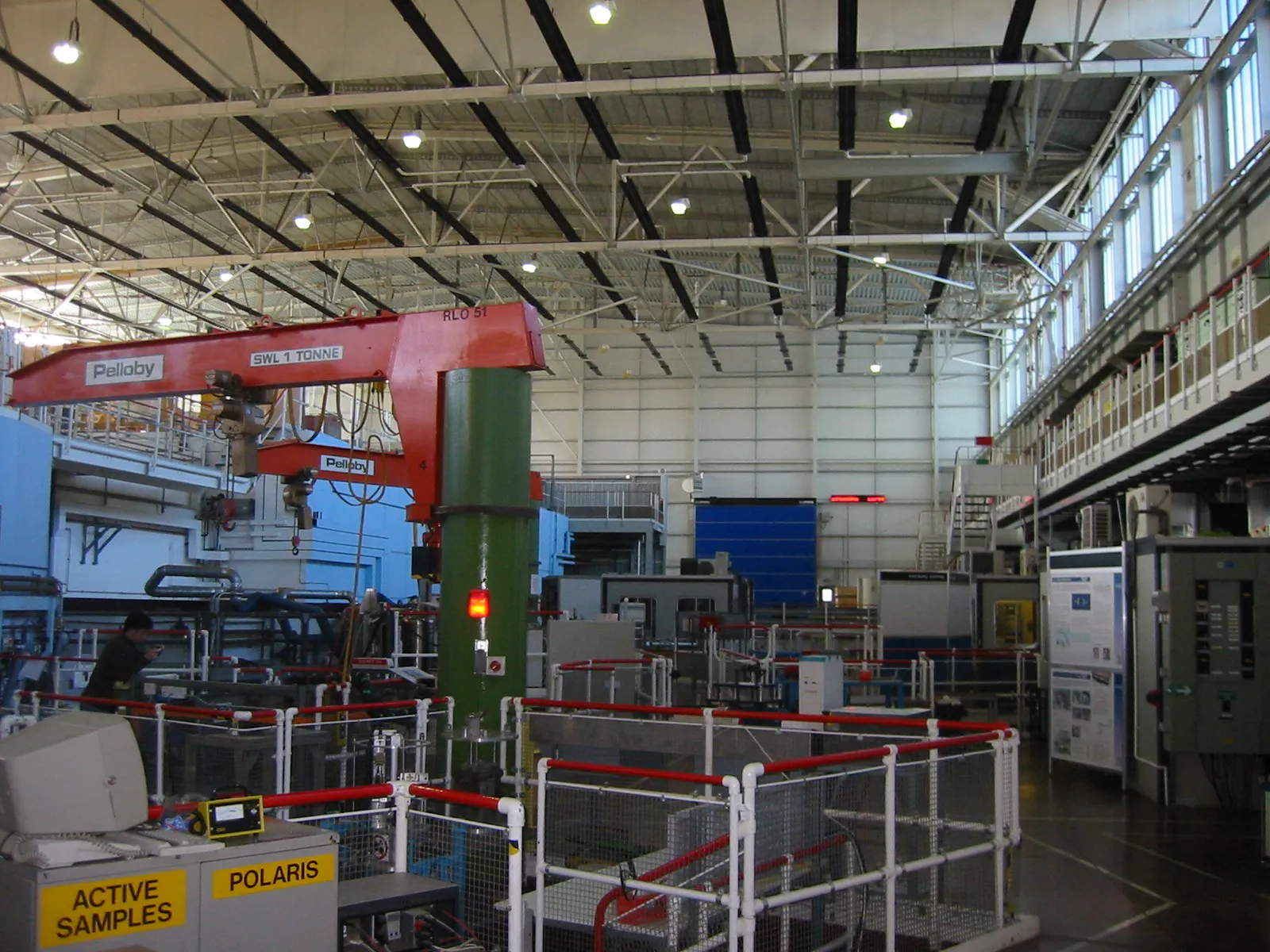
The KArlsruhe Rutherford Medium Energy Neutrino experiment used a 56-tonne segmented liquid scintillator 17.7 m from the ISIS target. Its clean pulsed beam timing allowed strong background rejection. No ν̄e excess was found, leaving a small region of LSND parameter space allowed.
Compare all experiments → · World map →
In plain words
KARMEN ran at the same time as LSND and searched for the same oscillation with a similar neutrino source, but in England and with a cleaner time structure. It saw nothing. Because the two experiments overlapped only partly in distance and sensitivity, the combination did not kill the LSND signal; it squeezed it into a narrower region.
How the detector works
The ISIS spallation neutron source at the Rutherford Appleton Laboratory accelerated protons to 800 MeV and delivered them in two short pulses, about 100 ns wide, 50 times per second. Pions decayed almost immediately, while the muons from their decay lived 2.2 μs. The neutrinos from muon decay, including the ν̄µ of interest, therefore arrived in a time window well separated from the prompt pulse, and cosmic backgrounds between pulses could be measured directly. The detector was a 56-tonne liquid scintillator calorimeter divided into 512 optically separated modules, about 17.7 m from the target, inside heavy steel shielding with active vetoes. An upgraded veto from 1997 (KARMEN 2) reduced cosmic-ray-induced neutrons sharply.
Key results
The final KARMEN 2 analysis (2002) found 15 candidate events for ν̄µ → ν̄e, compared with an expected background of 15.8 ± 0.5, and so no evidence of oscillation. A joint statistical analysis with LSND left allowed regions mainly between about 0.2 and 1 eV², and around 7 eV². KARMEN also measured neutrino–carbon reactions, for example charged- and neutral-current excitation of ¹²C, which serve as benchmarks for nuclear theory.
Why it matters for neutrino physics
KARMEN shows how timing can replace sheer size in background suppression, and it set the first constraints on the LSND parameter space. The narrow surviving region became the target of MiniBooNE. The ISIS source is described under ISIS and LANSCE.
Frequently asked questions
Did KARMEN refute LSND?
Not completely. Its shorter baseline and lower statistics left part of the LSND region allowed in a combined analysis.
What does KARMEN stand for?
KArlsruhe Rutherford Medium Energy Neutrino experiment, a collaboration led from Karlsruhe with British partners.
Original papers
- Final resultB. Armbruster et al. (KARMEN Collaboration), Upper limits for neutrino oscillations ν̄μ→ν̄e from muon decay at rest, Phys. Rev. D 65, 112001 (2002)DOI 10.1103/PhysRevD.65.112001arXiv:hep-ex/0203021
Related terms
People
On the timeline
Mentioned in 14 pages
Lessons 1
Last updated: · Editorial standard
Cite this page
Text
Neutrino Atlas (2026). “KARMEN”. Retrieved 22 November 2026, from https://neutrino-atlas.com/terms/karmen/BibTeX
@misc{neutrinoatlas2026termskarmen,
  title        = {KARMEN},
  author       = {{Neutrino Atlas}},
  year         = {2026},
  url          = {https://neutrino-atlas.com/terms/karmen/},
  note         = {Accessed 2026-11-22},
  language     = {english}
}