BEST (Baksan Experiment on Sterile Transitions)
A 2019 gallium experiment with an intense ⁵¹Cr source that confirmed the gallium anomaly.
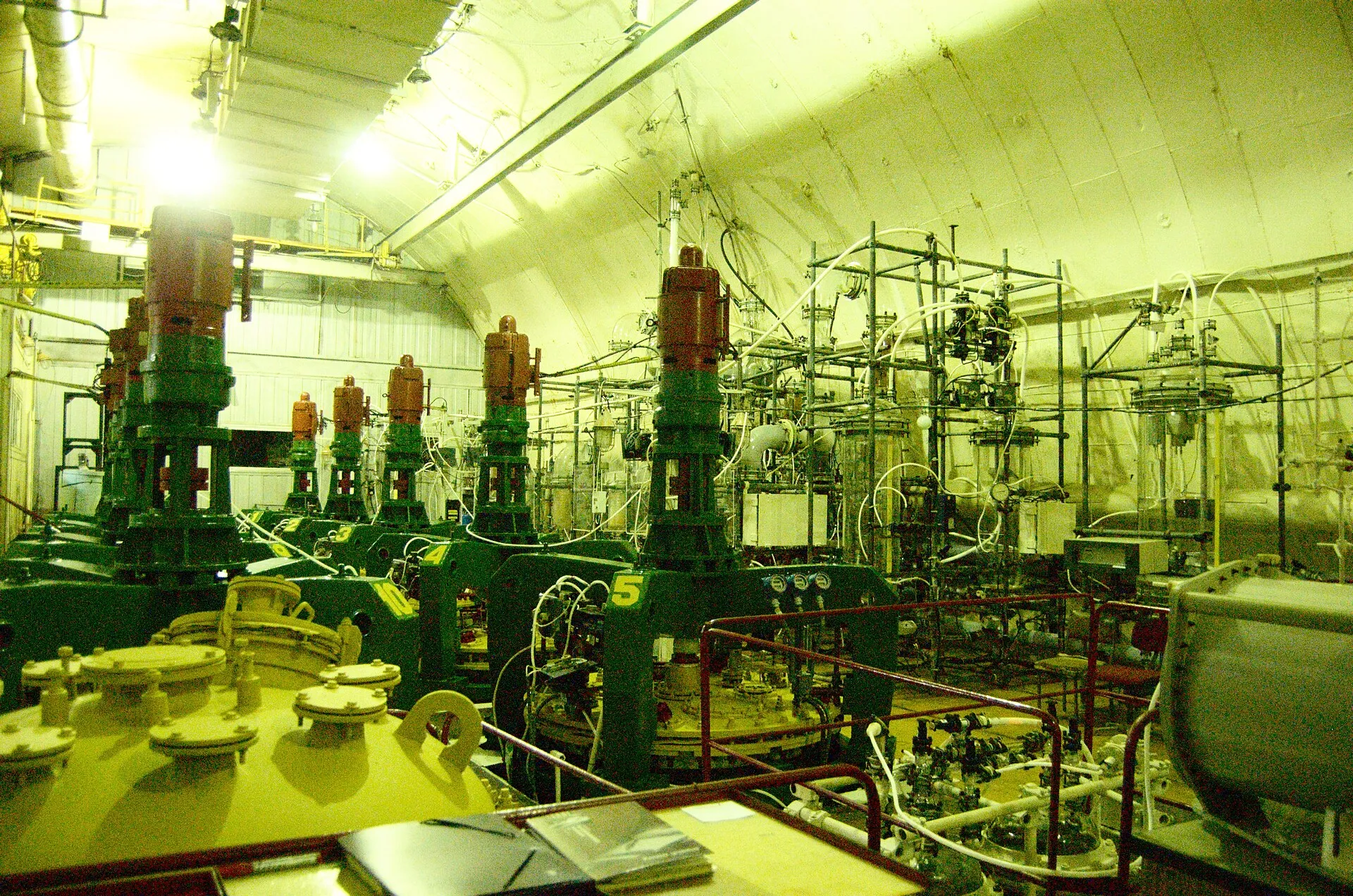
A 3.4 MCi ⁵¹Cr source was placed at the centre of two nested gallium volumes. Both zones measured about 20–25% fewer ⁷¹Ge atoms than predicted, without the distance dependence expected from short-baseline oscillation. Results published in 2022 strengthened the anomaly.
Compare all experiments → · World map →
In plain words
Gallium detectors once counted solar neutrinos by turning gallium atoms into germanium. When they were calibrated with man-made radioactive sources, they found consistently fewer germanium atoms than predicted. BEST repeated that calibration with the most intense source yet and a cleverer geometry: two nested gallium volumes, so that an oscillation over a short distance would show up as a difference between the inner and outer zones.
How the experiment works
A source of the isotope ⁵¹Cr with an initial activity of about 3.4 megacuries, produced in a reactor in Russia, was placed at the centre of a sphere containing about 7.5 tonnes of liquid metallic gallium, itself inside a cylinder holding about 40 tonnes. ⁵¹Cr decays by electron capture, emitting monoenergetic neutrinos of about 750 keV. A few of them are captured through νe + ⁷¹Ga → ⁷¹Ge + e⁻. Every few days the germanium atoms were chemically extracted from each zone and counted through their decays in small proportional counters, the technique developed for SAGE at the Baksan Neutrino Observatory. The source was inserted in July 2019, followed by a series of exposures lasting several days each.
Key results
Published in 2022, the ratios of measured to predicted capture rates were 0.79 ± 0.05 in the inner zone and 0.77 ± 0.05 in the outer zone. BEST alone sees the deficit at about 4σ, and the combination with earlier source tests by SAGE and GALLEX, known as the gallium anomaly, is stronger still. The two zones agree with each other, so BEST saw no clear distance dependence.
Why it matters for neutrino physics
An oscillation explanation would require Δm² above about 1 eV² and a large mixing, sin²2θ around 0.3 to 0.4. That is in tension with reactor experiments such as STEREO and with solar-neutrino data. The alternatives are an error in the capture cross section for ⁷¹Ga, which depends on nuclear matrix elements, in the source activity, or in the extraction efficiency. Each has been re-examined without a clear resolution. Vladimir Gavrin, long-time leader of SAGE, led the experiment.
Frequently asked questions
Is the gallium anomaly evidence for a sterile neutrino?
It is compatible with one but in conflict with other data in the simplest model. Most physicists consider the question open.
Why use a radioactive source instead of the Sun?
The source has a known activity and a single neutrino energy at a known distance, which makes it a precise calibration of the detector and of the capture cross section.
Original papers
- DiscoveryV. V. Barinov et al., Results from the Baksan Experiment on Sterile Transitions (BEST), Phys. Rev. Lett. 128, 232501 (2022)DOI 10.1103/PhysRevLett.128.232501arXiv:2109.11482
- MeasurementV. V. Barinov et al., Search for electron-neutrino transitions to sterile states in the BEST experiment, Phys. Rev. C 105, 065502 (2022)DOI 10.1103/PhysRevC.105.065502arXiv:2201.07364
Related terms
People
Latest research on this topic
- Expansion schemes for finite density QCD equation of state: which one is the best?Borsányi, Szabolcs, Fodor, Zoltán, Guenther, Jana N. et al. · 18 October 2026
- Optimal, Best-Known Divisible Binary Codes and Related Quantum CodesChen, Hao, Yu, Cong, Chen, Yaqi et al. · October 2026
- Which Milky Way Streams Make the Best Dark Matter Detectors?Chandra, Vedant, Conroy, Charlie, Wechsler, Risa et al. · 30 September 2026
- The best of all worlds: gravitational-wave transient detection with multiple pipelinesMoustakidis, Nikolas, Moustakidis, Theofilos, Chatterjee, Deep et al. · 28 September 2026
- Which Type Ia supernova observables best indicate the ages of their progenitor stars?Kim, Young-Lo, Chung, Chul, Lee, Young-Wook et al. · 10 September 2026
- Best Annealing Path of Simulated Quantum Annealing via Efficient Adiabatic Phase TransitionMurashima, Kiyotaka · 31 August 2026
On the timeline
Mentioned in 22 pages
Milestones 3
Terms 14
Last updated: · Editorial standard
Cite this page
Text
Neutrino Atlas (2026). “BEST (Baksan Experiment on Sterile Transitions)”. Retrieved 22 November 2026, from https://neutrino-atlas.com/terms/best/BibTeX
@misc{neutrinoatlas2026termsbest,
  title        = {BEST (Baksan Experiment on Sterile Transitions)},
  author       = {{Neutrino Atlas}},
  year         = {2026},
  url          = {https://neutrino-atlas.com/terms/best/},
  note         = {Accessed 2026-11-22},
  language     = {english}
}