SAGE (Soviet–American Gallium Experiment)
A metallic-gallium radiochemical detector at Baksan that measured the low-energy solar pp neutrinos.
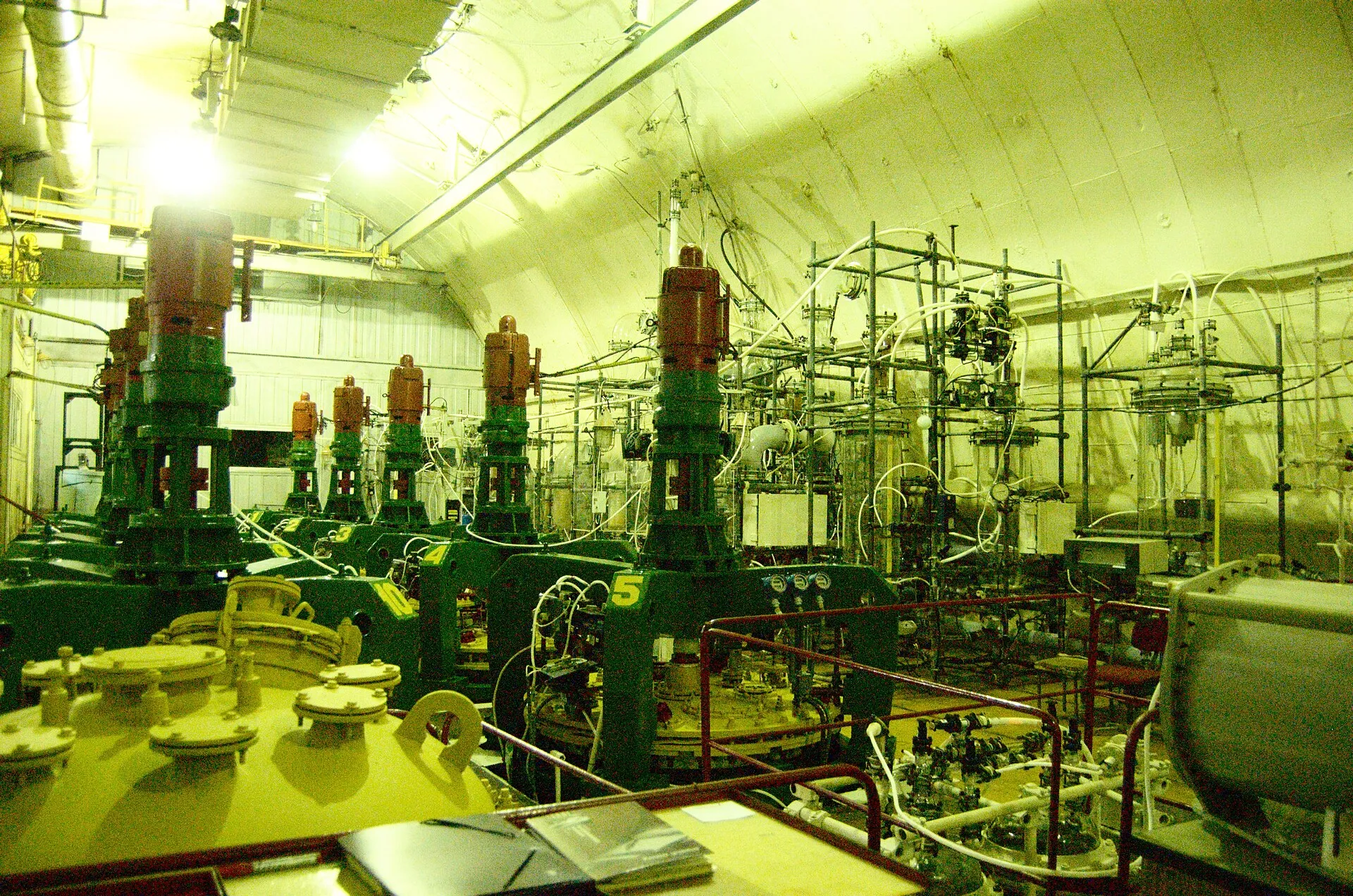
About 50 tonnes of liquid gallium metal captured νe via ⁷¹Ga → ⁷¹Ge above 233 keV. SAGE measured about 65 SNU against a prediction of about 130 SNU, confirming the solar deficit also for pp neutrinos. ⁵¹Cr and ³⁷Ar source calibrations showed a deficit (the gallium anomaly).
Compare all experiments → · World map →
In plain words
Most neutrinos from the Sun come from the first step of hydrogen fusion and carry very little energy. Chlorine and water detectors cannot see them. Gallium can: a neutrino above 233 keV can turn a gallium atom into germanium. SAGE used tens of tonnes of liquid gallium metal to count these germanium atoms and thereby test the most basic solar fusion reaction.
How the detector works
SAGE sits at the Baksan Neutrino Observatory in the North Caucasus, about 2100 metres below the summit of Mount Andyrchi. It used 50 to 57 tonnes of gallium kept liquid just above its melting point of about 30 °C.
After an exposure of about a month, the germanium was chemically extracted from the metal, converted into germane gas (GeH₄) and counted in small proportional counters, which register the X-rays and Auger electrons of the ⁷¹Ge decay. Only a handful of germanium atoms were produced per run.
Key results
Measurements began in December 1989, with the main data series starting in January 1990. Based on data from 1990 to 2007, SAGE reported a capture rate of 65.4 SNU, about 56 to 60 per cent of the roughly 130 SNU predicted by the standard solar model. Calibrations with an intense ⁵¹Cr neutrino source in 1995 and a ³⁷Ar source in 2004 checked the efficiency of the method; the argon source gave only about 79 per cent of the expected germanium. Together with GALLEX this became the gallium anomaly, which the follow-up experiment BEST confirmed in 2022.
History
The experiment grew from Soviet gallium plans led by Georgy Zatsepin and was joined by US groups, including Los Alamos and Kenneth Lande's team; Hans Bethe contributed to the analysis. Vladimir Gavrin has led it for most of its history. Both SAGE and GALLEX/GNO showed that the pp neutrino deficit is smaller than the ⁸B deficit, a key clue to energy-dependent flavour conversion.
Frequently asked questions
What does SAGE stand for?
Soviet–American Gallium Experiment; after 1991 it is also called the Russian–American Gallium Experiment.
Is the gallium anomaly evidence for sterile neutrinos?
A light sterile neutrino could explain it, but such a solution conflicts with other data. Uncertainties in the capture cross section are also being re-examined, so the question remains open.
Original papers
- First resultA. I. Abazov et al. (SAGE Collaboration), Search for neutrinos from the Sun using the reaction 71Ga(νe,e−)71Ge, Phys. Rev. Lett. 67, 3332 (1991)DOI 10.1103/PhysRevLett.67.3332
- MeasurementJ. N. Abdurashitov et al. (SAGE Collaboration), Measurement of the solar neutrino capture rate with gallium metal. III. Results for the 2002–2007 data-taking period, Phys. Rev. C 80, 015807 (2009)DOI 10.1103/PhysRevC.80.015807
Related terms
People
- John Norris Bahcall
- Georgy Timofeyevich Zatsepin
- Vladimir N. Gavrin (Vladimir Nikolaevich Gavrin)
- Vadim Alekseevich Kuzmin
- Bruce T. Cleveland
- Kenneth Lande
- Steven R. Elliott
Latest research on this topic
- Singlet-only always-on gapless exchange spin qubits: Charge noise effects and two-qubit gatesFoulk, Nathan L., Laubscher, Katharina, Hoffman, Silas et al. · 16 April 2026
On the timeline
Mentioned in 39 pages
Lessons 5
Milestones 6
People 9
Terms 18
Last updated: · Editorial standard
Cite this page
Text
Neutrino Atlas (2026). “SAGE (Soviet–American Gallium Experiment)”. Retrieved 22 November 2026, from https://neutrino-atlas.com/terms/sage/BibTeX
@misc{neutrinoatlas2026termssage,
  title        = {SAGE (Soviet–American Gallium Experiment)},
  author       = {{Neutrino Atlas}},
  year         = {2026},
  url          = {https://neutrino-atlas.com/terms/sage/},
  note         = {Accessed 2026-11-22},
  language     = {english}
}