 Illustration
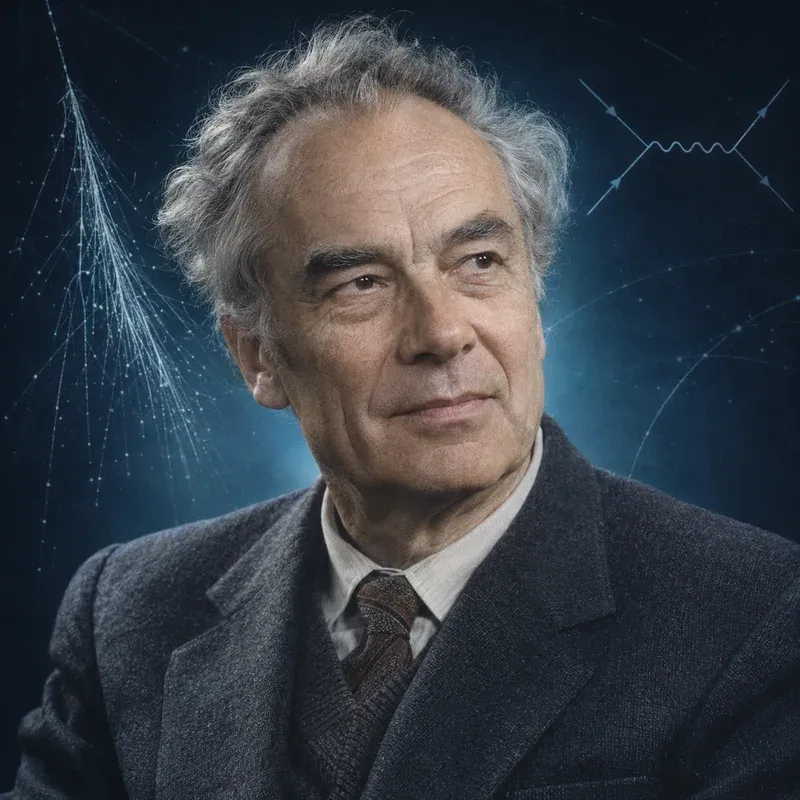
Georgy Timofeyevich Zatsepin
Zatsepin, with Kuzmin, predicted in 1966 the cutoff of the cosmic-ray spectrum from interactions with the cosmic microwave background, and in 1969 with Berezinsky showed that the same interactions produce cosmogenic high-energy neutrinos. He founded the Soviet programme of neutrino astrophysics, building the Baksan Neutrino Observatory, and shared the 2000 Pontecorvo Prize with Vladimir Gavrin for gallium–germanium solar neutrino research at Baksan.
- Born
- 28 May 1917
Moscow, Russia - Died
- 8 March 2010
Moscow, Russia - Nationality
- Soviet/Russian
- Field
- Cosmic-ray physics; neutrino astrophysics
- Institutions
- Moscow State University (Skobeltsyn Institute of Nuclear Physics), Lebedev Physical Institute, Institute for Nuclear Research (INR), Moscow
Early life and education
Georgy Timofeyevich Zatsepin was born in Moscow on 28 May 1917. He graduated from the Faculty of Physics of Moscow State University in 1941. During the war he spent about three years working at an aircraft plant, first in Moscow and then in Irkutsk, before returning to the university as a postgraduate student in 1944. His candidate dissertation dealt with the density spectrum of extensive air showers, the cascades of particles that a single high-energy cosmic ray produces in the atmosphere.
Cosmic-ray physics
From 1950 Zatsepin worked at the Lebedev Physical Institute. His analysis of air-shower data showed that these showers are driven by a nuclear cascade, in which energetic hadrons repeatedly collide with air nuclei, rather than by electromagnetic processes alone. This work, which formed his 1954 doctoral dissertation, earned him the Stalin Prize in 1951. He became a professor in 1958 and for decades chaired the department of cosmic rays and space physics at the Skobeltsyn Institute of Nuclear Physics of Moscow State University.
Key contributions to neutrino astrophysics
In 1966, shortly after the discovery of the cosmic microwave background, Zatsepin and Vadim Kuzmin pointed out that cosmic-ray protons above about 5×10¹⁹ eV would collide with these relic photons and lose energy by producing pions. The same conclusion was reached independently by Kenneth Greisen, and the predicted suppression of the spectrum became known as the Greisen–Zatsepin–Kuzmin (GZK) cutoff. It was later observed by large air-shower arrays including the Pierre Auger Observatory.
In 1969 Zatsepin and his younger colleague Veniamin Berezinsky recognised the neutrino side of this process: the charged pions decay into neutrinos, so the universe should contain a guaranteed flux of ultra-high-energy cosmogenic neutrinos. Searching for them remains a goal of IceCube, radio detectors and future observatories. Zatsepin and Berezinsky later wrote one of the first monographs on neutrino astrophysics (mid-1970s).
In 1968 Zatsepin also proposed a way to measure the neutrino mass with a supernova. Neutrinos of different energies emitted at the same moment would arrive at slightly different times if neutrinos have mass, because lower-energy ones travel more slowly. This time-of-flight method was applied to the burst from SN 1987A and gave a limit of the order of 10–20 eV on the electron antineutrino mass.
Founding the Baksan Neutrino Observatory
Zatsepin's most lasting institutional achievement was the Soviet programme of underground neutrino research. He set up a neutrino laboratory at the Lebedev Institute, where methods for detecting solar neutrinos were developed, and later headed the laboratory of neutrino astrophysics at the Institute for Nuclear Research in Moscow. Together with Alexander Chudakov and others he was a driving force behind the Baksan Neutrino Observatory in the North Caucasus, with tunnels driven under Mount Andyrchi. Its scintillation telescope recorded neutrinos from SN 1987A, and its gallium experiment SAGE measured the low-energy pp neutrinos from the Sun. For the creation of the observatory he received the State Prize of the Russian Federation in 1998, and in 2000 he shared the Bruno Pontecorvo Prize with Vladimir Gavrin for the gallium–germanium solar neutrino research.
Legacy
Zatsepin became a full member of the USSR Academy of Sciences in 1981 and received the Lenin Prize in 1982 and the Ó Ceallaigh Medal of the IUPAP Cosmic Ray Commission in 1999. He died in Moscow on 8 March 2010. His ideas – the GZK cutoff, cosmogenic neutrinos and supernova time-of-flight – remain basic tools of high-energy astroparticle physics.
Known for
- Greisen–Zatsepin–Kuzmin (GZK) cutoff (1966)
- Cosmogenic neutrinos (with Berezinsky, 1969)
- Founding the Baksan Neutrino Observatory
- Gallium solar neutrino research (SAGE)
Chronology
- 1966GZK cutoff with Kuzmin
- 1969Cosmogenic neutrinos with Berezinsky
- 1998State Prize for the Baksan Neutrino Observatory
- 2000Bruno Pontecorvo Prize (with Gavrin)
Original papers
- G. T. Zatsepin, V. A. Kuz'min, Upper limit of the spectrum of cosmic rays, JETP Lett. 4, 78 (1966)
- V. S. Berezinsky, G. T. Zatsepin, Cosmic rays at ultra high energies (neutrino?), Phys. Lett. B 28, 423 (1969)
Experiments
- Baksan Neutrino Observatory
- SAGE (Soviet–American Gallium Experiment)
- Pierre Auger Observatory (neutrino search)
- IceCube Neutrino Observatory
Connected people
Frequently asked questions
What is the GZK cutoff?
The predicted drop in the number of cosmic-ray protons above about 5×10¹⁹ eV, caused by their collisions with photons of the cosmic microwave background. Zatsepin and Kuzmin, and independently Greisen, proposed it in 1966.
What are cosmogenic neutrinos?
Neutrinos produced when ultra-high-energy cosmic rays interact with background photons during their journey through space. Berezinsky and Zatsepin predicted them in 1969; they have not yet been detected.
On the timeline
Mentioned in 14 pages
Lessons 1
People 7
Last updated: · Editorial standard
Cite this page
Text
Neutrino Atlas (2026). “Georgy Timofeyevich Zatsepin”. Retrieved 22 November 2026, from https://neutrino-atlas.com/people/georgy-zatsepin/BibTeX
@misc{neutrinoatlas2026peoplegeorgyzatsepin,
  title        = {Georgy Timofeyevich Zatsepin},
  author       = {{Neutrino Atlas}},
  year         = {2026},
  url          = {https://neutrino-atlas.com/people/georgy-zatsepin/},
  note         = {Accessed 2026-11-22},
  language     = {english}
}