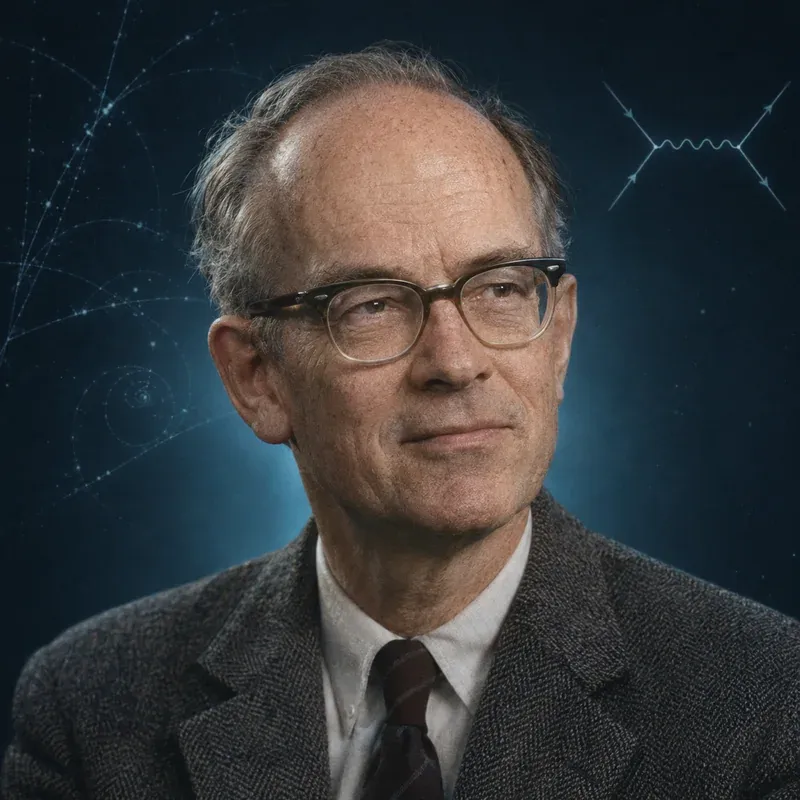
 Illustration
Kenneth Ingvard Greisen
In a 1960 review of cosmic-ray showers Greisen proposed detecting cosmic neutrinos with a Cherenkov counter about 15 m in diameter, holding some 3000 tons of inexpensive liquid, deep in a mine, and predicted that neutrino detection would become a tool of physics and astronomy within a decade. The proposal, published alongside Frederick Reines's article on neutrino interactions, is one of the founding documents of high-energy neutrino astronomy. In 1966 he showed that cosmic-ray protons above about 6 × 10¹⁹ eV lose energy on the cosmic microwave background through pion production, the GZK cutoff; the decays of those pions produce the cosmogenic neutrinos that ultra-high-energy neutrino detectors now seek.
- Born
- 24 January 1918
Perth Amboy, New Jersey, USA - Died
- 17 March 2007
Ithaca, New York, USA - Nationality
- American
- Field
- Cosmic-ray physics and high-energy astrophysics
- Institutions
- Franklin and Marshall College (BS 1938), Cornell University (PhD 1942), Los Alamos Laboratory (Manhattan Project), Cornell University
Early life and education
Kenneth Greisen was born in Perth Amboy, New Jersey, in 1918. He graduated summa cum laude from Franklin and Marshall College in 1938 and went to Cornell University, where he became the first American student of the Italian physicist Bruno Rossi. Together they ran an experiment with cosmic-ray muons that confirmed relativistic time dilation, and in 1941 they published "Cosmic Ray Theory", which remained a standard reference for years. Greisen received his PhD in 1942 with a thesis on the intensity of cosmic rays at low altitude.
Los Alamos and Cornell
From 1943 to 1946 Greisen worked at Los Alamos on the Manhattan Project, where he helped lead the group that designed the explosive initiator for the first atomic bomb, and he watched the Trinity test on 16 July 1945 from a station about ten miles away. After the war he returned to Cornell for the rest of his career. His group measured cosmic rays with scintillator arrays on campus and at altitude on Mount Evans in Colorado, and with detectors 600 m underground in a salt mine near Ithaca that recorded penetrating muons.
A neutrino telescope in a mine
In 1960 the Annual Review of Nuclear Science carried two articles that looked ahead to neutrino astronomy, one by Frederick Reines and one by Greisen on cosmic-ray showers. Greisen proposed a large Cherenkov counter about 15 m in diameter, located far underground in a mine, in which "the mass of the sensitive detector could be about 3000 tons of inexpensive liquid". He estimated that the Crab Nebula might give one event every three years, yet expected that "within the next decade cosmic ray neutrino detection will become one of the tools of both physics and astronomy." The same year Moisey Markov proposed instrumenting lakes or the sea; together these ideas point to the later water Cherenkov detectors and neutrino telescopes.
The end of the cosmic-ray spectrum
Soon after the discovery of the cosmic microwave background, Greisen showed in early 1966 that cosmic-ray protons above about 6 × 10¹⁹ eV collide with its photons and produce pions, losing energy within distances short compared with intergalactic scales. The spectrum from distant sources should therefore end sharply. Georgy Zatsepin and Vadim Kuzmin reached the same conclusion independently, and the effect is now called the GZK cutoff. The charged pions decay into neutrinos, so the cutoff implies a guaranteed flux of cosmogenic neutrinos, first calculated by Veniamin Berezinsky and Zatsepin; it is the main target of ultra-high-energy neutrino searches with radio detection.
To test his prediction Greisen developed the detection of air showers by the fluorescence light they excite in nitrogen. The idea was refined in Utah into the Fly's Eye and HiRes detectors, and it is used at the Pierre Auger Observatory. HiRes reported evidence for the suppression and dip he had predicted two weeks before his death.
Later life
Greisen's balloon-borne telescopes detected pulsed high-energy gamma rays from the Crab pulsar. He was elected to the National Academy of Sciences in 1974 and served Cornell as ombudsman, chair of astronomy and dean of the faculty (1978–1983). He died in Ithaca on 17 March 2007.
Known for
- Greisen–Zatsepin–Kuzmin (GZK) cutoff (1966)
- Proposal of a large underground Cherenkov detector for cosmic neutrinos (1960)
- Air-fluorescence detection of cosmic-ray showers (Fly's Eye concept)
- "Cosmic Ray Theory" with Bruno Rossi (1941)
- First high-energy gamma rays from the Crab pulsar
Chronology
- 1942PhD at Cornell under Bruno Rossi
- 1945Witnesses the Trinity test at Los Alamos
- 1960Proposes an underground Cherenkov detector for cosmic neutrinos
- 1966Predicts the cosmic-ray spectrum cutoff (GZK)
- 1974Elected to the US National Academy of Sciences
- 1978Dean of the Cornell faculty (to 1983)
Original papers
- K. Greisen, Cosmic ray showers, Annu. Rev. Nucl. Sci. 10, 63 (1960)DOI 10.1146/annurev.ns.10.120160.000431
- K. Greisen, End to the cosmic-ray spectrum?, Phys. Rev. Lett. 16, 748 (1966)DOI 10.1103/PhysRevLett.16.748
Experiments
- Fly's Eye / HiRes
- Pierre Auger Observatory (neutrino search)
Connected people
- Georgy Timofeyevich Zatsepin
- Frederick Reines
- Moisey Alexandrovich Markov
- Veniamin Sergeevich Berezinsky
- Hans Bethe
Frequently asked questions
What is the GZK cutoff?
The predicted end of the cosmic-ray proton spectrum near 6 × 10¹⁹ eV, caused by pion production on the cosmic microwave background. Greisen and, independently, Zatsepin and Kuzmin derived it in 1966.
Did Kenneth Greisen propose a neutrino detector?
Yes. In 1960 he proposed a 3000-ton underground Cherenkov detector in a mine to observe cosmic neutrinos.
Mentioned in 1 page
Terms 1
Last updated: · Editorial standard
Cite this page
Text
Neutrino Atlas (2026). “Kenneth Ingvard Greisen”. Retrieved 22 November 2026, from https://neutrino-atlas.com/people/kenneth-greisen/BibTeX
@misc{neutrinoatlas2026peoplekennethgreisen,
  title        = {Kenneth Ingvard Greisen},
  author       = {{Neutrino Atlas}},
  year         = {2026},
  url          = {https://neutrino-atlas.com/people/kenneth-greisen/},
  note         = {Accessed 2026-11-22},
  language     = {english}
}