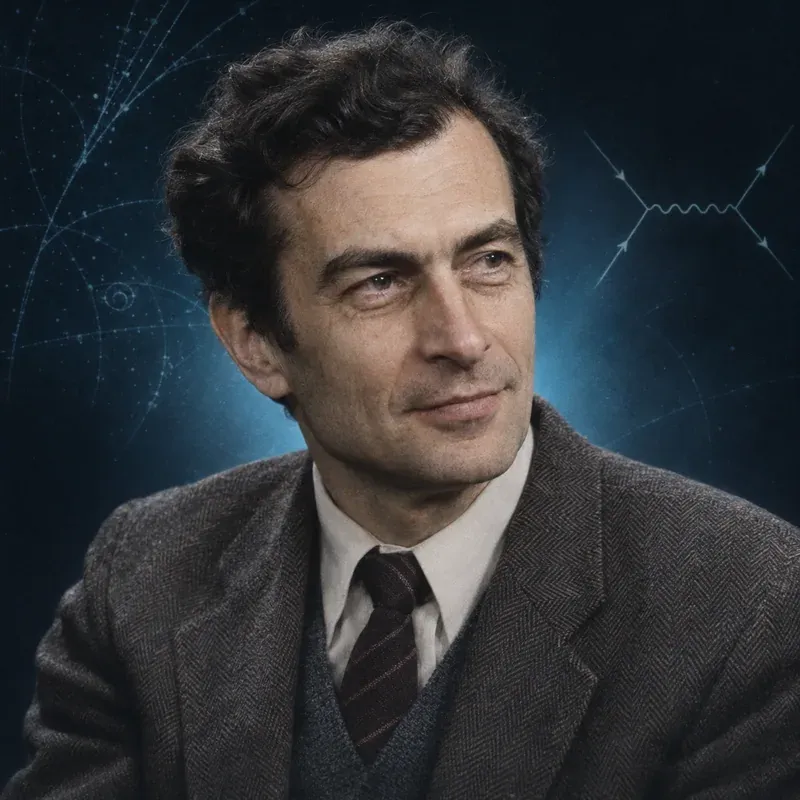
 Illustration
Veniamin Sergeevich Berezinsky
In 1969, with G. T. Zatsepin, Berezinsky proposed that ultra-high-energy cosmic-ray protons colliding with cosmic microwave background photons produce a flux of very high-energy 'cosmogenic' neutrinos, a foundation of high-energy neutrino astronomy. In 1975, with Smirnov, he linked diffuse high-energy neutrino and gamma-ray fluxes, a basis of multimessenger astrophysics, and in 1977 with Gazizov discussed resonant W production by electron antineutrinos, a process IceCube later observed.
- Born
- 17 April 1934
Volgograd, USSR - Died
- 16 April 2023
- Nationality
- Russian
- Field
- Astroparticle physics; high-energy neutrino astrophysics
- Institutions
- Institute for Nuclear Research (INR), Moscow, Laboratori Nazionali del Gran Sasso (LNGS)
Early life and education
Veniamin Sergeevich Berezinsky was born on 17 April 1934 in the city now called Volgograd. He graduated from the physics department of Moscow State University in 1962 and completed postgraduate studies at the Lebedev Physical Institute in 1965. His candidate thesis (1967) dealt with the radiative decay of the charged pion; his doctoral thesis (1975) with ultra-high-energy cosmic rays and their interaction with matter.
Path to neutrino physics
From 1970 to 2009 Berezinsky worked at the Institute for Nuclear Research in Moscow, in the Laboratory of Neutrino Astrophysics headed by Georgy Zatsepin. The lab was a centre of the young idea that neutrinos could be used to study the cosmos, from the Sun to the most energetic sources.
Key contributions
In 1966 Kenneth Greisen and, independently, Zatsepin and Vadim Kuzmin showed that cosmic-ray protons above about 5 × 10¹⁹ eV should lose energy by colliding with photons of the cosmic microwave background and producing pions (the GZK effect). In 1969 Berezinsky and Zatsepin pointed out the consequence for neutrinos: the charged pions decay and produce a flux of very high-energy cosmogenic neutrinos, and they devised a method for calculating it. Because the protons and the background photons certainly exist, this flux is close to guaranteed. The paper is regarded as a founding work of ultra-high-energy neutrino astronomy.
In 1975, with Alexei Smirnov, he linked high-energy neutrinos and gamma rays. Pion production creates both; the gamma rays cascade down to lower energies on their way through the universe, so the measured diffuse gamma-ray background caps the possible neutrino flux. This 'cascade limit' is one of the foundations of multimessenger astronomy. In 1977, with A. Z. Gazizov, he worked out resonant W-boson production when electron antineutrinos scatter on electrons, the process known as the Glashow resonance after Sheldon Glashow, who proposed it in 1960; IceCube recorded an event consistent with it at about 6 PeV in 2016. In the same year he and Zatsepin wrote on the DUMAND deep-ocean neutrino telescope.
He also proposed the 'dip' model, in which a feature of the ultra-high-energy cosmic-ray spectrum is explained by protons losing energy through electron–positron pair production on background photons, and worked on neutrinos from topological defects and superheavy dark matter and on the solar neutrino problem.
Later work
From 1990 Berezinsky worked in Italy. He became director of research at the Gran Sasso laboratory in 1992 and headed its astroparticle group from 1996 to 2014. He was a co-organiser and coordinating editor of the journal Astroparticle Physics. His books include 'Neutrino Astrophysics' (1975, with Zatsepin) and 'Astrophysics of Cosmic Rays' (English edition 1990, with Bulanov, Ginzburg, Dogiel and Ptuskin). His honours include the IUPAP O'Ceallaigh Medal (2007), the Markov Prize (2010) and the Enrico Fermi Prize of the Italian Physical Society (2017). He died on 16 April 2023.
Known for
- Cosmogenic (GZK) neutrinos (with Zatsepin, 1969)
- Neutrino–gamma-ray connection (with Smirnov, 1975)
- Pair-production 'dip' model of UHE cosmic rays
- Book 'Neutrino Astrophysics' (1975, with Zatsepin)
Chronology
- 1969Cosmogenic neutrinos with Zatsepin
- 1975'Neutrino Astrophysics' book; neutrino–gamma bound with Smirnov
- 1992Director of research at LNGS
- 2017Enrico Fermi Prize of the Italian Physical Society
Original papers
- V. S. Berezinsky, G. T. Zatsepin, Cosmic rays at ultra high energies (neutrino?), Phys. Lett. B 28, 423 (1969)
- V. S. Berezinsky, G. T. Zatsepin, Neutrino Astrophysics, Nauka, Moscow (1975)
Experiments
Connected people
- Alexei Yuryevich Smirnov
- Georgy Timofeyevich Zatsepin
- Sheldon Lee Glashow
- Kenneth Ingvard Greisen
- Vadim Alekseevich Kuzmin
Frequently asked questions
What are cosmogenic neutrinos?
Neutrinos produced when ultra-high-energy cosmic rays collide with the cosmic microwave background on their way through space. Berezinsky and Zatsepin predicted them in 1969; their energies lie around 10¹⁸ eV.
Have cosmogenic neutrinos been detected?
Not conclusively. IceCube, the Pierre Auger Observatory and ANITA have set upper limits. The event KM3-230213A, with an estimated energy of about 220 PeV, has been discussed as possibly cosmogenic, but a single event cannot settle the question.
Did Berezinsky predict the Glashow resonance?
No, Sheldon Glashow proposed it in 1960. Berezinsky and Gazizov developed its theory for astrophysical neutrinos in 1977, which helped make it a target for neutrino telescopes.
On the timeline
Mentioned in 9 pages
Last updated: · Editorial standard
Cite this page
Text
Neutrino Atlas (2026). “Veniamin Sergeevich Berezinsky”. Retrieved 22 November 2026, from https://neutrino-atlas.com/people/veniamin-berezinsky/BibTeX
@misc{neutrinoatlas2026peopleveniaminberezinsky,
  title        = {Veniamin Sergeevich Berezinsky},
  author       = {{Neutrino Atlas}},
  year         = {2026},
  url          = {https://neutrino-atlas.com/people/veniamin-berezinsky/},
  note         = {Accessed 2026-11-22},
  language     = {english}
}