KM3NeT
A distributed deep-sea neutrino observatory in the Mediterranean, with two detectors for astronomy and oscillations.
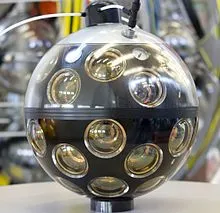
KM3NeT uses multi-PMT digital optical modules on vertical 'detection units'. ARCA, off Sicily at about 3500 m, targets high-energy astrophysics. ORCA, off Toulon at about 2450 m, is densely spaced to study atmospheric oscillations and the mass ordering. Both are under construction while taking data. ARCA recorded the most energetic neutrino ever seen (KM3-230213A). By October 2026 ARCA had 62 and ORCA 44 detection units installed, of 230 and 115 planned.
Compare all experiments → · World map →
In plain words
KM3NeT is a pair of neutrino telescopes being built on the floor of the Mediterranean Sea. Hundreds of tall, thin cables rise from the sea bed, each carrying a column of glass spheres packed with small light sensors. One site, off Sicily, is spread out over a cubic kilometre to catch rare cosmic neutrinos; the other, off southern France, is packed tightly to study the much more common, lower-energy neutrinos made in the atmosphere.
How the detector works
The building block is the digital optical module: a 17-inch glass sphere holding 31 small 3-inch photomultipliers that look in all directions. This segmentation gives directional information within one module and helps reject the potassium-40 background of sea water. Eighteen modules hang on a vertical detection unit, anchored to the sea floor and held taut by a buoy; units are deployed from a ship as compact spheres that unroll on the sea bed and are connected by a remotely operated vehicle.
- ARCA (Astroparticle Research with Cosmics in the Abyss), about 3500 m deep off Portopalo di Capo Passero, Sicily: units about 90 m apart with 36 m between modules, planned 230 units and about 1 km³, for TeV–PeV astrophysical neutrinos.
- ORCA (Oscillation Research with Cosmics in the Abyss), about 2450 m deep off Toulon: units about 20 m apart with 9 m spacing, planned 115 units, for GeV atmospheric oscillations and the mass ordering.
Key results
- On 13 February 2023 the still small ARCA recorded KM3-230213A, the most energetic neutrino ever detected, at about 220 PeV.
- With its first six units, ORCA measured atmospheric ν_μ disappearance and set constraints on non-standard interactions, neutrino decay and Lorentz-invariance violation.
- Searches for neutrino sources, dark matter and transients, in joint analyses with ANTARES data and other observatories.
Status today
Both detectors take data while construction continues; each sea campaign adds new units. Like its predecessor, KM3NeT also hosts instruments for sea science. Because it lies in the Northern Hemisphere, it sees the central Milky Way through the Earth, complementing IceCube and Baikal-GVD.
Frequently asked questions
What does KM3NeT stand for?
Cubic Kilometre Neutrino Telescope, referring to the size of its ARCA detector.
Why does KM3NeT have two sites?
Astronomy at high energies needs a huge, sparse volume, while oscillation studies at a few GeV need densely packed sensors. One technology serves both, at two depths and spacings.
Original papers
- ProposalS. Adrián-Martínez et al. (KM3NeT Collaboration), Letter of intent for KM3NeT 2.0, J. Phys. G 43, 084001 (2016)DOI 10.1088/0954-3899/43/8/084001arXiv:1601.07459
- DiscoveryS. Aiello et al. (KM3NeT Collaboration), Observation of an ultra-high-energy cosmic neutrino with KM3NeT, Nature 638, 376 (2025)DOI 10.1038/s41586-024-08543-1
Go deeper
- KM3-230213AThe highest-energy neutrino ever detected, about 220 PeV, recorded by KM3NeT/ARCA on 13 February 2023.
Related terms
People
Latest research on this topic
- Hidden Neutrino Active Galaxy Candidates: Prospects for Catalog and Stacking Searches with IceCube, IceCube-Gen2, and KM3NeTMukhopadhyay, Mainak, Carpio, Jose Alonso, Patel, Heer et al. · 30 October 2026
- Searches for coincident Gravitational Waves and High-Energy Neutrinos from the KM3NeT and ANTARES telescopes during O3ANTARES Collaboration · 21 October 2026
- Data and Computing Infrastructure for KM3NeT- Towards Full DeploymentKM3NeT Collaboration · 21 October 2026
- IceCube neutrino point-source searches in the direction of the KM3NeT ultra-high-energy eventAbbasi, R., Ackermann, M., Adams, J. et al. · 10 September 2026
- Cosmological Evolution of Primordial Black Holes: UV/IR Decoupling and the KM3NeT 220 PeV Neutrino AnomalyDey, Debdatta, Parvez, Tausif, Shankaranarayanan, S. · 10 September 2026
- KM3NeT/ARCA stacking search for high-energy neutrino point sources: the case of ultra-luminous infrared galaxies and blazarsKM3NeT Collaboration · 3 September 2026
On the timeline
- 1960Markov proposes deep underwater neutrino detection
- 2008ANTARES completes the first deep-sea telescope
- 2025KM3NeT detects a 220 PeV neutrino
Mentioned in 75 pages
Lessons 7
FAQ 6
Comparisons 3
Milestones 11
- 1960 · Markov proposes deep underwater neutrino detection
- 1969 · Cosmogenic neutrinos predicted
- 1976 · DUMAND plans a deep-ocean neutrino telescope
- 1993 · First underwater neutrino telescope in Lake Baikal
- 2008 · ANTARES completes the first deep-sea telescope
- 2018 · Blazar TXS 0506+056 linked to a neutrino
- 2021 · IceCube detects a Glashow resonance candidate
- 2022 · IceCube sees neutrinos from galaxy NGC 1068
People 6
Terms 42
- Acoustic neutrino detection
- Angular resolution
- ANTARES
- Astrophysical flavour ratio
- Astrophysical neutrino sources
- Atmospheric & Large water Cherenkov experiments
- Atmospheric neutrinos
- Baikal-GVD
34 more
- Cascade (shower) events
- Cherenkov radiation (detection)
- Digital optical module (DOM)
- DUMAND
- Earth matter effects
- Event topologies in neutrino telescopes
- Experiments & detectors
- Galactic plane neutrino emission
- Gamma-ray bursts and neutrinos
- Glashow resonance
- High-energy astrophysical neutrinos
- HUNT (High-energy Underwater Neutrino Telescope)
- Ice / Deep-water Cherenkov telescope
- KM3-230213A
- Mass-ordering sensitivity
- NEMO (Neutrino Mediterranean Observatory)
- NESTOR
- Neutrino astronomy
- Neutrino telescopes
- Neutrino tomography
- Neutrinos from dark matter annihilation
- Neutron-star mergers and neutrinos
- NGC 1068
- Open questions in oscillations
- Oscillogram
- P-ONE (Pacific Ocean Neutrino Experiment)
- Parametric resonance in the Earth
- Photomultiplier tube (PMT)
- SNEWS (SuperNova Early Warning System)
- TeV–PeV–EeV scale
- Track events
- TRIDENT (Hailing)
- Ultra-high-energy neutrinos
- Zenith angle
Last updated: · Editorial standard
Cite this page
Text
Neutrino Atlas (2026). “KM3NeT”. Retrieved 22 November 2026, from https://neutrino-atlas.com/terms/km3net/BibTeX
@misc{neutrinoatlas2026termskm3net,
  title        = {KM3NeT},
  author       = {{Neutrino Atlas}},
  year         = {2026},
  url          = {https://neutrino-atlas.com/terms/km3net/},
  note         = {Accessed 2026-11-22},
  language     = {english}
}