Baikal-GVD
A deep-water neutrino telescope in Lake Baikal, Siberia, growing towards a cubic-kilometre volume.
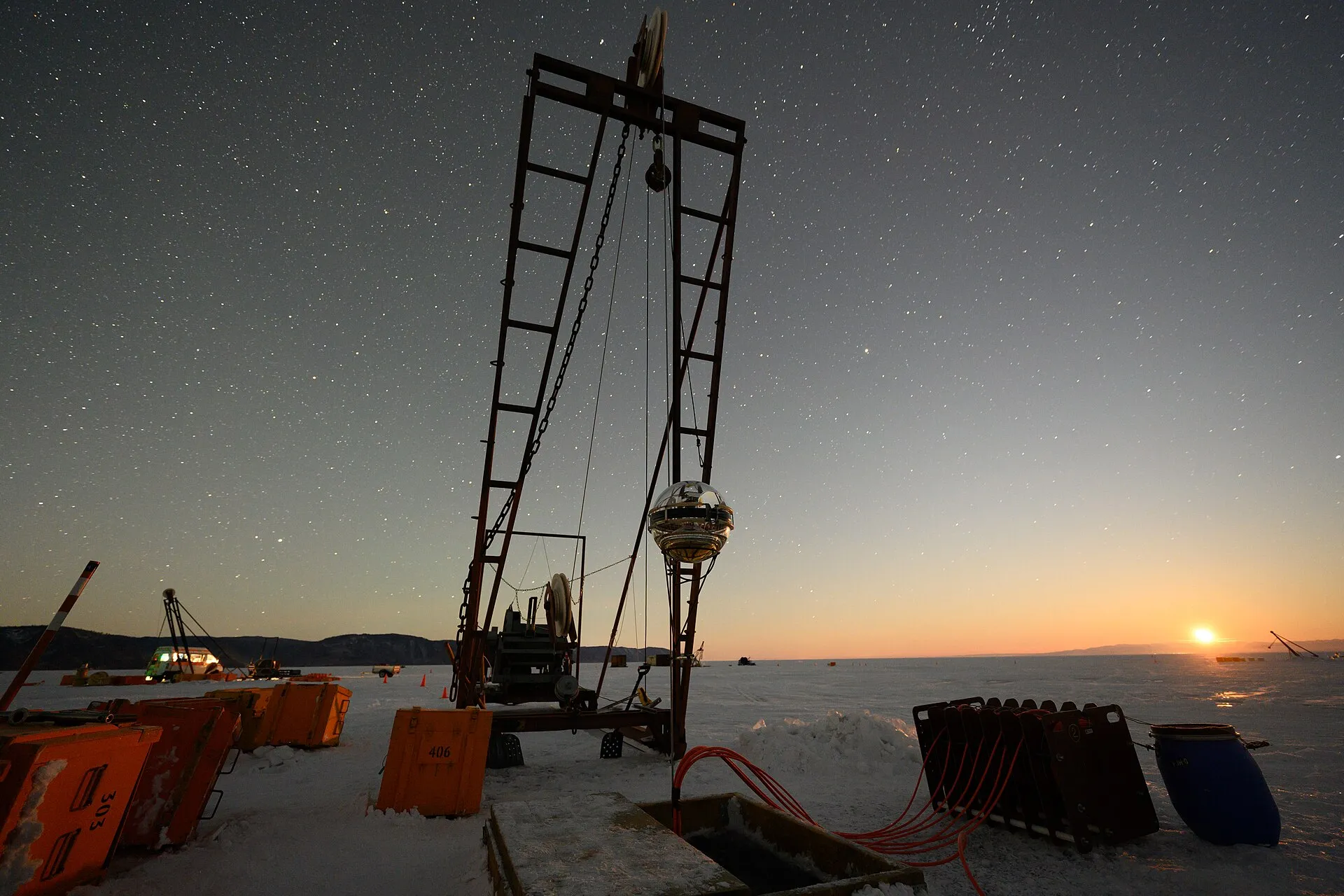
Following NT-200 (1998), the first underwater telescope to detect neutrinos, the Gigaton Volume Detector deploys clusters of optical module strings each winter from the frozen lake surface, at about 750–1300 m depth. It has measured the diffuse astrophysical flux with cascades, consistent with IceCube.
Compare all experiments → · World map →
In plain words
Lake Baikal in Siberia is the deepest lake on Earth, and in winter it freezes over with ice thick enough to carry trucks and cranes. Physicists use that ice as a working platform: they cut holes, lower long cables carrying glass spheres with light sensors more than a kilometre into the clear water, and connect them to shore. Year by year the array grows, turning a piece of the lake into a neutrino telescope that watches the Southern sky through the Earth.
How the detector works
The basic unit is a cluster of eight vertical strings with 36 optical modules each, 288 in total, each module holding a 10-inch photomultiplier. The sensors sit at roughly 750 to 1275 m depth and record the Cherenkov light of muon tracks and particle showers. Fresh water scatters light less than ice, so tracks can be reconstructed with good angular precision, while the light background from potassium-40 is far lower than in sea water. Deployment happens each February to April from the frozen surface.
History
The Baikal collaboration, long led by Grigory Domogatsky of the Institute for Nuclear Research in Moscow and later with the Joint Institute for Nuclear Research in Dubna, began site studies in the early 1980s. Its NT-200 telescope with 192 optical modules was completed in April 1998 and was the first underwater detector to record neutrino-induced upward muons. The first cluster of the Gigaton Volume Detector (GVD), named "Dubna", was installed in 2015.
In numbers
- By April 2025 the telescope comprised 14 clusters, 117 strings and 4,212 optical modules.
- This corresponds to a detection volume of about 0.7 km³ for cascades.
- From upward-going cascades recorded between 2018 and 2024 the collaboration measured the diffuse astrophysical flux at 5.1σ, with a spectral index of about 2.6, broadly consistent with IceCube.
Why it matters for neutrino physics
Baikal-GVD is located in the Northern Hemisphere and therefore sees the Southern sky, including the Galactic Centre, through the Earth – the half of the sky that IceCube observes only with high backgrounds. An independent confirmation of the cosmic astrophysical flux in a different medium, with different systematic errors, is valuable on its own. Together with IceCube and KM3NeT, Baikal-GVD is part of the Global Neutrino Network that coordinates alerts and joint analyses.
Frequently asked questions
Why build a neutrino telescope in a lake?
Lake Baikal is more than 1.6 km deep, its water is very clear and almost free of the radioactive potassium found in sea water, and the winter ice cover provides a stable platform for installation.
Is Baikal-GVD finished?
No. It is still being expanded by new clusters each winter, with the long-term aim of reaching a cubic-kilometre scale.
Original papers
- First resultI. A. Belolaptikov et al. (Baikal Collaboration), The Baikal underwater neutrino telescope: Design, performance and first results, Astropart. Phys. 7, 263 (1997)
- MeasurementV. A. Allakhverdyan et al. (Baikal-GVD Collaboration), Diffuse neutrino flux measurements with the Baikal-GVD neutrino telescope, Phys. Rev. D 107, 042005 (2023)DOI 10.1103/PhysRevD.107.042005arXiv:2211.09447
Related terms
People
- Moisey Alexandrovich Markov
- Christian Spiering
- Grigory Vladimirovich Domogatsky
- Veniamin Sergeevich Berezinsky
Latest research on this topic
- Search for Point-Like Neutrino Sources with Baikal-GVDBondarev, E., Zaborov, D. · 22 September 2026
- Multi-Threading for Baikal-GVD Core Software FrameworkSolovjev, A.G. · 20 July 2026
- Expected Cascade Spectrum from Atmospheric Muons in the Baikal-GVD Neutrino TelescopeLisitsin, M.V., Nikolaenko, R.V., Petrukhin, A.A. et al. · 24 May 2026
- From raw data to neutrino candidates: a neural-network pipeline for Baikal-GVDMatseiko, A., Plotnikov, G., Kharuk, I. · 11 May 2026
- First Constraints on Point-like Astrophysical Sources Using Baikal-GVD Muon Neutrino EventsGVD Collaboration · 22 March 2026
- Towards Baikal-Top: Feasibility study of an onshore detector system for the joint registration of EAS with Baikal-GVDKravchenko, E.A., Rubtsov, G.I., Zhadan, D.S. · 4 December 2025
On the timeline
- 1960Markov proposes deep underwater neutrino detection
- 1993First underwater neutrino telescope in Lake Baikal
Mentioned in 28 pages
Lessons 1
Milestones 4
People 8
Terms 13
Last updated: · Editorial standard
Cite this page
Text
Neutrino Atlas (2026). “Baikal-GVD”. Retrieved 22 November 2026, from https://neutrino-atlas.com/terms/baikal-gvd/BibTeX
@misc{neutrinoatlas2026termsbaikalgvd,
  title        = {Baikal-GVD},
  author       = {{Neutrino Atlas}},
  year         = {2026},
  url          = {https://neutrino-atlas.com/terms/baikal-gvd/},
  note         = {Accessed 2026-11-22},
  language     = {english}
}