ANITA
A NASA balloon-borne radio antenna array that circled Antarctica searching for Askaryan pulses from EeV neutrinos.
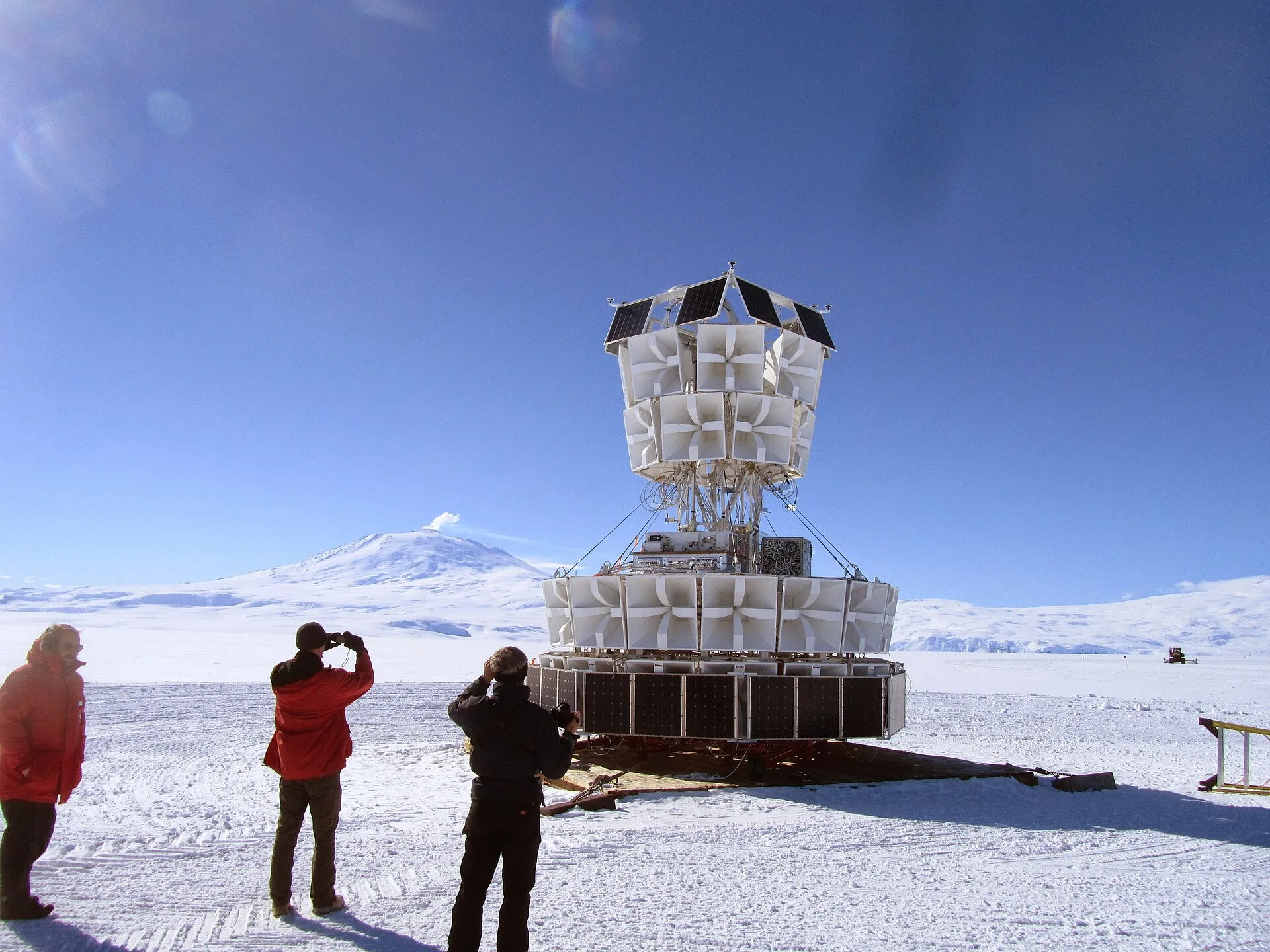
The Antarctic Impulsive Transient Antenna flew four times between 2006 and 2016. It set limits on the EeV neutrino flux and recorded unexplained 'anomalous' upward-going events whose origin is still debated.
Compare all experiments → · World map →
In plain words
ANITA was a set of radio antennas carried by a giant NASA balloon about 37 km above Antarctica. From that height it could watch more than a million square kilometres of ice at once. The idea: when an ultra-high-energy neutrino crashes into the ice, the resulting particle shower emits a nanosecond-long radio pulse, and ice is so transparent to radio waves that the pulse escapes and can be picked up far away.
How the detector worked
The physics is the Askaryan effect, predicted by Gurgen Askaryan in 1962: a particle shower in a dense medium develops an excess of electrons of roughly 20%, and this moving charge emits coherent radio waves at frequencies below about 1 GHz. ANITA carried dozens of dual-polarised horn antennas pointing outwards and slightly downwards and recorded signals between about 200 and 1200 MHz. Interferometric reconstruction gave the direction of each pulse, and its polarisation told neutrino-like pulses from radio pulses of cosmic-ray air showers, which are reflected by the ice and change their polarity on reflection.
ANITA flew four times on long-duration balloon flights circling the continent: 2006–07, 2008–09, 2014–15 and 2016. The project was led by Peter Gorham at the University of Hawaii.
Key results
- Some of the strongest limits of their time on the diffuse flux of neutrinos above about 10¹⁹ eV, which constrained models of cosmogenic neutrinos.
- Detection of dozens of radio pulses from cosmic-ray air showers, which demonstrated the radio technique.
- Two 'anomalous' events, from the 2006 and 2014 flights, that looked like cosmic-ray showers emerging steeply upward from the ice, with non-inverted polarity. For a Standard Model particle, this would require crossing thousands of kilometres of rock.
The anomalous events
Explanations range from unusual ice reflections and subsurface structures to physics beyond the Standard Model, such as long-lived particles. Searches by IceCube and by the Pierre Auger Observatory, published in 2025, found no matching upward-going showers, and the events cannot be explained as ordinary upward air showers. Their origin remains unresolved.
Status today
Its successor PUEO, the Payload for Ultrahigh Energy Observations led by the University of Chicago, flew from 19 December 2025 to 12 January 2026 with a more sensitive, phased-array trigger. Ground-based radio detection arrays in Antarctica and Greenland pursue the same goal.
Frequently asked questions
Did ANITA detect any neutrinos?
No neutrino was identified with confidence. ANITA set flux limits and recorded unexplained events whose interpretation is still open.
Why use a balloon?
From about 37 km altitude a single instrument can monitor more than a million square kilometres of ice, far more than any ground-based array.
Original papers
- First resultP. W. Gorham et al. (ANITA Collaboration), New Limits on the Ultra-high Energy Cosmic Neutrino Flux from the ANITA Experiment, Phys. Rev. Lett. 103, 051103 (2009)DOI 10.1103/PhysRevLett.103.051103arXiv:0812.2715
Related terms
People
Latest research on this topic
- A Dark-Sector Mass Flip-Flop Mechanism for the ANITA-IV EventsChattopadhyay, Dibya S., Argüelles, Carlos A., Brdar, Vedran · 12 November 2026
- Exact spherical-wave forward model for radio reflection from stratified media and implications for the anomalous-polarity events observed by ANITADasgupta, Paramita · 17 August 2026
- Four, One, and None: Quantifying the Ultra-High-Energy Neutrino Anomaly Across ANITA-IV, KM3NeT, and IceCubeChattopadhyay, Dibya S., Argüelles, Carlos A., Brdar, Vedran · 21 July 2026
- A possible solution to the mystery of the ANITA anomalous eventsVillata, Massimo · 14 April 2026
- Seafloor topography enhances KM3NeT sensitivity to ANITA-like eventsArgüelles, Carlos A., Bertólez-Martínez, Toni, Burgos-Mondéjar, Alba et al. · 24 October 2025
Mentioned in 11 pages
Milestones 1
Last updated: · Editorial standard
Cite this page
Text
Neutrino Atlas (2026). “ANITA”. Retrieved 22 November 2026, from https://neutrino-atlas.com/terms/anita/BibTeX
@misc{neutrinoatlas2026termsanita,
  title        = {ANITA},
  author       = {{Neutrino Atlas}},
  year         = {2026},
  url          = {https://neutrino-atlas.com/terms/anita/},
  note         = {Accessed 2026-11-22},
  language     = {english}
}