ANTARES
The first operational deep-sea neutrino telescope, in the Mediterranean off Toulon.
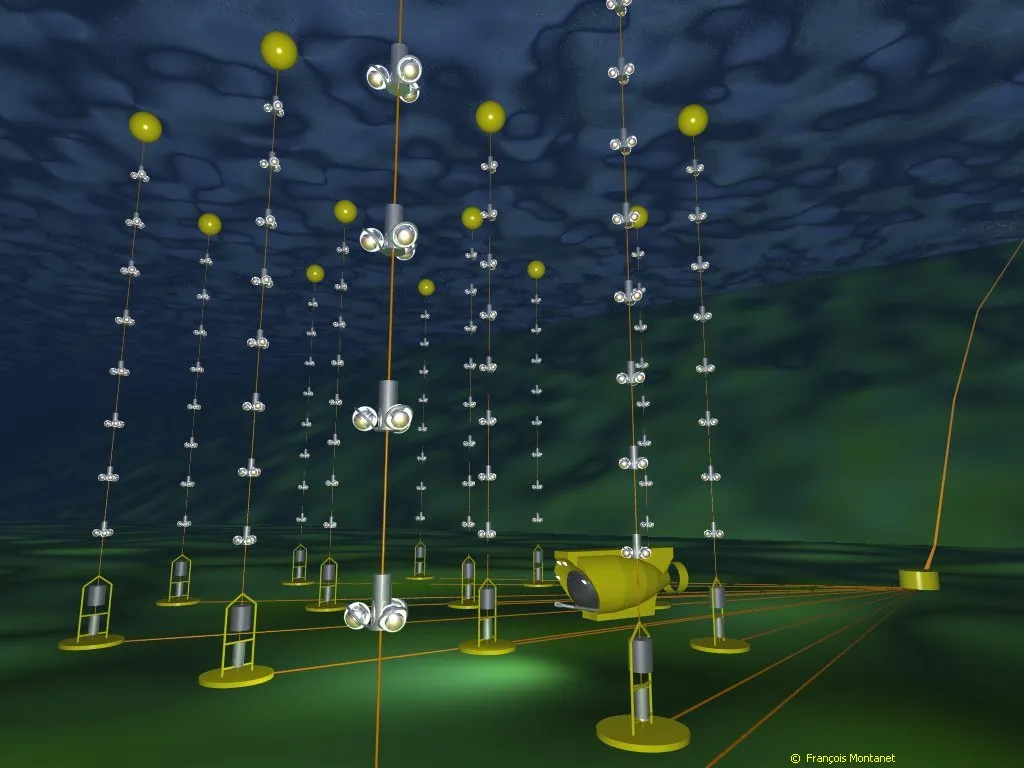
Twelve detection lines carrying about 885 optical modules, at 2475 m depth, observed atmospheric neutrinos and searched for astrophysical sources with good angular resolution for the Southern sky. It was decommissioned in 2022 as KM3NeT took over.
Compare all experiments → · World map →
In plain words
ANTARES was the first neutrino telescope to run successfully in the deep sea. Twelve tall cables, each anchored to the sea floor and held upright by a buoy, carried hundreds of light sensors in the dark water of the Mediterranean, about 40 km off the French coast near Toulon. For fourteen years it watched for the faint flashes of light that neutrinos leave when they interact in or near the detector, and it showed that a telescope can work reliably in the hostile environment of the deep ocean.
How the detector worked
Each of the 12 detection lines was about 450 m tall and carried 25 storeys with three 10-inch photomultipliers in glass spheres, looking downward at 45°; in total about 885 sensors at 2475 m depth. An electro-optical cable connected the array to the shore station at La Seyne-sur-Mer, and the lines were linked on the sea floor by a remotely operated submarine. Their positions, which shift with the sea currents, were tracked continuously by an acoustic system and compasses.
Sea water scatters light less than ice, so ANTARES reached a median angular resolution of better than half a degree for muon tracks at high energy. Its challenges were the light background from the decay of potassium-40 and from bioluminescent organisms, and the slow fouling of the glass spheres.
Key results
- Measurement of atmospheric muon neutrinos and of atmospheric oscillation parameters from low-energy events.
- Some of the best constraints on point sources in the Southern sky, including the region of the Galactic Centre.
- Searches for dark matter, magnetic monopoles and neutrinos coinciding with gravitational-wave events.
- Real-time alerts to optical telescopes as part of multimessenger astronomy.
- Continuous monitoring of the deep sea for oceanography and marine biology, including bioluminescence and whale sounds.
History
The collaboration formed in 1996, the first line was connected in 2006 and the detector was completed in May 2008. ANTARES was switched off in February 2022 and recovered from the sea, as its successor KM3NeT took over. Physicists such as Paschal Coyle carried the experience from ANTARES into the new project.
Why it matters for neutrino physics
ANTARES resolved the practical problems that had stopped DUMAND: underwater connectors, deployment by submarine and long-term stability. It demonstrated that a Northern-Hemisphere sea-water telescope complements IceCube by watching the Southern sky with good pointing, and it provided the know-how for KM3NeT.
Frequently asked questions
Where was ANTARES located?
In the Mediterranean Sea, about 40 km off Toulon, France, at a depth of 2475 m.
Is ANTARES still running?
No. It was decommissioned in February 2022. Its successor KM3NeT is operating and growing at two Mediterranean sites.
Original papers
- ProposalM. Ageron et al. (ANTARES Collaboration), ANTARES: the first undersea neutrino telescope, Nucl. Instrum. Meth. A 656, 11 (2011)DOI 10.1016/j.nima.2011.06.103
Related terms
People
Latest research on this topic
- Searches for coincident Gravitational Waves and High-Energy Neutrinos from the KM3NeT and ANTARES telescopes during O3ANTARES Collaboration · 21 October 2026
- Search for dark matter annihilation in the Sun using the full ANTARES datasetANTARES Collaboration · 29 September 2026
- Combined KM3NeT/ARCA and ANTARES search for compact neutrino sourcesKulikovskiy, V., Caiffi, B., Garre, S. Alves et al. · 15 July 2026
- Down going muon rate monitoring in the ANTARES detectorGracheva, K., Anghinolfi, M., Kulikovskiy, V. et al. · 20 May 2026
- Galactic Template Analysis with ANTARESANTARES Collaboration · 18 December 2025
- Deep learning framework for enhanced neutrino reconstruction of single-line events in the ANTARES telescopeANTARES Collaboration · 20 November 2025
On the timeline
Mentioned in 25 pages
Lessons 1
Milestones 5
People 6
Terms 13
Last updated: · Editorial standard
Cite this page
Text
Neutrino Atlas (2026). “ANTARES”. Retrieved 22 November 2026, from https://neutrino-atlas.com/terms/antares/BibTeX
@misc{neutrinoatlas2026termsantares,
  title        = {ANTARES},
  author       = {{Neutrino Atlas}},
  year         = {2026},
  url          = {https://neutrino-atlas.com/terms/antares/},
  note         = {Accessed 2026-11-22},
  language     = {english}
}