2023Discovery
IceCube observes neutrinos from the Milky Way
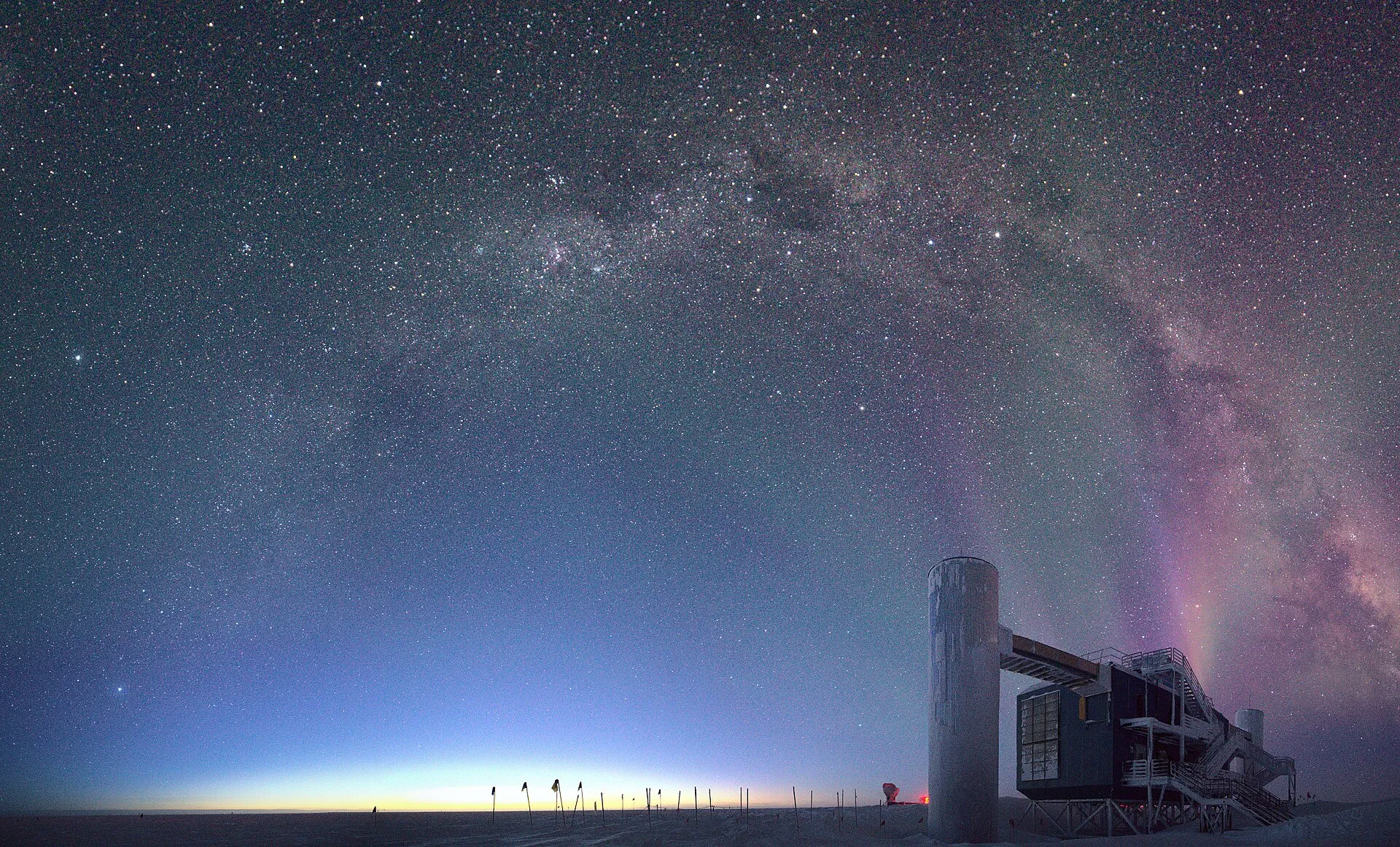
In Science on 29 June 2023, IceCube reported evidence at 4.5σ for high-energy neutrino emission from the plane of our Galaxy. The analysis used ten years of cascade events, whose better acceptance for the southern sky offset their poorer angular resolution, and machine-learning techniques for event selection. The neutrinos are expected from cosmic rays interacting with interstellar gas. It gave the first view of the Milky Way in particles other than light.
- Date
- 29 June 2023
- Kind of event
- Discovery
- People involved
- Francis Halzen
- Experiments
- IceCube Neutrino Observatory
The situation before
The Milky Way glows in high-energy gamma rays along its plane, as the Fermi satellite had mapped in detail. These gamma rays come mostly from cosmic rays striking interstellar gas and producing neutral pions. The same collisions also create charged pions, whose decays should yield neutrinos. A neutrino glow from the Galaxy was therefore expected, but it had never been seen: earlier IceCube and ANTARES searches reached only weak hints and upper limits.
The difficulty was geometric. Most of the Galactic plane, including the Galactic Centre, lies in the southern sky. At the South Pole, neutrinos from there arrive from above, together with a huge flux of atmospheric muons. IceCube's classic method, upward-going muon tracks that use the Earth as a filter, works only for the northern sky.
What happened
The decisive analysis switched to cascade events: roughly spherical light showers produced when a neutrino interacts inside the detector. Because the interaction starts within the instrumented ice, incoming atmospheric muons can be vetoed, so the southern sky becomes accessible. The price is poor direction: a cascade points back only to within several degrees, compared with under one degree for a track.
A team led by Mirco Hünnefeld at TU Dortmund and Steve Sclafani at Drexel University applied machine-learning methods to select and reconstruct cascades. This kept more than an order of magnitude more events than earlier selections, with better angular and energy resolution. The final sample contained about 60,000 neutrinos from ten years of data, 2011 to 2021.
The data were compared with three predicted maps of Galactic neutrino emission: one extrapolated from Fermi gamma-ray observations and two alternative models known as KRAγ. The Galactic plane template was preferred over a background-only hypothesis at 4.5σ. The paper appeared in Science on 29 June 2023 (volume 380).
Reaction
Drexel physicist Naoko Kurahashi Neilson said: "Observing our own galaxy for the first time using particles instead of light is a huge step". Co-lead analyst Steve Sclafani noted that a neutrino counterpart to the gamma-ray glow "has now been measured, thus confirming what we know about our galaxy and cosmic ray sources". The result was widely reported as the first image of the Milky Way in anything other than electromagnetic radiation.
Francis Halzen added a perspective: the Galactic contribution is only about a tenth of the total astrophysical neutrino flux at these energies. In neutrinos, unlike in light, the distant Universe outshines our own Galaxy.
Why it matters
The measurement confirmed that cosmic rays interact with gas throughout the Galaxy as models predict, and it showed that the Milky Way is a comparatively dim neutrino source. Because the emission is diffuse along the plane, it does not yet identify individual sources such as supernova remnants or a hypothetical Galactic PeVatron. Doing so needs sharper pointing for southern-sky events, which KM3NeT in the Mediterranean can supply. Together with the NGC 1068 result a few months earlier, it marked the shift of IceCube from detecting a diffuse flux to mapping the neutrino sky, a body of work later recognised by the 2026 Nobel Prize to Halzen.
Frequently asked questions
When did IceCube detect neutrinos from the Milky Way?
The evidence was published in Science on 29 June 2023, based on ten years of cascade events recorded from 2011 to 2021.
Why were cascades used instead of tracks?
The Galactic plane lies mostly in the southern sky, where IceCube sees many atmospheric muons. Cascades that start inside the detector can be separated from these muons, though their directions are less precise.
How bright is the Milky Way in neutrinos?
It contributes roughly a tenth of the astrophysical neutrino flux at TeV energies; most of the flux comes from outside the Galaxy.
Original papers
- DiscoveryR. Abbasi et al. (IceCube Collaboration), Observation of high-energy neutrinos from the Galactic plane, Science 380, 1338 (2023)DOI 10.1126/science.adc9818arXiv:2307.04427
Concepts
Mentioned in 1 page
Lessons 1
Last updated: · Editorial standard
Cite this page
Text
Neutrino Atlas (2026). “2023: IceCube observes neutrinos from the Milky Way”. Retrieved 22 November 2026, from https://neutrino-atlas.com/timeline/2023-icecube-galactic-plane/BibTeX
@misc{neutrinoatlas20262023icecubegalacticplane,
  title        = {2023: IceCube observes neutrinos from the Milky Way},
  author       = {{Neutrino Atlas}},
  year         = {2026},
  url          = {https://neutrino-atlas.com/timeline/2023-icecube-galactic-plane/},
  note         = {Accessed 2026-11-22},
  language     = {english}
}