2020Experiment
Hyper-Kamiokande construction is approved
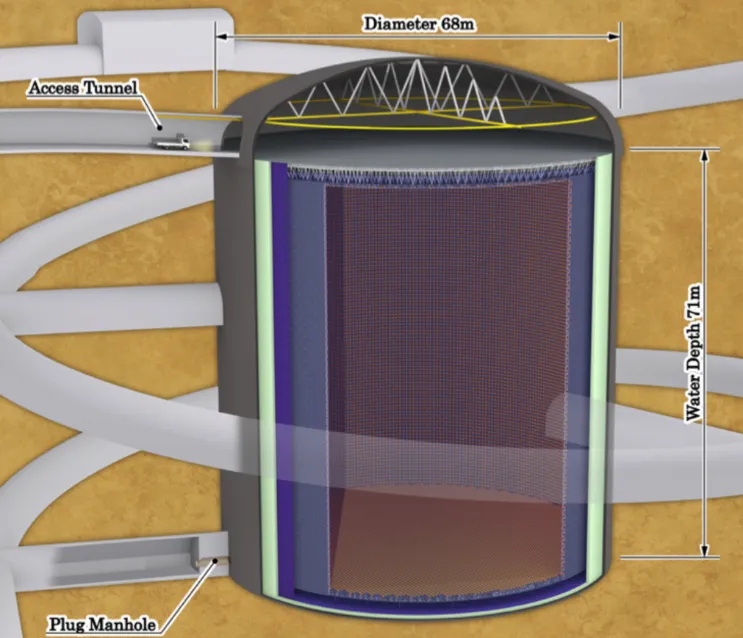
In February 2020 the Japanese Diet approved the budget for Hyper-Kamiokande, formally launching the project. The detector will hold about 260,000 tonnes of ultra-pure water, about eight times the fiducial mass of Super-Kamiokande, in a new cavern near Kamioka, and will serve as far detector for an upgraded J-PARC beam. Its goals include CP violation, proton decay and supernova neutrinos. Operations are planned for 2028.
- Date
- 2020
- Kind of event
- Experiment
- People involved
- Masato Shiozawa, Francesca Di Lodovico
- Experiments
- Hyper-Kamiokande, J-PARC Neutrino Beam
Background
Super-Kamiokande, running since 1996, had made the Kamioka region the centre of water Cherenkov neutrino physics. Proposals for a much larger successor were discussed from the early 2000s, and a formal letter of intent for Hyper-Kamiokande appeared in 2011. The goals were ambitious: discover leptonic CP violation with the beam from J-PARC, search for proton decay with unprecedented sensitivity, and record thousands of neutrinos from a galactic supernova. For years the project waited for a funding decision by the Japanese government.
What happened
In early 2020 the National Diet of Japan approved a supplementary budget that included the first construction funds for Hyper-Kamiokande. The University of Tokyo and the High Energy Accelerator Research Organization (KEK) announced in February 2020 that the project had officially started, with operations planned for 2028.
The plan foresees a cylindrical tank about 68 m in diameter and 71 m high, holding about 260,000 tonnes of ultra-pure water, in a new cavern about 600 m underground near Kamioka. Its fiducial volume of about 188,000 tonnes is roughly eight times that of Super-Kamiokande. About 20,000 newly developed 50 cm photosensors with about twice the efficiency of Super-Kamiokande's tubes, plus multi-PMT modules, will watch the water. The far detector will receive the J-PARC neutrino beam 295 km away, upgraded toward 1.3 MW, with improved near detectors and a new intermediate water Cherenkov detector.
The international collaboration, with Masato Shiozawa and Francesca Di Lodovico among its leaders, brought together several hundred physicists from Japan and more than a dozen other countries, with substantial contributions from Europe and North America to photosensors, electronics and the near detectors.
Consequences
Excavation of the access tunnel began in 2021, and work on the huge main cavern followed. The approval came as DUNE was also under construction, setting up two complementary experiments: Hyper-K with a shorter baseline and enormous statistics, DUNE with a longer baseline and stronger matter effects. Together they are expected to determine δCP and the mass ordering, continuing the work that T2K began in the same beam.
Frequently asked questions
When was Hyper-Kamiokande approved?
The Japanese Diet approved the first construction budget in early 2020, and the project officially started in February 2020.
How big is Hyper-Kamiokande?
About 260,000 tonnes of water in total, with a fiducial volume about eight times that of Super-Kamiokande.
What will it study?
CP violation in neutrino oscillations with the J-PARC beam, proton decay, supernova, solar and atmospheric neutrinos.
Original papers
- ProposalK. Abe et al. (Hyper-Kamiokande Proto-Collaboration), Hyper-Kamiokande Design Report, arXiv:1805.04163 (2018)arXiv:1805.04163
Concepts
Mentioned in 1 page
Lessons 1
Last updated: · Editorial standard
Cite this page
Text
Neutrino Atlas (2026). “2020: Hyper-Kamiokande construction is approved”. Retrieved 22 November 2026, from https://neutrino-atlas.com/timeline/2020-hyper-kamiokande-approved/BibTeX
@misc{neutrinoatlas20260hyperkamiokandeapproved,
  title        = {2020: Hyper-Kamiokande construction is approved},
  author       = {{Neutrino Atlas}},
  year         = {2026},
  url          = {https://neutrino-atlas.com/timeline/2020-hyper-kamiokande-approved/},
  note         = {Accessed 2026-11-22},
  language     = {english}
}