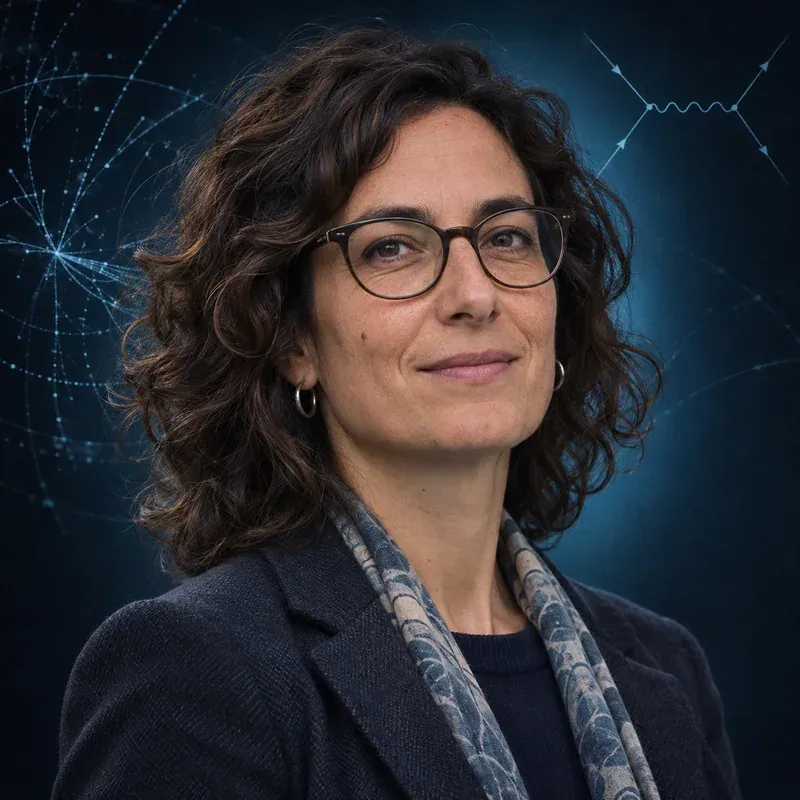
 Illustration
Francesca Di Lodovico
Di Lodovico, professor of particle physics at King's College London, is the international spokesperson of Hyper-Kamiokande, re-elected for a second term in 2023. Hyper-K, a 260,000-ton water-Cherenkov detector with about 40,000 photosensors fed by the J-PARC beam, is expected to start data-taking around 2027 to search for leptonic CP violation and proton decay.
- Nationality
- Italian
- Field
- Experimental particle physics
- Institutions
- King's College London
Education and early career
Francesca Di Lodovico graduated from La Sapienza University in Rome and earned her PhD at ETH Zurich, working on searches for the Higgs boson and supersymmetry at the LEP-2 collider. As a postdoctoral researcher with the University of Edinburgh and then the University of Wisconsin–Madison she worked on b-quark physics at the BaBar experiment at SLAC.
Path to neutrino physics
In 2004 she became a lecturer at Queen Mary University of London, where she founded a neutrino physics group, was promoted to professor and headed the Particle Physics Research Centre. She received a European Research Council Starting Grant in 2007 for her work on T2K, the long-baseline experiment that sends a muon-neutrino beam from J-PARC to Super-Kamiokande, 295 km away. As a T2K and Super-K member she was among the laureates of the 2016 Breakthrough Prize in Fundamental Physics awarded to the major oscillation experiments. In 2019 she moved to King's College London to set up its Experimental Particle and Astroparticle Physics group.
Hyper-Kamiokande
Di Lodovico is the international spokesperson of Hyper-Kamiokande and was re-elected for a second term in 2023. Hyper-K is the successor of Kamiokande and Super-Kamiokande: a water Cherenkov detector holding 260,000 tonnes of water, read out by tens of thousands of photomultipliers, and fed by an upgraded J-PARC beam. Its main goals are to measure leptonic CP violation by comparing the oscillations of neutrinos and antineutrinos, to search for proton decay as a test of grand unification, and to observe supernova, solar and atmospheric neutrinos. Data-taking is expected to begin around 2027. She has said she hopes the experiment will "create a plethora of data that colleagues across the world will draw upon for many years to come."
Other work
Her group at King's also takes part in SNO+, which searches for neutrinoless double beta decay to test whether neutrinos are Majorana particles, and in ANNIE at Fermilab, which measures how many neutrons neutrino interactions release in a gadolinium-loaded water detector, an input for Hyper-K's analyses.
Known for
- International spokesperson of Hyper-Kamiokande (re-elected 2023)
Chronology
- 2023Re-elected Hyper-Kamiokande international spokesperson
Experiments
Connected people
Frequently asked questions
What is Francesca Di Lodovico's role in Hyper-Kamiokande?
She is the international spokesperson of the collaboration, a role to which she was re-elected for a second term in 2023.
When will Hyper-Kamiokande start?
According to King's College London, data-taking is expected to begin in 2027.
On the timeline
Mentioned in 4 pages
Last updated: · Editorial standard
Cite this page
Text
Neutrino Atlas (2026). “Francesca Di Lodovico”. Retrieved 22 November 2026, from https://neutrino-atlas.com/people/francesca-di-lodovico/BibTeX
@misc{neutrinoatlas2026eoplefrancescadilodovico,
  title        = {Francesca Di Lodovico},
  author       = {{Neutrino Atlas}},
  year         = {2026},
  url          = {https://neutrino-atlas.com/people/francesca-di-lodovico/},
  note         = {Accessed 2026-11-22},
  language     = {english}
}