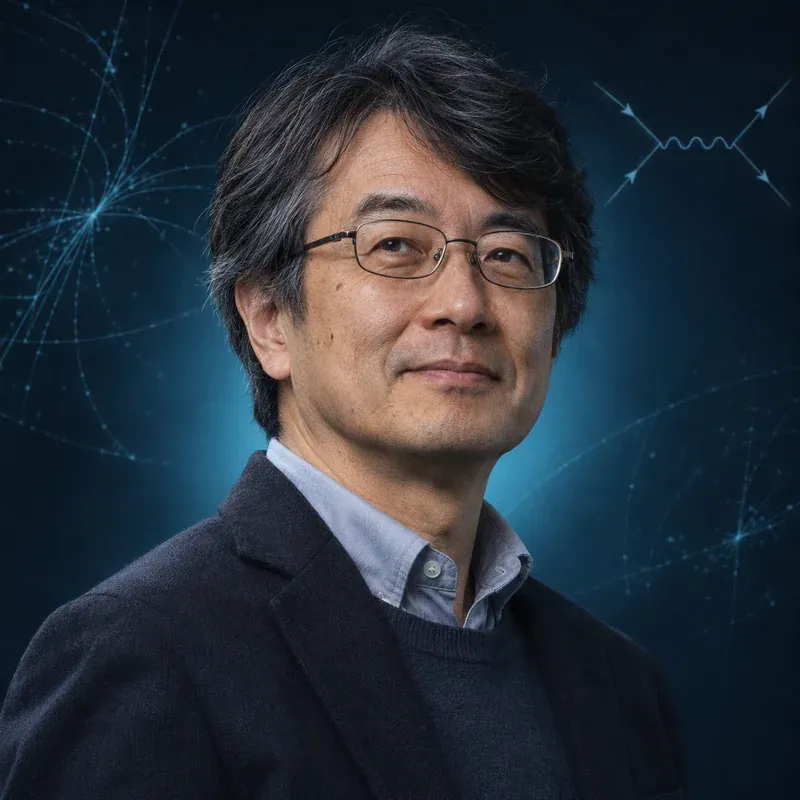
 Illustration
Masato Shiozawa
Shiozawa, a professor at ICRR, is director of the Kamioka Observatory, which runs Super-Kamiokande, and co-spokesperson of Hyper-Kamiokande, the 260-kiloton successor water-Cherenkov detector under construction. As a member of T2K's analysis steering group he shared the 2015 Yoji Totsuka Prize for the discovery of muon-to-electron neutrino oscillations.
- Nationality
- Japanese
- Field
- Experimental neutrino and proton-decay physics
- Institutions
- Institute for Cosmic Ray Research (ICRR), University of Tokyo, Kamioka Observatory
Background
Masato Shiozawa is a Japanese experimental physicist and professor at the Institute for Cosmic Ray Research (ICRR) of the University of Tokyo. His research spans nucleon decay, neutrino mixing and masses, grand unification and CP violation, all of it pursued at the Kamioka underground site in Gifu Prefecture. He is director of the Kamioka Observatory, which operates Super-Kamiokande, and co-spokesperson of its successor, Hyper-Kamiokande.
Proton decay at Super-Kamiokande
Grand unified theories predict that the proton is not absolutely stable. In the simplest models its favoured decay is p → e⁺π⁰: the positron and the two photons from the neutral pion each produce a Cherenkov ring, and their combined energy and momentum add up to the proton mass at rest. Shiozawa was first author of Super-Kamiokande's 1998 search for this channel, which used an exposure of 25.5 kiloton-years, found no signal and set a lower limit of 1.6 × 10³³ years on the partial lifetime (90% confidence level). He continued to work on these searches as the exposure grew; the same detector and the same data underpin the atmospheric neutrino analyses that revealed neutrino oscillation.
T2K and electron-neutrino appearance
Super-Kamiokande is also the far detector of T2K, which sends a muon-neutrino beam 295 km from J-PARC in Tokai. As a member of T2K's analysis steering group, Shiozawa contributed to the observation, announced in July 2013, of muon neutrinos turning into electron neutrinos, the appearance channel that depends on θ13 and on the CP phase. In 2015 he shared the Yoji Totsuka Prize with Takashi Kobayashi and Tsuyoshi Nakaya for contributions to this discovery.
Hyper-Kamiokande
Hyper-Kamiokande is a 260-kiloton water Cherenkov detector being excavated in Hida, about eight times larger in fiducial mass than Super-Kamiokande. It will serve as far detector for an upgraded J-PARC beam to study leptonic CP violation, and it will extend the reach for proton decay and for supernova, solar and atmospheric neutrinos. As co-spokesperson, alongside colleagues such as Francesca Di Lodovico, Shiozawa represents the international collaboration and reports on construction progress; at a symposium in Toyama in May 2026 marking 30 years of Super-Kamiokande observations he described the 30-year journey as the result of joint work between scientists and the local community.
Known for
- Director of Kamioka Observatory
- Co-spokesperson of Hyper-Kamiokande
- Super-Kamiokande proton-decay searches
- T2K νμ→νe discovery (Totsuka Prize 2015)
Chronology
- 2015Yoji Totsuka Prize (with T. Kobayashi and T. Nakaya)
Experiments
Connected people
Frequently asked questions
What is Masato Shiozawa known for?
For proton-decay searches with Super-Kamiokande, for his role in T2K's discovery of electron-neutrino appearance, and for leading the Kamioka Observatory and the Hyper-Kamiokande collaboration.
Has Super-Kamiokande seen proton decay?
No. Its searches, including the p → e⁺π⁰ channel that Shiozawa analysed, have found no signal and set the world's strongest lower limits on the proton lifetime in this mode.
On the timeline
Mentioned in 6 pages
Last updated: · Editorial standard
Cite this page
Text
Neutrino Atlas (2026). “Masato Shiozawa”. Retrieved 22 November 2026, from https://neutrino-atlas.com/people/masato-shiozawa/BibTeX
@misc{neutrinoatlas2026peoplemasatoshiozawa,
  title        = {Masato Shiozawa},
  author       = {{Neutrino Atlas}},
  year         = {2026},
  url          = {https://neutrino-atlas.com/people/masato-shiozawa/},
  note         = {Accessed 2026-11-22},
  language     = {english}
}