T2K
A Japanese long-baseline experiment that discovered νµ → νe appearance and provides constraints on CP violation.
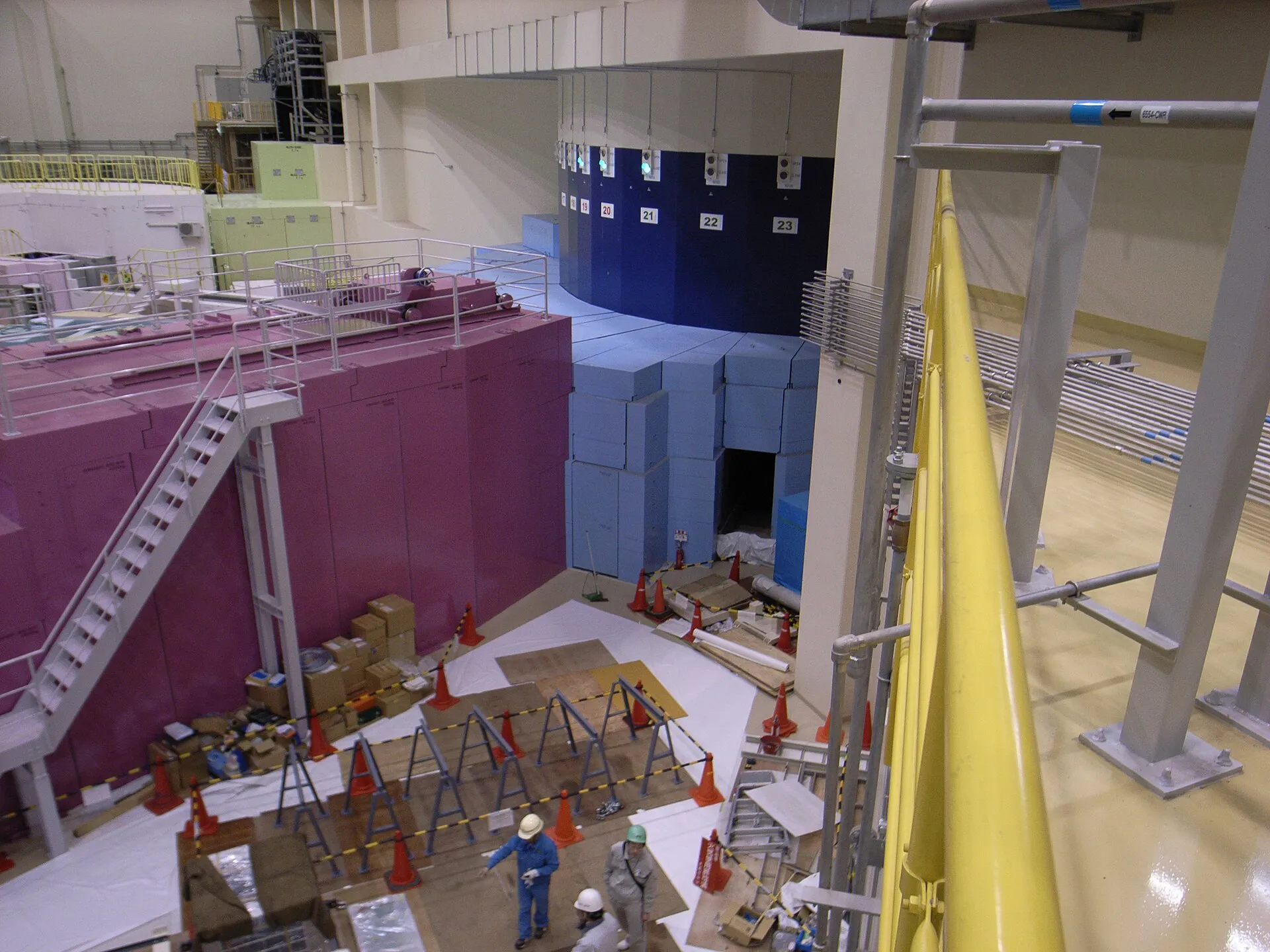
An off-axis (2.5°) beam from J-PARC peaked at 0.6 GeV is measured by the ND280 near detector and by Super-K 295 km away. T2K reported the first indication of νe appearance in 2011 and established it in 2013. In 2020 (Nature) it excluded large regions of δCP at 3σ, favouring near-maximal CP violation. A joint analysis with NOvA appeared in 2025.
Compare all experiments → · World map →
In plain words
T2K fires an intense beam of muon neutrinos from the east coast of Japan to Super-Kamiokande on the other side of the island and counts how many arrive as electron neutrinos. Comparing that rate for neutrinos and antineutrinos is the most direct way to test whether neutrinos and antineutrinos behave differently, the effect known as CP violation.
How the experiment works
Protons from the 30 GeV Main Ring of J-PARC in Tokai produce pions that are focused by three magnetic horns. T2K pioneered the off-axis technique: Super-Kamiokande, 295 km away, sits 2.5° off the beam centre, so it receives a narrow spectrum peaked at about 0.6 GeV, right at the first oscillation maximum. Near the target, the on-axis INGRID detector monitors the beam direction and the off-axis ND280 detector measures flux and interactions with tracking chambers and scintillator in a magnet. ND280 received a major upgrade, installed in 2023–2024, with a finely segmented scintillator cube detector and new time-projection chambers. Since 2020 Super-K has been loaded with gadolinium, improving neutron tagging.
Key results
- 2011: first indication of νe appearance, 6 events at 2.5σ, published a few months after the Tōhoku earthquake had halted J-PARC.
- 2013: observation of νµ → νe appearance at 7.3σ with 28 events, the first observation of an oscillation channel by appearance of a new flavour.
- Precise measurements of θ₂₃ and Δm²₃₂ from muon-neutrino disappearance.
- 2020 (Nature): CP-conserving values of δCP disfavoured at 95 percent confidence, with large regions excluded at 3σ; the data favour near-maximal CP violation.
- October 2025 (Nature): the first joint analysis with NOvA, using ten years of T2K and six years of NOvA data. It reduced the uncertainty on the mass splitting below 2 percent but left the mass ordering open.
Status today
T2K continues with higher beam power and the upgraded near detector. From around the end of the decade the same beam will feed Hyper-Kamiokande. The experiment was founded by Koichiro Nishikawa; Takashi Kobayashi led the beamline construction and served as spokesperson from 2009 to 2015.
Frequently asked questions
Has T2K discovered CP violation?
No. It disfavours CP conservation at about the 2σ level and excludes some δCP values at 3σ. A discovery at 5σ is expected only from Hyper-Kamiokande and DUNE.
Why 2.5 degrees off-axis?
Pion decay kinematics give off-axis neutrinos an almost fixed energy. At 2.5° that energy is about 0.6 GeV, which puts the first oscillation maximum at 295 km.
Original papers
- First resultK. Abe et al. (T2K Collaboration), Indication of Electron Neutrino Appearance from an Accelerator-produced Off-axis Muon Neutrino Beam, Phys. Rev. Lett. 107, 041801 (2011)DOI 10.1103/PhysRevLett.107.041801arXiv:1106.2822
- DiscoveryK. Abe et al. (T2K Collaboration), Observation of Electron Neutrino Appearance in a Muon Neutrino Beam, Phys. Rev. Lett. 112, 061802 (2014)DOI 10.1103/PhysRevLett.112.061802
- MeasurementK. Abe et al. (T2K Collaboration), Constraint on the matter–antimatter symmetry-violating phase in neutrino oscillations, Nature 580, 339 (2020)DOI 10.1038/s41586-020-2177-0
Related terms
- Neutrino vs antineutrino mode
- Hyper-Kamiokande
- J-PARC Neutrino Beam
- Off-axis beam (facility)
- Super-Kamiokande
People
- Arthur B. McDonald
- Atsuto Suzuki
- Kam-Biu Luk
- Kōichirō Nishikawa
- Masataka Fukugita
- Takaaki Kajita
- Wang Yifang
- Gianluigi Fogli
- Kate Scholberg
- M. Concepción (Concha) González-García
- Vernon Duane Barger
- Yōichirō Suzuki
- Makoto Kobayashi
- Stephen J. Parke
- Francesca Di Lodovico
- Mark D. Messier
Latest research on this topic
- Performance of 3D segmented detector SuperFGD in the T2K neutrino beamKudenko, Yury · 13 October 2026
- Search for Heavy Neutral Leptons in T2K ExperimentGorshanov, K.Yu. · 22 September 2026
- Particle Identification in Highly Segmented Detector SuperFGD of the T2K Neutrino ExperimentShvartsman, A.S. · 22 September 2026
- Selection of Muon Neutrino Charge-Current Interactions with Single Pion Production in the Upgraded Near Detector ND280 of the T2K ExperimentFedorova, D.V., Izmaylov, A.O. · 22 September 2026
- Commissioning and Performance of the Time-of-Flight Detector for the T2K Neutrino Oscillation ExperimentAlt, C., Amziane, L., Baudis, N. et al. · 17 September 2026
- First double-differential measurement of pionless charged-current muon neutrino interactions using kinematic imbalance observables on carbon and oxygen with the T2K experimentT2K Collaboration · 12 July 2026
On the timeline
- 2011T2K finds hints of electron-neutrino appearance
- 2015Breakthrough Prize honours five oscillation experiments
- 2020T2K constrains CP violation in neutrinos
- 2025NOvA and T2K publish a joint analysis
Mentioned in 143 pages
Lessons 7
FAQ 2
Comparisons 4
Milestones 18
- 1960 · Proposals for accelerator neutrino beams
- 1962 · Maki, Nakagawa and Sakata introduce neutrino mixing
- 1986 · Fukugita and Yanagida propose leptogenesis
- 1988 · Nobel Prize for the muon neutrino
- 1996 · Super-Kamiokande begins operation
- 1999 · K2K starts the first long-baseline experiment
- 2011 · Double Chooz gives the first reactor hint of θ₁₃
- 2011 · T2K finds hints of electron-neutrino appearance
10 more
- 2012 · Daya Bay discovers a non-zero θ₁₃
- 2012 · RENO confirms θ₁₃
- 2015 · Breakthrough Prize honours five oscillation experiments
- 2016 · NOvA reports its first oscillation results
- 2020 · Hyper-Kamiokande construction is approved
- 2020 · T2K constrains CP violation in neutrinos
- 2023 · FASER detects neutrinos from a collider
- 2025 · Hyper-Kamiokande cavern excavation completed
- 2025 · NOvA and T2K publish a joint analysis
- 2026 · JUNO sees a first hint of the mass ordering
People 27
- Antonio Ereditato
- Atsuto Suzuki
- Francesca Di Lodovico
- Henry W. Sobel
- Kam-Biu Luk
- Kate Scholberg
- Kōichirō Nishikawa
- Leon M. Lederman
19 more
- Lev Landau
- M. Concepción (Concha) González-García
- Makoto Kobayashi
- Masataka Fukugita
- Masato Shiozawa
- Melvin Schwartz
- Nicola Cabibbo
- Simon van der Meer
- Soo-Bong Kim
- Stanislav Pavlovich Mikheyev
- Stephen J. Parke
- Takaaki Kajita
- Takashi Kobayashi
- Thomas Schwetz
- Toshihide Maskawa
- Tsuyoshi Nakaya
- Vernon Duane Barger
- Wang Yifang
- Yōichirō Suzuki
Terms 85
- Accelerator Long-baseline experiments
- Accelerator neutrino beams
- Accelerator neutrinos
- Antiparticle
- Appearance measurement
- Appearance vs disappearance
- Atmospheric & Large water Cherenkov experiments
- Atmospheric mass splitting Δm²31
77 more
- Axial form factor and axial mass
- Baseline
- Beta beam
- Charge conjugation
- Charged-current interaction
- Coherent pion production
- Conventional neutrino beam
- CP violation
- CP-Violating phase δCP
- CP-Violation sensitivity (δCP)
- CPT theorem
- Cross sections
- Daya Bay
- Decay pipe & beam absorber
- DeepCore & IceCube upgrade
- Double Chooz
- Electronvolt
- Experiments & detectors
- Exposure
- Feldman–Cousins method
- Flavour symmetries
- GeV scale
- Global fit
- Heavy neutral lepton
- Hyper-Kamiokande
- Interaction cross section
- Intrinsic beam contamination and wrong-sign background
- J-PARC Neutrino Beam
- K2K
- Kamioka Observatory
- L/E (baseline over energy)
- Lepton generation
- Leptonic CP violation
- Magnetic horn
- Major neutrino beamlines
- Mass-ordering sensitivity
- Matter-antimatter asymmetry
- Maximum-likelihood fit
- Michel electron
- MINERvA
- Mixing angle θ13
- Mixing angle θ23
- Monte Carlo simulation & event generators
- Muon neutrino
- NA61/SHINE
- Near and far detectors
- Near-to-far extrapolation
- Neutral-current interaction
- Neutrino energy reconstruction
- Neutrino kinetic energy
- Neutrino mass ordering
- Neutrino portal
- Neutrino vs antineutrino mode
- Neutrino-nucleus scattering regimes
- Non-standard interactions
- NOvA
- Nuclear models for neutrino scattering
- Off-axis beam
- Off-axis beam (facility)
- Oscillation observables
- Oscillation parameter degeneracies
- Photodetection
- Production target
- Protons on target (POT)
- Quasi-elastic scattering
- Resonance production
- Segmented scintillator tracking calorimeter
- Signal-to-background ratio
- Silicon photomultiplier (SiPM)
- Statistical uncertainty
- Super-Kamiokande
- Symmetries and their violation
- T violation in oscillations
- Units and relativistic kinematics
- Water Cherenkov detector
- Wavelength shifter
- θ23 octant
Last updated: · Editorial standard
Cite this page
Text
Neutrino Atlas (2026). “T2K”. Retrieved 22 November 2026, from https://neutrino-atlas.com/terms/t2k/BibTeX
@misc{neutrinoatlas2026termst2k,
  title        = {T2K},
  author       = {{Neutrino Atlas}},
  year         = {2026},
  url          = {https://neutrino-atlas.com/terms/t2k/},
  note         = {Accessed 2026-11-22},
  language     = {english}
}