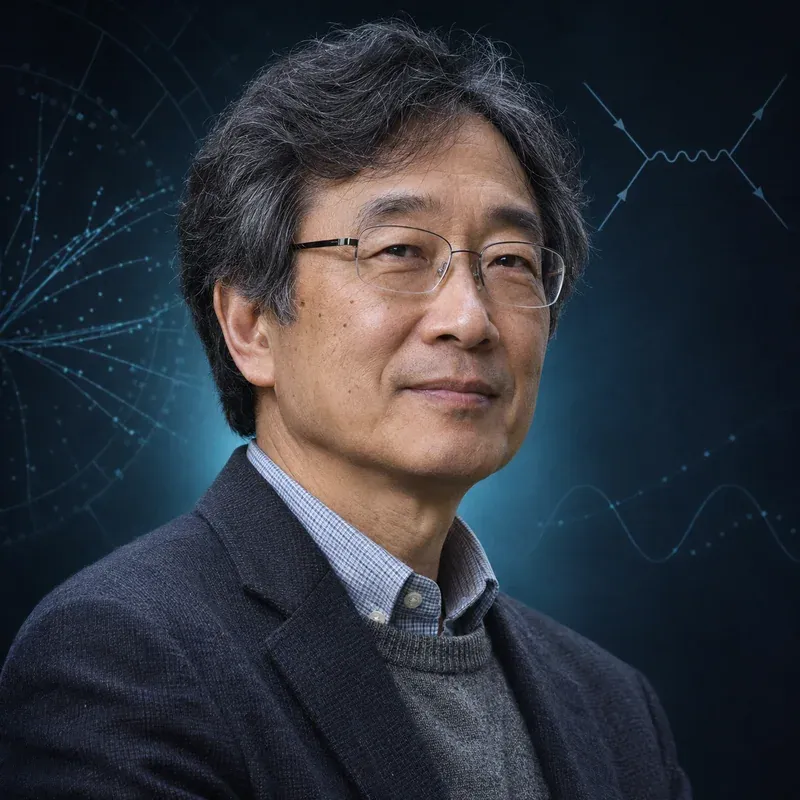
 Illustration
Soo-Bong Kim
Kim built and leads RENO, a reactor antineutrino experiment at the Hanbit (Yonggwang) nuclear power plant in Korea, which began taking data on 1 August 2011. In April 2012 RENO independently confirmed the non-zero theta13 reported by Daya Bay. Earlier he was a member of the Kamiokande-II collaboration that detected neutrinos from SN 1987A.
- Born
- 1960
Busan, South Korea - Nationality
- South Korean
- Field
- Experimental particle physics
- Institutions
- Seoul National University, University of Pennsylvania, University of Michigan, Boston University
Early life and education
Soo-Bong Kim was born in 1960 and grew up in Busan, South Korea. He graduated from Dongrae High School in 1979 and studied physics at Seoul National University, earning his bachelor's degree in 1983 and a master's degree there. He then went to the University of Pennsylvania, where he received his PhD in 1989 under Alfred Mann, one of the American partners in the Japanese Kamiokande experiment.
From Kamiokande to the top quark
Kim's doctoral work took him to Kamiokande-II, where he measured solar neutrinos and helped confirm the deficit known as the solar neutrino problem. He was also part of the collaboration that recorded the neutrino burst from SN 1987A and shared the 1988 Asahi Prize and the 1989 Bruno Rossi Prize awarded to the Kamiokande-II team.
As a postdoctoral fellow and research investigator at the University of Michigan, and from 1996 at Boston University, he worked on the CDF experiment at Fermilab's Tevatron, which discovered the top quark in 1994–95, and on Super-Kamiokande, whose 1998 atmospheric-neutrino results established neutrino oscillations. He later contributed to K2K, the first accelerator long-baseline oscillation experiment. In 1998 he joined Seoul National University.
Building RENO
By the mid-2000s two of the three mixing angles in the PMNS matrix were known, but the third, θ₁₃, had only an upper limit from CHOOZ. Its value mattered because leptonic CP violation in oscillations requires θ₁₃ to be non-zero. Reactor experiments offered a clean test: over about a kilometre, electron antineutrinos from a power plant should disappear slightly in proportion to sin²2θ₁₃, without matter effects or dependence on the CP phase.
In 2006 Kim began building RENO, the Reactor Experiment for Neutrino Oscillation, at the Hanbit (formerly Yonggwang) nuclear power plant on Korea's west coast, which has six reactors in a line. RENO uses two identical detectors, a near one about 300 metres and a far one about 1.4 kilometres from the reactor line, each filled with gadolinium-loaded liquid scintillator to tag inverse beta decay events. Comparing the near and far detectors cancels most uncertainties in the reactor flux. The facility was completed in early 2011 and began data taking on 1 August 2011.
Key results
In March 2012 the Daya Bay experiment in China, led by Wang Yifang and Kam-Biu Luk, announced a non-zero θ₁₃. Less than a month later RENO reported an independent observation of reactor antineutrino disappearance with a significance of about 4.9 standard deviations, giving sin²2θ₁₃ of about 0.1. Kim commented at the time: “This surprisingly large value of theta one-three will strongly promote the next round of neutrino experiments.” The two results together settled the question and opened the way to the CP-violation and mass-ordering programmes of T2K, NOvA, DUNE and JUNO. RENO later measured the effective mass-squared difference and reported an excess of events around 5 MeV in the reactor spectrum, the so-called 5 MeV bump.
In 2016 Kim shared the Bruno Pontecorvo Prize with Wang Yifang and Koichiro Nishikawa, and in 2020 he received the Ho-Am Prize in Science.
Known for
- Leader of RENO
- Independent confirmation of non-zero theta13 (2012)
- Kamiokande-II / Super-K member
- Pontecorvo Prize 2016
- Ho-Am Prize 2020
Chronology
- 1989PhD, University of Pennsylvania
- 2006Begins building RENO
- 2011RENO begins data taking (1 August)
- 2012RENO measures theta13
- 2016Bruno Pontecorvo Prize
- 2020Ho-Am Prize in Science
Original papers
- RENO Collaboration (J. K. Ahn et al.), Observation of reactor electron antineutrinos disappearance in the RENO experiment, Phys. Rev. Lett. 108, 191802 (2012)DOI 10.1103/PhysRevLett.108.191802
Experiments
Connected people
Frequently asked questions
What did RENO measure?
RENO measured the disappearance of reactor electron antineutrinos at Hanbit in South Korea and in April 2012 independently confirmed that the mixing angle θ₁₃ is non-zero.
Was Soo-Bong Kim involved in the discovery of neutrino oscillations?
Yes. He was a member of the Super-Kamiokande collaboration, whose atmospheric-neutrino results of 1998 established oscillations, and earlier of Kamiokande-II.
Which prizes has Kim received?
The Bruno Pontecorvo Prize (2016) and the Ho-Am Prize in Science (2020), as well as shares of collaboration prizes for Kamiokande-II and Super-Kamiokande.
On the timeline
Mentioned in 5 pages
People 1
Terms 2
Last updated: · Editorial standard
Cite this page
Text
Neutrino Atlas (2026). “Soo-Bong Kim”. Retrieved 22 November 2026, from https://neutrino-atlas.com/people/soo-bong-kim/BibTeX
@misc{neutrinoatlas2026peoplesoobongkim,
  title        = {Soo-Bong Kim},
  author       = {{Neutrino Atlas}},
  year         = {2026},
  url          = {https://neutrino-atlas.com/people/soo-bong-kim/},
  note         = {Accessed 2026-11-22},
  language     = {english}
}