CHOOZ
A 1990s reactor experiment in France that set the first strong upper limit on θ₁₃.
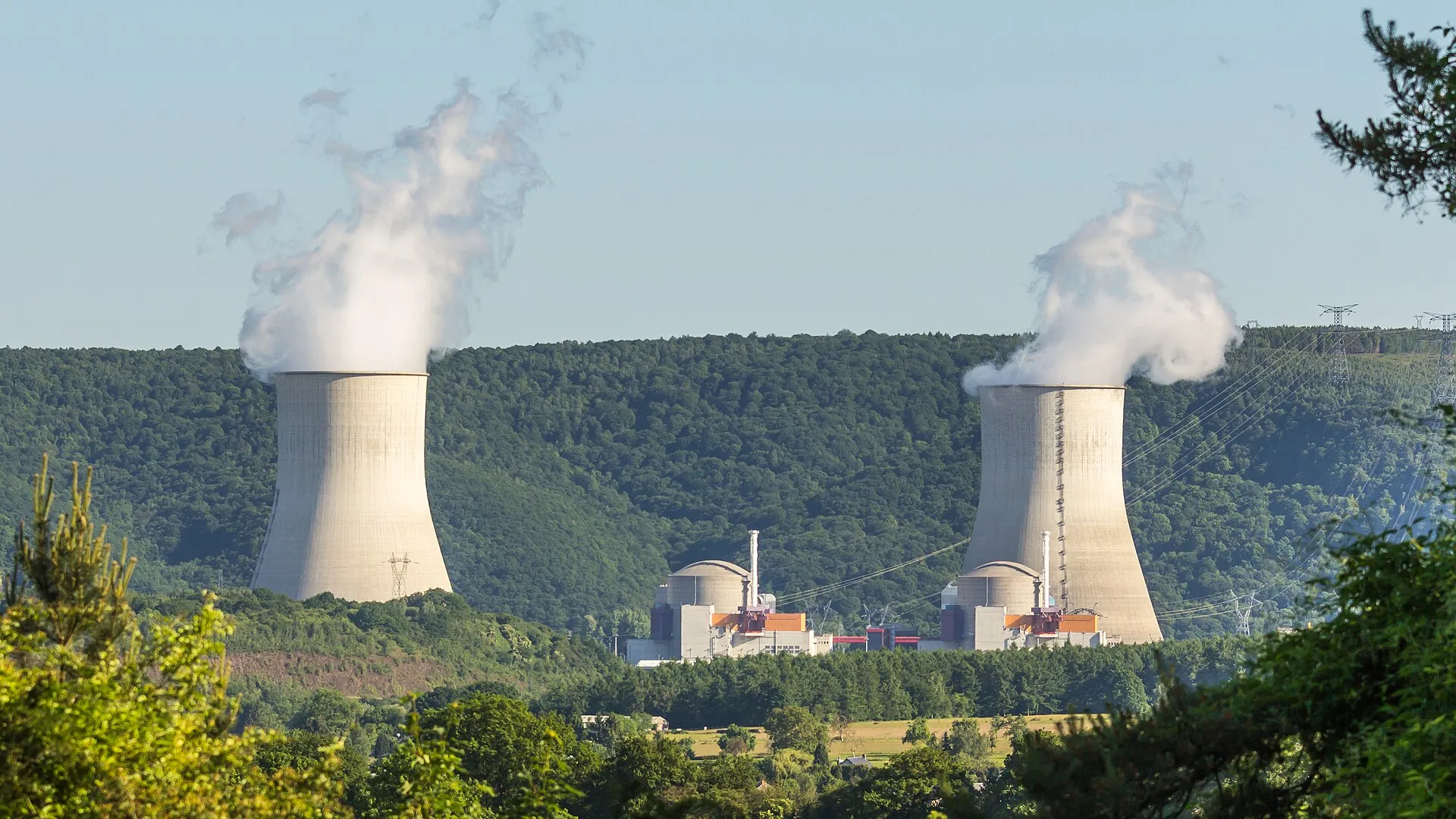
A 5-tonne Gd-loaded scintillator detector about 1 km from the Chooz reactors, in an underground site, saw no ν̄e deficit. The resulting limit (sin²2θ₁₃ ≲ 0.1–0.15) stood for over a decade and also excluded νµ → νe as the atmospheric oscillation channel.
Compare all experiments → · World map →
In plain words
A nuclear reactor is a steady, intense source of electron antineutrinos. If some of them change flavour on the way, a detector placed about a kilometre away should count fewer than expected. CHOOZ was built to look for exactly that deficit. It found none, and that "nothing" turned out to be one of the most quoted numbers in neutrino physics for more than a decade.
How the detector works
The detector sat in an existing tunnel under about 300 metres water equivalent of rock, roughly 1 km from the two new pressurised-water reactors of the Chooz B power station in the French Ardennes. Its core was about 5 tonnes of liquid scintillator doped with gadolinium, surrounded by an undoped scintillator layer and a veto. Antineutrinos were recorded through inverse beta decay: a prompt positron flash followed some 30 microseconds later by the gamma cascade from neutron capture on gadolinium. This delayed coincidence is the classic reactor signature.
A lucky circumstance helped. Data taking ran from April 1997 to July 1998, while the reactors were being commissioned and only gradually reached full power. CHOOZ could therefore measure its background with the reactors off or at low power, something later experiments at running plants could rarely do.
Key results
The ratio of observed to expected events was consistent with one, with an uncertainty of roughly 4 percent. For the atmospheric mass splitting this excluded θ₁₃ values above sin²2θ₁₃ ≈ 0.10–0.15 at 90 percent confidence, depending on the exact value of Δm². The same data ruled out νµ → νe as the main channel behind the atmospheric anomaly seen by Super-Kamiokande, pointing instead to νµ → ντ. The final analysis appeared in the European Physical Journal C in 2003.
Why it matters for neutrino physics
For years, global analyses treated θ₁₃ as "small, perhaps zero" largely because of CHOOZ. The limit shaped the design of the next generation: to see a deficit of a few percent, a single detector was not enough, because the reactor flux itself was only known to a few percent. This led to the near and far detector concept of Double Chooz, Daya Bay and RENO.
Frequently asked questions
Why is a null result from CHOOZ so important?
It set the best upper limit on θ₁₃ for over ten years and told theorists that the third mixing angle is much smaller than the other two. It also fixed the sensitivity that successor experiments had to beat.
Is CHOOZ the same site as Double Chooz?
Yes. Double Chooz reused the original underground laboratory for its far detector and added a near detector closer to the reactors.
Original papers
- First resultM. Apollonio et al. (CHOOZ Collaboration), Initial results from the CHOOZ long baseline reactor neutrino oscillation experiment, Phys. Lett. B 420, 397 (1998)arXiv:hep-ex/9711002
- Final resultM. Apollonio et al. (CHOOZ Collaboration), Search for neutrino oscillations on a long base-line at the CHOOZ nuclear power station, Eur. Phys. J. C 27, 331 (2003)DOI 10.1140/epjc/s2002-01127-9arXiv:hep-ex/0301017
Related terms
Latest research on this topic
- Determination of Background Components in the DOUBLE CHOOZ Detectors for Both Reactors in the Off-Mode: Analysis of the Residual Spectrum of Reactor AntineutrinosVlasenko, A.P., Sinev, V.V. · 12 July 2026
- Prospect of the NUCLEUS experiment at Chooz for coherent elastic neutrino-nucleus scattering and new physics searchesNUCLEUS Collaboration · 25 March 2026
On the timeline
- 1998CHOOZ sees no reactor antineutrino disappearance
- 2011Double Chooz gives the first reactor hint of θ₁₃
Mentioned in 19 pages
Milestones 8
- 1988 · Kamiokande finds an atmospheric neutrino anomaly
- 1995 · Nobel Prize for neutrino detection
- 1998 · CHOOZ sees no reactor antineutrino disappearance
- 1998 · Super-Kamiokande discovers neutrino oscillation
- 2002 · KamLAND sees reactor antineutrinos disappear
- 2011 · Double Chooz gives the first reactor hint of θ₁₃
- 2011 · T2K finds hints of electron-neutrino appearance
- 2012 · RENO confirms θ₁₃
Last updated: · Editorial standard
Cite this page
Text
Neutrino Atlas (2026). “CHOOZ”. Retrieved 22 November 2026, from https://neutrino-atlas.com/terms/chooz/BibTeX
@misc{neutrinoatlas2026termschooz,
  title        = {CHOOZ},
  author       = {{Neutrino Atlas}},
  year         = {2026},
  url          = {https://neutrino-atlas.com/terms/chooz/},
  note         = {Accessed 2026-11-22},
  language     = {english}
}