Double Chooz
The successor to CHOOZ with near and far detectors, which gave early indications of non-zero θ₁₃.
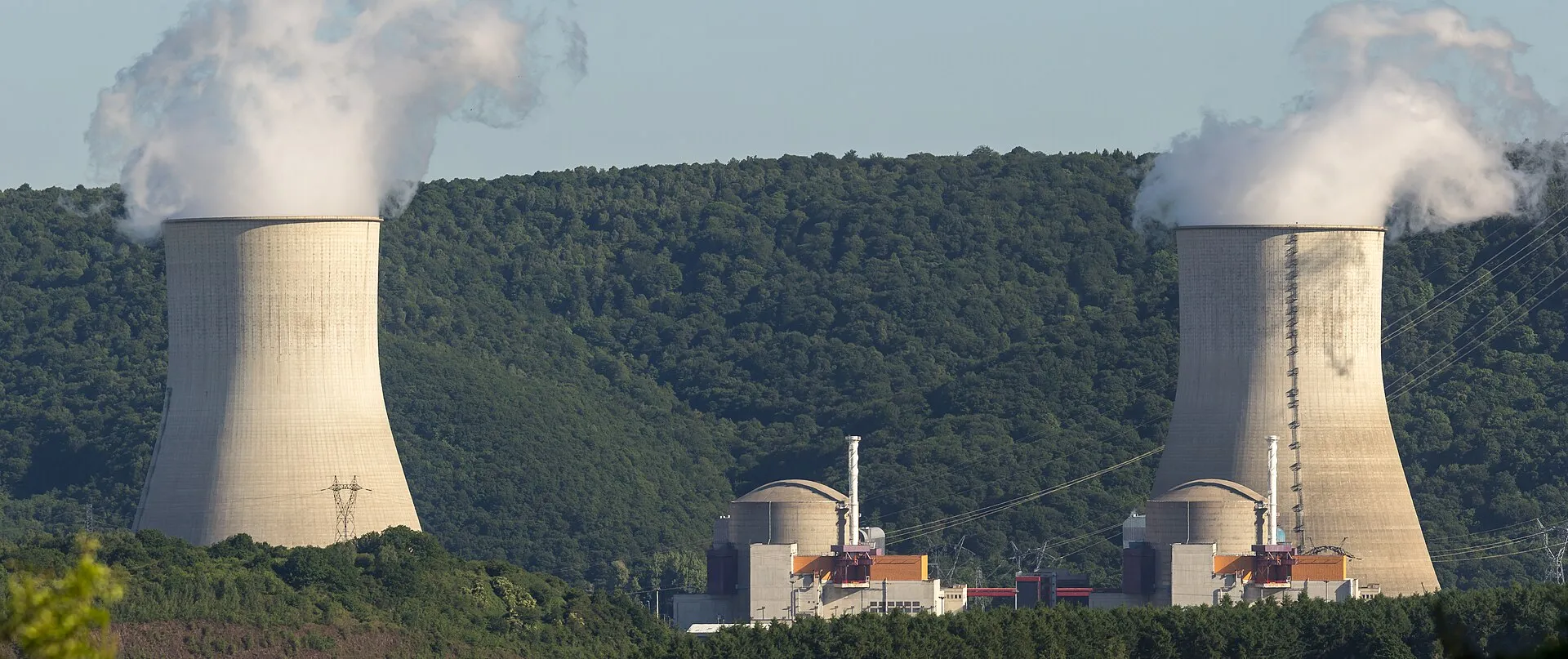
With improved Gd-doped scintillator detectors at about 400 m and 1050 m, Double Chooz reported a ν̄e deficit in late 2011, consistent with non-zero θ₁₃. Its precise neutron-capture studies also contributed to understanding the 5 MeV bump.
Compare all experiments → · World map →
In plain words
Double Chooz returned to the CHOOZ site with a simple idea: if you cannot know exactly how many antineutrinos a reactor emits, measure them twice. One detector close to the reactors counts what comes out; an identical one farther away counts what is left. Their ratio cancels most uncertainties of the source and of the detectors themselves.
How the detector works
Each detector is a set of nested vessels. At the centre, about 10 m³ of gadolinium-doped liquid scintillator forms the neutrino target. It is surrounded by an undoped "gamma catcher" that contains escaping gamma rays, a non-scintillating oil buffer carrying 390 photomultiplier tubes, an inner liquid veto and an outer plastic-scintillator veto against cosmic muons. The far detector, in the old CHOOZ laboratory at about 1050 m, started in April 2011. The near detector, about 400 m from the cores, joined at the end of 2014.
Key results
- November 2011: first report of an electron-antineutrino deficit using the far detector alone, published in 2012 with sin²2θ₁₃ = 0.086 ± 0.041 (stat) ± 0.030 (syst). Together with T2K this was an early hint of non-zero θ₁₃, shortly before the 5σ discovery by Daya Bay.
- Independent θ₁₃ measurements using neutron captures on hydrogen instead of gadolinium, which doubled the usable target and tested the systematics.
- Short periods with both reactors switched off, which allowed a direct measurement of the background.
- A clear observation of the spectral excess around 5 MeV, the 5 MeV bump.
- A final result in Nature Physics (2020): sin²2θ₁₃ = 0.105 ± 0.014, obtained with a "total neutron capture" method that counts captures on gadolinium, hydrogen and carbon together.
Why it matters for neutrino physics
Double Chooz had the smallest reactor power and only two cores, so its statistics never matched Daya Bay. Its value lay in methods: the hydrogen-capture analysis, the reactor-off data and the total-capture technique reduced detector-related uncertainties in ways now used by others. Its precise neutron-capture studies also helped to quantify how well reactor flux models describe the measured reactor spectrum. Data taking ended in 2018.
Frequently asked questions
Did Double Chooz discover θ₁₃?
It gave one of the first indications in late 2011, but at low significance. The 5σ discovery came from Daya Bay in March 2012, followed by RENO.
Why does the final value differ from Daya Bay?
The Double Chooz value of 0.105 ± 0.014 is about 1.4 standard deviations above the Daya Bay value, a difference compatible with statistical fluctuations.
Original papers
- First resultY. Abe et al. (Double Chooz Collaboration), Indication of Reactor ν̄e Disappearance in the Double Chooz Experiment, Phys. Rev. Lett. 108, 131801 (2012)DOI 10.1103/PhysRevLett.108.131801arXiv:1112.6353
- Final resultH. de Kerret et al. (Double Chooz Collaboration), Double Chooz θ13 measurement via total neutron capture detection, Nature Phys. 16, 558 (2020)DOI 10.1038/s41567-020-0831-yarXiv:1901.09445
Related terms
People
Latest research on this topic
- Determination of Background Components in the DOUBLE CHOOZ Detectors for Both Reactors in the Off-Mode: Analysis of the Residual Spectrum of Reactor AntineutrinosVlasenko, A.P., Sinev, V.V. · 12 July 2026
On the timeline
Mentioned in 34 pages
Milestones 6
Terms 20
- 5 MeV bump
- Appearance vs disappearance
- CHOOZ
- Daya Bay
- Flavour symmetries
- Gadolinium loading
- Inverse beta decay
- Inverse beta decay (IBD)
12 more
- Lorentz and CPT violation in neutrinos
- Mixing angle θ13
- Near and far detectors
- Nuclear reactors as neutrino sources
- NUCLEUS
- Oscillation observables
- Oscillation parameter degeneracies
- Rate vs shape analysis
- Reactor antineutrino spectrum
- Reactor antineutrinos
- Reactor neutrino experiments
- Two-flavour approximation
Last updated: · Editorial standard
Cite this page
Text
Neutrino Atlas (2026). “Double Chooz”. Retrieved 22 November 2026, from https://neutrino-atlas.com/terms/double-chooz/BibTeX
@misc{neutrinoatlas2026termsdoublechooz,
  title        = {Double Chooz},
  author       = {{Neutrino Atlas}},
  year         = {2026},
  url          = {https://neutrino-atlas.com/terms/double-chooz/},
  note         = {Accessed 2026-11-22},
  language     = {english}
}