Palo Verde
A reactor experiment in Arizona (1998–2000) that, like CHOOZ, found no ν̄e disappearance at baselines near 800 m.
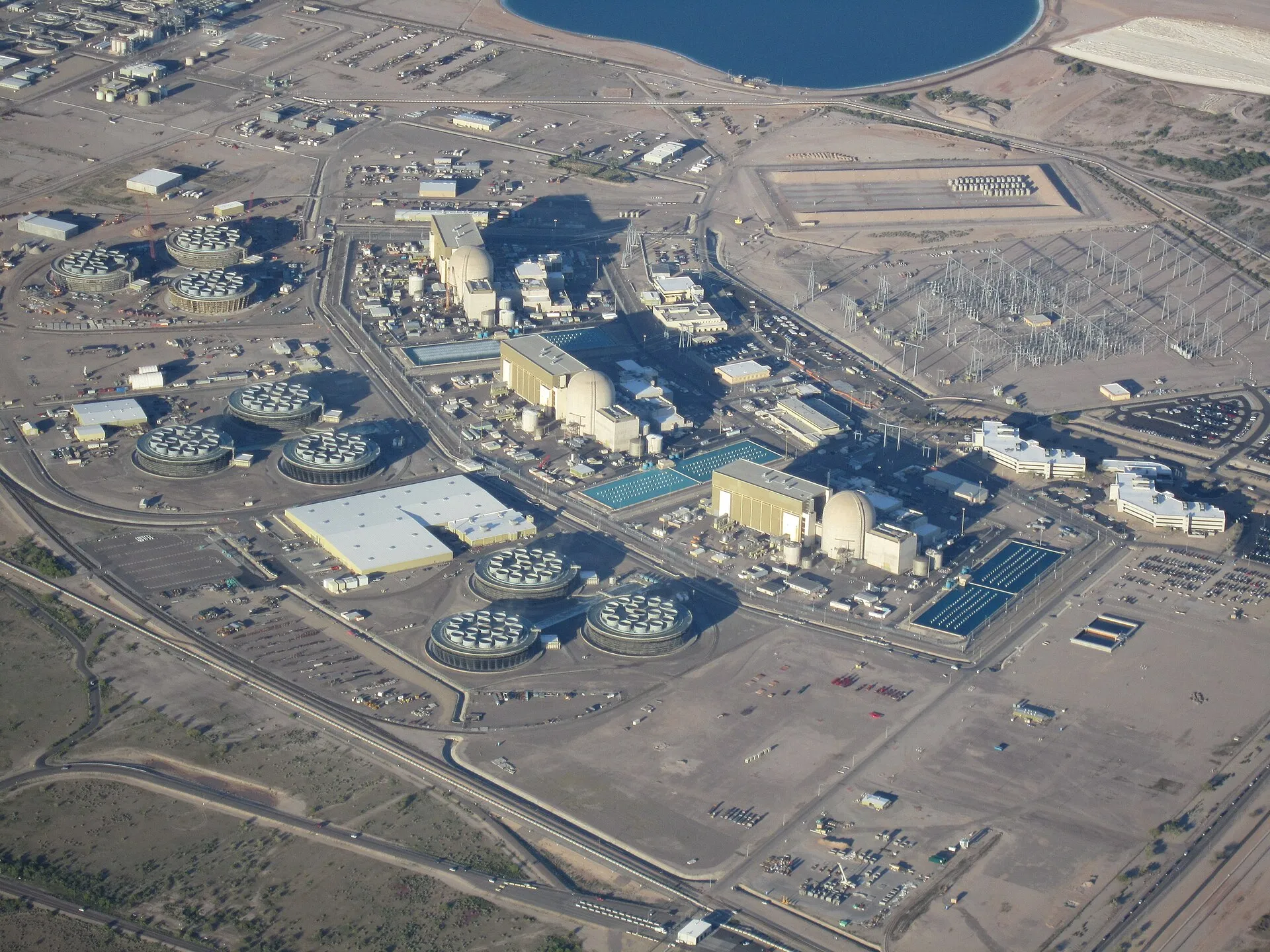
Palo Verde used 11.3 t of gadolinium-loaded liquid scintillator in 66 acrylic cells, 750 m from one and 890 m from two reactors of the Palo Verde Nuclear Generating Station. It sat under only 32 metres water equivalent, so segmentation and a muon veto were essential. With 350 days of data it excluded ν̄e → ν̄x oscillation for Δm² > 1.1 × 10⁻³ eV² at maximal mixing.
Compare all experiments → · World map →
In plain words
By the late 1990s the atmospheric neutrino anomaly pointed to a mass splitting of a few times 10⁻³ eV². For reactor antineutrinos of a few MeV, that splitting would cause a deficit about a kilometre from the core. Palo Verde, in the Arizona desert, was one of two experiments built to look for it. The other was CHOOZ in France.
How the detector works
The Palo Verde power station has three large pressurised-water reactors. The detector sat 890 m from two of them and 750 m from the third, in an underground bunker with only 32 metres water equivalent of overburden. Cosmic-ray muons were therefore far more frequent than at CHOOZ. To cope, the 11.3 tonnes of gadolinium-loaded liquid scintillator were divided into 66 long acrylic cells, read out at both ends, and surrounded by water shielding and a muon veto.
An inverse beta decay event left a positron signal plus its two annihilation gammas in neighbouring cells, followed by gammas from neutron capture on gadolinium. Requiring this pattern in a segmented detector suppressed backgrounds. Because the three reactors were refuelled one at a time, the experiment could compare periods with different reactor power.
Key results
Between September 1998 and July 2000 the experiment collected 350 days of data, including about 108 days with one reactor off. The observed rate matched the expectation. The final analysis excluded ν̄e → ν̄x oscillation for Δm² > 1.1 × 10⁻³ eV² at maximal mixing and for sin²2θ > 0.17 at large Δm².
Why it matters
Together with CHOOZ, Palo Verde showed that the atmospheric anomaly was not νµ → νe oscillation, and it bounded the mixing angle later called θ₁₃. The collaboration was led by Felix Boehm and included Giorgio Gratta, whose next reactor project, KamLAND, went on to observe oscillation at much longer distances.
Frequently asked questions
Why was Palo Verde built at such a shallow site?
No deep site existed near the reactors. The team relied on segmentation, shielding and a veto to handle the higher muon rate.
How does Palo Verde relate to Daya Bay?
Palo Verde and CHOOZ set upper limits on θ₁₃. Daya Bay and its contemporaries used near and far detectors to measure it in 2012.
Original papers
- First resultF. Boehm et al., Search for Neutrino Oscillations at the Palo Verde Nuclear Reactors, Phys. Rev. Lett. 84, 3764 (2000)DOI 10.1103/PhysRevLett.84.3764arXiv:hep-ex/9912050
- Final resultF. Boehm et al., Final results from the Palo Verde neutrino oscillation experiment, Phys. Rev. D 64, 112001 (2001)DOI 10.1103/PhysRevD.64.112001arXiv:hep-ex/0107009
Related terms
People
Mentioned in 4 pages
Last updated: · Editorial standard
Cite this page
Text
Neutrino Atlas (2026). “Palo Verde”. Retrieved 22 November 2026, from https://neutrino-atlas.com/terms/palo-verde/BibTeX
@misc{neutrinoatlas2026termspaloverde,
  title        = {Palo Verde},
  author       = {{Neutrino Atlas}},
  year         = {2026},
  url          = {https://neutrino-atlas.com/terms/palo-verde/},
  note         = {Accessed 2026-11-22},
  language     = {english}
}