 Illustration
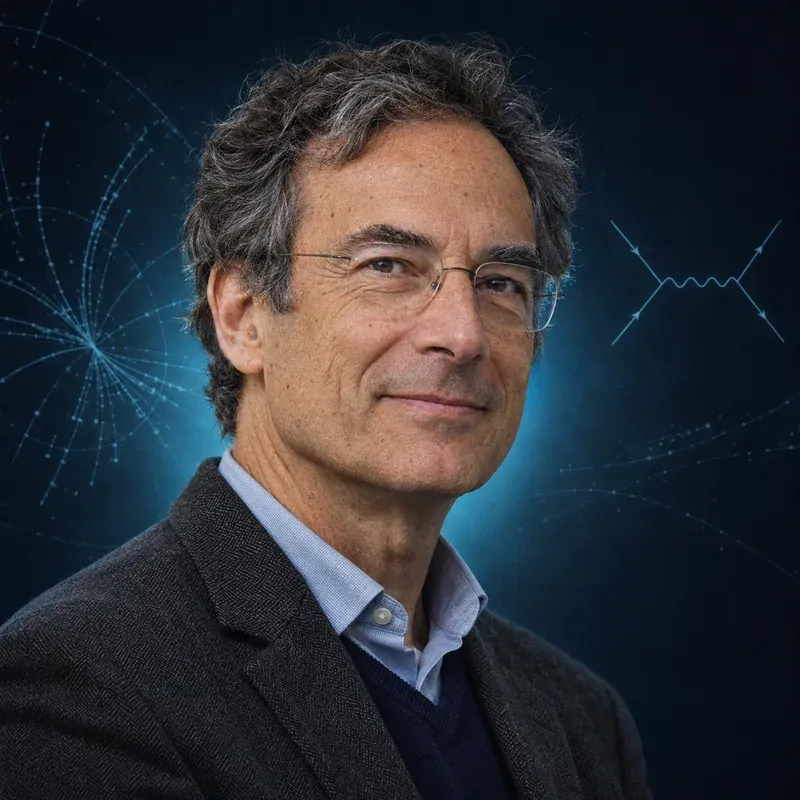
Giorgio Gratta
Gratta's group built the Palo Verde reactor oscillation experiment (1995-2000), started the US component of KamLAND in 1998, and contributed to its reactor-oscillation and geoneutrino results. He is a scientific leader of the EXO programme: EXO-200, a 200 kg enriched-xenon detector taking data from 2011, measured the two-neutrino double beta decay half-life of ¹³⁶Xe and searched for the neutrinoless mode; the planned 5-tonne nEXO is its successor.
- Nationality
- Italian-American
- Field
- Experimental particle physics
- Institutions
- Stanford University
Career
Giorgio Gratta is an experimental physicist at Stanford University, where he is professor of physics and has served as department chair. He began his career in experiments at particle colliders; in 1981 he received the Enrico Persico Prize of the Accademia dei Lincei. At Stanford his group turned to neutrinos and later also to tests of gravity at short distances.
Reactor neutrinos: Palo Verde and KamLAND
From 1995 to 2000 Gratta's group, built and ran the Palo Verde experiment at the nuclear power station near Phoenix. It looked for the disappearance of reactor antineutrinos about 800 metres from the cores, detected through inverse beta decay in a segmented, gadolinium-loaded liquid scintillator. No oscillation was seen, but the limit on the mixing angle θ13 was for years the second best after CHOOZ.
In 1998 the group joined the design of KamLAND in Japan and started its US component. KamLAND, led by Atsuto Suzuki, watched antineutrinos from dozens of Japanese reactors at an average distance of about 180 km. From 2002 it saw the first oscillation of antineutrinos from a terrestrial source, gave the best value of the solar mass splitting Δm²₂₁, and later traced more than one full oscillation cycle. It also made the first observation of geoneutrinos from the Earth's interior. Gratta shared in the 2016 Breakthrough Prize awarded to KamLAND and other oscillation experiments.
Xenon and double beta decay
Since 2000 the group has pursued double beta decay of xenon-136. Early research showed that combining ionisation and scintillation signals in liquid xenon substantially improves energy resolution, the key figure of merit for separating a neutrinoless signal from the ordinary decay. This led to EXO-200, a xenon TPC holding 200 kg of enriched xenon at the WIPP underground site in New Mexico. It began data-taking on 1 June 2011 and quickly made the first observation of two-neutrino double beta decay in ¹³⁶Xe; its half-life of 2.165 × 10²¹ years is among the slowest processes ever measured directly. Its final search for the neutrinoless mode (2019) reached a sensitivity of 5 × 10²⁵ years.
Gratta is a scientific leader of the successor, nEXO, a planned 5-tonne enriched-xenon detector, likely at SNOLAB, designed to reach half-life sensitivities beyond 10²⁸ years.
Known for
- Palo Verde reactor experiment
- US participation in KamLAND
- EXO-200
- nEXO
Chronology
- 1995Palo Verde reactor experiment begins
- 1998Group joins KamLAND design, starts US component
- 2011EXO-200 starts data taking (1 June)
- 2019EXO-200 final 0vbb search, sensitivity 5e25 yr
Experiments
Connected people
Frequently asked questions
What experiments did Giorgio Gratta lead?
His group built the Palo Verde reactor experiment, started the US part of KamLAND, and is central to EXO-200 and the planned nEXO search for neutrinoless double beta decay.
Why xenon for double beta decay?
Xenon-136 decays by double beta emission, can be enriched in large quantities and serves as both source and detector; reading out light and charge together gives good energy resolution.
On the timeline
Mentioned in 7 pages
Last updated: · Editorial standard
Cite this page
Text
Neutrino Atlas (2026). “Giorgio Gratta”. Retrieved 22 November 2026, from https://neutrino-atlas.com/people/giorgio-gratta/BibTeX
@misc{neutrinoatlas2026peoplegiorgiogratta,
  title        = {Giorgio Gratta},
  author       = {{Neutrino Atlas}},
  year         = {2026},
  url          = {https://neutrino-atlas.com/people/giorgio-gratta/},
  note         = {Accessed 2026-11-22},
  language     = {english}
}