2002Discovery
KamLAND sees reactor antineutrinos disappear
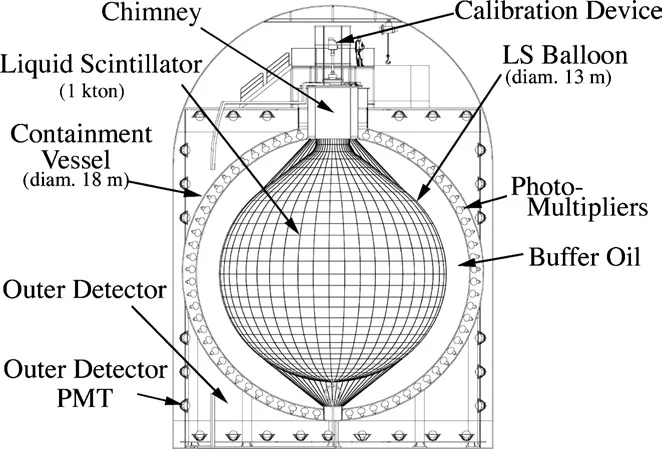
KamLAND, 1,000 tonnes of liquid scintillator in the Kamioka mine, detected antineutrinos from Japanese and Korean reactors at an average distance of about 180 km. In December 2002 it reported only about 61 percent of the expected events, the first observation of reactor antineutrino disappearance. Because the parameters matched the large-mixing-angle solution of the solar problem, it confirmed with an artificial source that solar flavour change is due to oscillation.
- Date
- 2002
- Kind of event
- Discovery
- People involved
- Atsuto Suzuki, Giorgio Gratta
- Experiments
- KamLAND, Kamioka Observatory
The situation before
By the spring of 2002 the solar evidence for flavour change was overwhelming, and global fits pointed to the large-mixing-angle (LMA) solution, with a mass-squared difference of order 10⁻⁵ eV². That value implied something testable on Earth: reactor antineutrinos of a few MeV should oscillate over distances of roughly 100 km. Earlier reactor experiments such as CHOOZ and Palo Verde, at about 1 km, were far too close to see it.
Japan offered an unusual setting. Its many nuclear power plants were clustered at distances of 140 to 210 km from the Kamioka mine, where the old Kamiokande cavity had become free. The Kamioka Liquid-scintillator Antineutrino Detector, KamLAND, placed 1,000 tonnes of liquid scintillator in a transparent balloon there, about 1,000 m underground. It was led by Atsuto Suzuki of Tohoku University, with a US group in which Giorgio Gratta of Stanford played a leading role.
What happened
KamLAND detected antineutrinos through inverse beta decay on protons: a prompt positron flash followed about 200 μs later by the gamma ray from neutron capture. Data taking began in January 2002. The first analysis used 145 days of data between March and October 2002, an exposure of 162 tonne-years.
- Expected without oscillation: 86.8 ± 5.6 events above a threshold of 3.4 MeV, chosen to exclude Earth's own antineutrinos.
- Observed: 54 events, with about one background event.
- Ratio of observed to expected: 0.611 ± 0.085 (stat) ± 0.041 (syst).
The probability that the deficit was a statistical fluctuation was below 0.05 percent. The paper was submitted on 6 December 2002 and published in Physical Review Letters 90, 021802 in January 2003 under the title „First results from KamLAND: evidence for reactor antineutrino disappearance“.
Reaction
The result was the first observation of reactor antineutrino disappearance. Combined with the solar data, it excluded all solar solutions except LMA, leaving a narrow region for Δm²₂₁ and the angle θ12. Because neutrinos from the Sun and antineutrinos from reactors gave consistent parameters, the result also supported CPT symmetry in the lepton sector. Physicists regarded the solar puzzle as settled from two independent directions within eight months: SNO had shown flavour change in April, and KamLAND now showed that oscillation with the expected parameters really occurs, using a source whose flux is known from reactor power records.
Consequences
KamLAND's role then shifted from discovery to precision. In 2004 it reported a distortion of the energy spectrum that traced the oscillation pattern itself, and in 2005 it used the same detector to make the first observation of geoneutrinos from the Earth's interior. Later the detector was converted to KamLAND-Zen for the search for neutrinoless double beta decay. The idea of a reactor experiment at the solar oscillation maximum lives on in JUNO in China, at a baseline of about 53 km.
Frequently asked questions
What did KamLAND discover in 2002?
It observed only about 61 percent of the antineutrinos expected from Japanese and Korean reactors at an average distance of about 180 km, the first observation of reactor antineutrino disappearance.
Why did KamLAND matter for the solar neutrino problem?
Its deficit matched the large-mixing-angle solution of the solar data. A man-made source with a known flux therefore confirmed that solar flavour change is due to neutrino oscillation.
Where is KamLAND?
In the Kamioka mine in Gifu Prefecture, Japan, in the cavity that once held the Kamiokande detector.
Original papers
- DiscoveryK. Eguchi et al. (KamLAND), First results from KamLAND: Evidence for reactor anti-neutrino disappearance, Phys. Rev. Lett. 90, 021802 (2003)DOI 10.1103/PhysRevLett.90.021802
Concepts
Mentioned in 1 page
Last updated: · Editorial standard
Cite this page
Text
Neutrino Atlas (2026). “2002: KamLAND sees reactor antineutrinos disappear”. Retrieved 22 November 2026, from https://neutrino-atlas.com/timeline/2002-kamland-reactor-disappearance/BibTeX
@misc{neutrinoatlas2026landreactordisappearance,
  title        = {2002: KamLAND sees reactor antineutrinos disappear},
  author       = {{Neutrino Atlas}},
  year         = {2026},
  url          = {https://neutrino-atlas.com/timeline/2002-kamland-reactor-disappearance/},
  note         = {Accessed 2026-11-22},
  language     = {english}
}