2001Experiment
Implosion chain destroys most Super-K photomultipliers
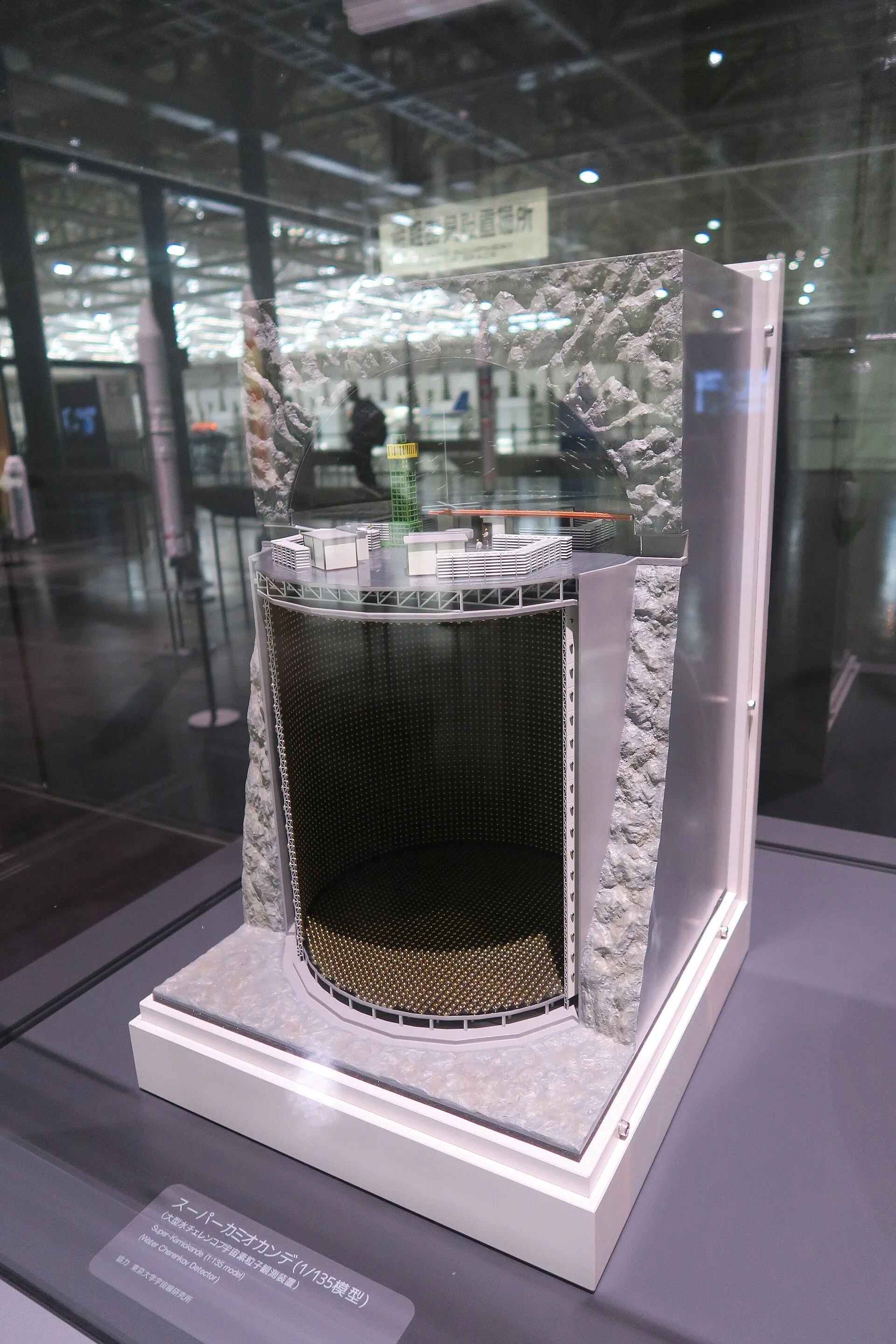
On 12 November 2001, while Super-Kamiokande was being refilled after maintenance, one photomultiplier at the bottom of the tank imploded and the shock wave destroyed about 6,600 more, over half the inner detector. The collaboration resumed in 2002 with the remaining tubes redistributed and protected by acrylic covers and fibreglass shells. Full coverage was restored in 2006.
- Date
- 12 November 2001
- Kind of event
- Experiment
- People involved
- Yōichirō Suzuki
- Experiments
- Super-Kamiokande
The situation before
By 2001 Super-Kamiokande was the most productive neutrino detector in the world. Its 1998 evidence for atmospheric oscillation had changed particle physics, its solar data were being combined with the first SNO results, and since 1999 it had served as the far detector of the K2K beam from KEK, 250 km away. After five years of continuous running the 50,000-tonne tank was drained in the summer of 2001 so that several hundred failed photomultiplier tubes could be replaced and the electronics serviced.
What happened
On 12 November 2001 the tank was being refilled with ultrapure water. A single 50 cm photomultiplier near the bottom imploded. The pressure wave it sent through the water cracked its neighbours, which imploded in turn, and within seconds a chain reaction had destroyed about 6,600 tubes, more than half of the inner detector, together with many outer-detector tubes. Nobody was hurt, but the detector was blind. The likely trigger and the investigation are described on the page about the photomultiplier accident.
Each tube was a large glass bulb made by Hamamatsu, and replacing all of them would take years. The Kamioka leadership under Yoji Totsuka decided almost at once not to wait. The surviving tubes, about 5,200 in the inner detector, were redistributed evenly over the walls, giving about 19 percent photocathode coverage instead of 40 percent. Every inner tube received a fibre-reinforced plastic shell with an acrylic front window, so that a future implosion could not start another chain reaction.
Recovery
- October 2002: the rebuilt detector, called SK-II, resumed data taking at reduced coverage.
- Early 2003: the K2K beam programme restarted with SK-II as far detector.
- 2005–2006: newly produced tubes were installed, and in mid-2006 SK-III began with the original density of about 11,100 inner tubes, all in protective cases.
Physicists at the observatory, including Yoichiro Suzuki, kept the solar and atmospheric programmes running throughout. With half the light collection, the energy threshold for solar neutrinos rose and the resolution worsened, so SK-II results carry larger uncertainties, but no data-taking era was lost entirely.
Why it matters
The accident is remembered as the worst instrumental disaster in neutrino physics and as an example of rapid recovery. It changed detector engineering: large photomultipliers in deep water are now routinely housed in pressure-resistant covers, a lesson carried into Hyper-Kamiokande and other large water detectors. It also showed that a collaboration could keep a flagship experiment scientifically alive while rebuilding it.
Frequently asked questions
When did the Super-Kamiokande accident happen?
On 12 November 2001, while the tank was being refilled after maintenance.
How long did it take to repair Super-Kamiokande?
Data taking resumed in October 2002 with half the tubes. Full coverage was restored in 2006 with the start of SK-III.
Could it happen again?
Since 2002 every inner tube sits in a protective shell designed to stop a single implosion from spreading, which is now standard practice for large water detectors.
Concepts
Last updated: · Editorial standard
Cite this page
Text
Neutrino Atlas (2026). “2001: Implosion chain destroys most Super-K photomultipliers”. Retrieved 22 November 2026, from https://neutrino-atlas.com/timeline/2001-super-k-accident/BibTeX
@misc{neutrinoatlas2026meline2001superkaccident,
  title        = {2001: Implosion chain destroys most Super-K photomultipliers},
  author       = {{Neutrino Atlas}},
  year         = {2026},
  url          = {https://neutrino-atlas.com/timeline/2001-super-k-accident/},
  note         = {Accessed 2026-11-22},
  language     = {english}
}