1998Discovery
Super-Kamiokande discovers neutrino oscillation
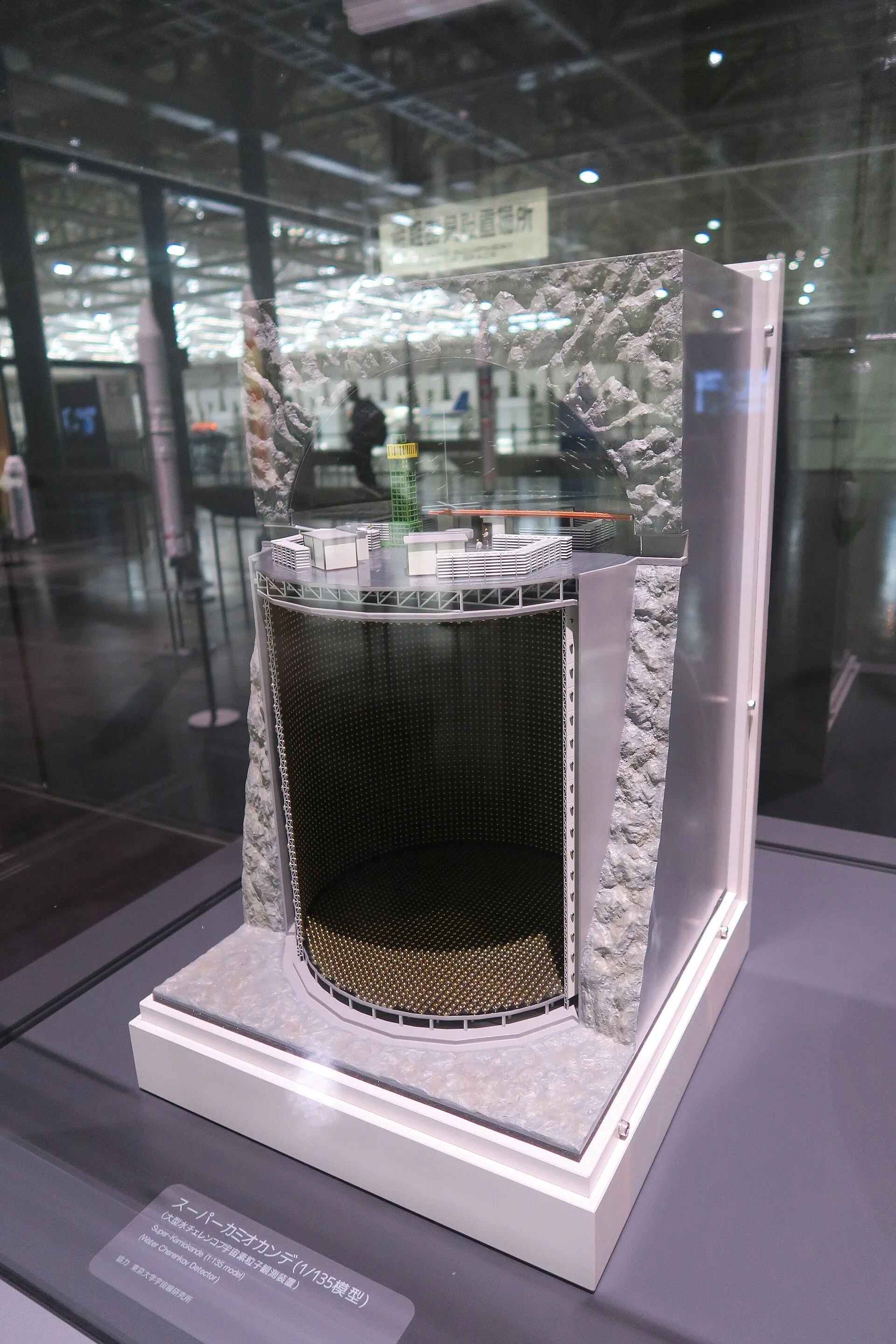
At the Neutrino '98 conference in Takayama on 5 June 1998, Takaaki Kajita presented Super-Kamiokande's evidence that upward-going muon neutrinos, which had crossed the Earth, were strongly depleted compared with downward-going ones. Electron neutrinos showed no such effect. The zenith-angle dependence matched muon-neutrino oscillation with nearly maximal mixing and a mass-squared difference of a few times 10⁻³ eV². It was the first compelling proof that neutrinos have mass, physics beyond the original Standard Model.
- Date
- 5 June 1998
- Kind of event
- Discovery
- People involved
- Takaaki Kajita, Yoji Totsuka, Yōichirō Suzuki, John G. Learned, Henry W. Sobel, Mark D. Messier
- Experiments
- Super-Kamiokande
The situation before
For ten years the atmospheric neutrino anomaly had been an uncomfortable puzzle. Kamiokande and IMB saw about 60 percent of the expected ratio of muon-like to electron-like events, while iron detectors such as Fréjus and NUSEX did not. Kamiokande's 1994 analysis of higher-energy events hinted at a dependence on direction, but with too few events to convince. The Earth offered a natural experiment. Neutrinos coming from above have travelled 10–20 km through the atmosphere, those from below up to 13,000 km through the planet. If muon neutrinos oscillate with a mass-squared difference of around 10⁻³ eV², those from below should be depleted and those from above not.
What happened
Super-Kamiokande had been running since April 1996. By spring 1998 it had collected 535 days of data, an exposure of 33 kilotonne-years, with several thousand contained atmospheric neutrino events. The analysis sorted them by particle type, energy and zenith angle. Electron-like events matched the no-oscillation prediction at all angles. Muon-like events with energies above about 1 GeV, whose direction follows the neutrino's closely, showed a strong up-down asymmetry:
On 5 June 1998, at the Neutrino '98 conference in Takayama, near Kamioka, Takaaki Kajita presented the result to an audience of several hundred physicists. Upward-going muon neutrinos had disappeared, by about half. The data fitted νμ → ντ oscillation with nearly maximal mixing, sin²2θ above 0.82, and a mass-squared difference between about 5 × 10⁻⁴ and 6 × 10⁻³ eV², at 90 percent confidence. A separate analysis of upward-going muons produced in the rock gave a consistent picture. The paper 'Evidence for oscillation of atmospheric neutrinos' was posted in early July and published in Physical Review Letters on 24 August 1998, with Yoji Totsuka as spokesman and collaborators including Yoichiro Suzuki, Henry Sobel, John Learned and Mark Messier.
Reaction
The announcement was received as the first compelling evidence that neutrinos have mass, and therefore that the Standard Model is incomplete. Newspapers around the world carried it on their front pages. The zenith-angle distribution, a direct pattern rather than an overall deficit compared with a flux model, was what convinced most sceptics. The muon-to-electron ratio in iron detectors became less of a concern after Soudan 2 also saw a deficit.
Consequences
- CHOOZ, also in 1998, ruled out oscillation into electron neutrinos, leaving tau neutrinos (or sterile ones, later disfavoured by Super-K itself).
- The accelerator experiments K2K (from 1999) and MINOS (from 2005) confirmed the effect with artificial beams; Super-Kamiokande and OPERA later observed tau neutrino appearance directly.
- Today's value of Δm²₃₂, about 2.5 × 10⁻³ eV², and θ₂₃ near 45° grew directly out of this measurement.
- In 2015 Kajita shared the Nobel Prize in Physics with Arthur B. McDonald 'for the discovery of neutrino oscillations, which shows that neutrinos have mass'.
Totsuka, who led the collaboration through the discovery, died in 2008; Koshiba, who had founded Kamiokande, received a share of the 2002 Nobel Prize.
Frequently asked questions
When was neutrino oscillation discovered?
Super-Kamiokande presented the evidence on 5 June 1998 at the Neutrino '98 conference in Takayama, Japan.
What did Super-Kamiokande see?
About half of the upward-going muon neutrinos, which had crossed the Earth, were missing, while downward-going ones and electron neutrinos matched predictions.
Who received the Nobel Prize for it?
Takaaki Kajita, in 2015, shared with Arthur B. McDonald of SNO.
Original papers
- DiscoveryY. Fukuda et al. (Super-Kamiokande), Evidence for oscillation of atmospheric neutrinos, Phys. Rev. Lett. 81, 1562 (1998)DOI 10.1103/PhysRevLett.81.1562
Concepts
Mentioned in 6 pages
Last updated: · Editorial standard
Cite this page
Text
Neutrino Atlas (2026). “1998: Super-Kamiokande discovers neutrino oscillation”. Retrieved 22 November 2026, from https://neutrino-atlas.com/timeline/1998-super-k-atmospheric-oscillation/BibTeX
@misc{neutrinoatlas2026rkatmosphericoscillation,
  title        = {1998: Super-Kamiokande discovers neutrino oscillation},
  author       = {{Neutrino Atlas}},
  year         = {2026},
  url          = {https://neutrino-atlas.com/timeline/1998-super-k-atmospheric-oscillation/},
  note         = {Accessed 2026-11-22},
  language     = {english}
}