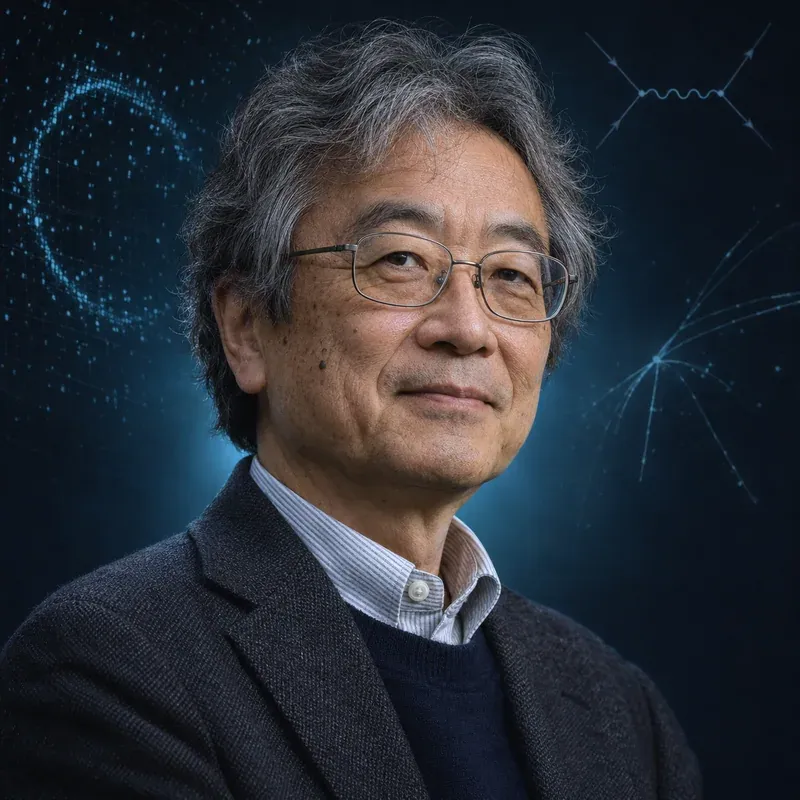
 Illustration
Yōichirō Suzuki
Suzuki is an experimental neutrino physicist at the Kamioka Observatory who played a leading role in Super-Kamiokande, including its solar neutrino programme. His work on neutrino oscillation was recognised with the Pontecorvo Prize (2010) and Cocconi Prize (2013), and he shared the 2016 Breakthrough Prize with Kajita and the Super-K team.
- Born
- 1952
Tokyo, Japan - Nationality
- Japanese
- Field
- Experimental neutrino physics
- Institutions
- Kyoto University (PhD 1979), Kamioka Observatory, Kavli IPMU, Institute for Cosmic Ray Research (ICRR), University of Tokyo
Early life and education
Yōichirō Suzuki was born in Tokyo in 1952 and grew up there; his father was a tailor. He studied physics at Kyoto University and completed his doctorate in 1979 under Kozo Miyake, a pioneer of underground cosmic-ray and proton-decay experiments in Japan. That background in deep-underground detectors set the direction for the rest of his career.
Path to neutrino physics
Suzuki joined the Institute for Cosmic Ray Research (ICRR) of the University of Tokyo and the group around Masatoshi Koshiba and Yoji Totsuka in the Kamioka mine. Kamiokande had been built to look for proton decay, but it became a neutrino observatory: it recorded neutrinos from SN 1987A, measured solar neutrinos in real time and saw an unexpected shortfall of muon-type atmospheric neutrinos. Those results motivated a far larger water Cherenkov detector, Super-Kamiokande, with 50,000 tonnes of ultrapure water, which began taking data in 1996.
Key contributions
Suzuki was one of the central figures of the Super-Kamiokande solar neutrino programme. Super-K detects the high-energy boron-8 neutrinos from the Sun through elastic scattering on electrons; the recoiling electron points back towards the Sun, so the detector can show that the signal really comes from there. The 1998 paper on the first 300 days of data (Physical Review Letters 81, 1158) confirmed with high statistics that the measured flux is well below the prediction of the standard solar model, the long-standing solar neutrino problem.
In 2001 the comparison of Super-K's precise elastic-scattering rate with the charged-current rate measured by SNO showed that electron neutrinos from the Sun change into other flavours on their way to Earth. Together with the atmospheric neutrino result announced by Takaaki Kajita in 1998, this established neutrino oscillation and hence non-zero neutrino mass. The 2010 Bruno Pontecorvo Prize honoured Suzuki for his outstanding contribution to the discovery of atmospheric and solar neutrino oscillations.
Leading Super-Kamiokande
Suzuki became spokesperson of the Super-Kamiokande collaboration in 2002, shortly after the accident of November 2001 in which a chain reaction of imploding photomultipliers destroyed more than half of the detector's sensors. His term covered the restart with roughly half the photomultipliers and the full reconstruction of the detector, and it also spanned the long-baseline programmes K2K and T2K, which use Super-K as their far detector. He handed the role to Masayuki Nakahata in May 2014. He also served as director of the Kamioka Observatory and as deputy director of the Kavli Institute for the Physics and Mathematics of the Universe (Kavli IPMU).
Beyond water Cherenkov detectors, Suzuki promoted liquid xenon as a medium for low-energy solar neutrino and dark-matter searches, an idea that led to the XMASS detector in the Kamioka mine.
Honours
- Asahi Prize (1999)
- Nishina Memorial Prize (2001)
- Bruno Pontecorvo Prize (2010)
- Giuseppe and Vanna Cocconi Prize of the European Physical Society (2013)
- Breakthrough Prize in Fundamental Physics (2016), shared with Takaaki Kajita and the Super-Kamiokande collaboration
Known for
- Super-Kamiokande solar and atmospheric neutrino results
- Bruno Pontecorvo Prize 2010
- Breakthrough Prize 2016 (with Kajita)
Chronology
- 1979PhD, Kyoto University
- 1998Super-K solar and atmospheric results
- 2001Nishina Memorial Prize
- 2010Bruno Pontecorvo Prize
- 2013EPS Cocconi Prize
- 2016Breakthrough Prize in Fundamental Physics
Original papers
- Y. Fukuda et al. (Super-Kamiokande), Measurements of the solar neutrino flux from Super-Kamiokande's first 300 days, Phys. Rev. Lett. 81, 1158 (1998)DOI 10.1103/PhysRevLett.81.1158
Experiments
Connected people
Frequently asked questions
What is Yōichirō Suzuki known for?
For his leading role in Super-Kamiokande, in particular its solar neutrino measurements, which helped prove that neutrinos oscillate, and for serving as the collaboration's spokesperson from 2002 to 2014.
Did Yōichirō Suzuki win a Nobel Prize?
No. The 2015 Nobel Prize in Physics for the discovery of neutrino oscillations went to Takaaki Kajita and Arthur B. McDonald. Suzuki shared the 2016 Breakthrough Prize in Fundamental Physics with Kajita and the Super-Kamiokande team.
How did Super-Kamiokande contribute to solving the solar neutrino problem?
Its precise measurement of solar neutrinos scattering on electrons, compared with SNO's charged-current measurement in 2001, showed that part of the Sun's electron neutrinos arrive as other flavours, which is the signature of oscillation.
On the timeline
- 1989Kamiokande sees solar neutrinos in real time
- 1996Super-Kamiokande begins operation
- 1998Super-Kamiokande discovers neutrino oscillation
- 2001Implosion chain destroys most Super-K photomultipliers
- 2015Breakthrough Prize honours five oscillation experiments
Mentioned in 11 pages
Milestones 5
Terms 1
Last updated: · Editorial standard
Cite this page
Text
Neutrino Atlas (2026). “Yōichirō Suzuki”. Retrieved 22 November 2026, from https://neutrino-atlas.com/people/yoichiro-suzuki/BibTeX
@misc{neutrinoatlas2026peopleyoichirosuzuki,
  title        = {Yōichirō Suzuki},
  author       = {{Neutrino Atlas}},
  year         = {2026},
  url          = {https://neutrino-atlas.com/people/yoichiro-suzuki/},
  note         = {Accessed 2026-11-22},
  language     = {english}
}