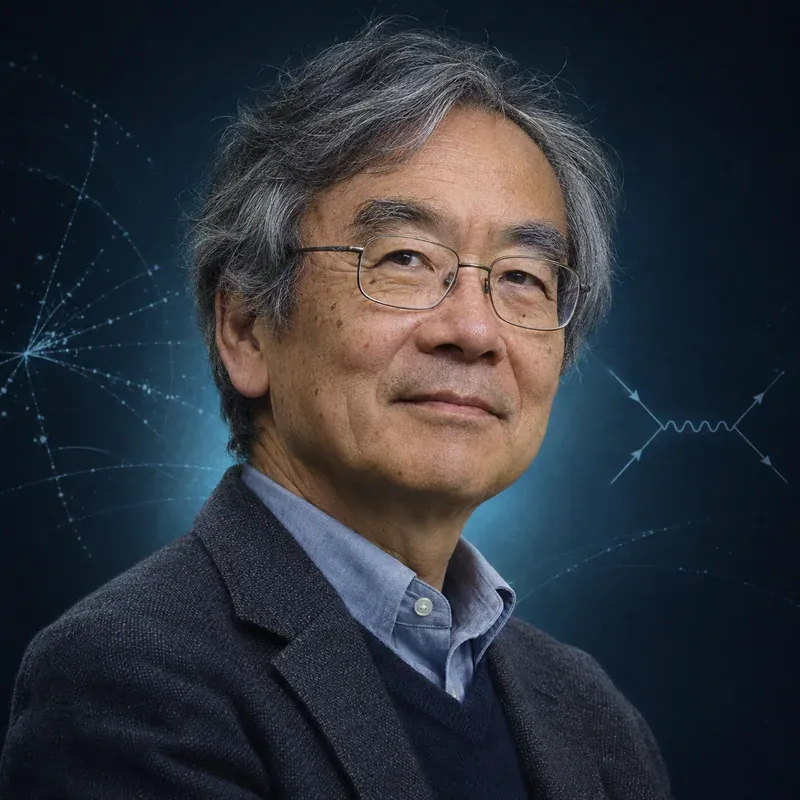
 Illustration
Kōichirō Nishikawa
Nishikawa founded and led K2K, the first long-baseline accelerator neutrino experiment, which sent a muon-neutrino beam 250 km from KEK to Super-Kamiokande (from 1999) and confirmed atmospheric-type oscillation. He then founded T2K, using the J-PARC beam to Super-Kamiokande, which in 2011 gave the first indication of electron-neutrino appearance (non-zero theta13).
- Born
- 1949
- Died
- 28 November 2018
- Nationality
- Japanese
- Field
- Experimental particle physics
- Institutions
- Kyoto University, KEK, J-PARC
Education and early career
Kōichirō Nishikawa was born in 1949. He graduated from Kyoto University in 1971 and went to the United States for his doctorate, which he completed at Northwestern University in 1980 under David Buchholz. He then worked at the University of Chicago, the State University of New York and the University of Tokyo, gaining experience in accelerator-based particle physics at a time when neutrino beams were mainly used to probe the structure of the nucleon.
He later held joint positions at KEK, Japan’s High Energy Accelerator Research Organization in Tsukuba, and at Kyoto University. At KEK he became director of the Institute of Particle and Nuclear Studies, and he served as deputy director of the J-PARC proton accelerator facility at Tōkai. He was professor emeritus of both KEK and Kyoto University.
Path to neutrino physics
In the mid-1990s the atmospheric neutrinos recorded by Kamiokande showed an anomaly: too few muon neutrinos compared with electron neutrinos. If this was due to oscillations, the relevant mass-squared difference implied that muon neutrinos of about one GeV should begin to disappear over a few hundred kilometres. Atmospheric neutrinos come from all directions with poorly known energies and fluxes. A controlled beam aimed from an accelerator at a distant detector would allow a cleaner test. Nishikawa proposed exactly this: a beam from the KEK proton synchrotron aimed at the new Super-Kamiokande detector, 250 kilometres away across Japan.
Key contributions
K2K, the KEK-to-Kamioka experiment, was the first long-baseline accelerator neutrino experiment. Its 12-GeV protons produced a beam of muon neutrinos with an average energy of roughly one GeV. A set of near detectors at KEK measured the beam before oscillations could act, and the far detector was Super-Kamiokande. Because the beam pulses were timed by GPS, neutrino events in Super-Kamiokande could be matched to individual spills. K2K ran from 1999 to 2004. Its first results, published in 2003, showed fewer muon neutrinos arriving than expected, and the final data set confirmed both the deficit and the distortion of the energy spectrum expected from oscillation. This confirmed with a man-made beam the oscillations that Super-Kamiokande had discovered with atmospheric neutrinos.
Nishikawa then founded T2K, Tokai to Kamioka, which uses the much more intense neutrino beam of the J-PARC accelerator complex. T2K’s neutrinos travel 295 kilometres to Super-Kamiokande. The beam is aimed 2.5 degrees away from the detector, a technique known as an off-axis beam: kinematics of pion decay then deliver a narrow energy spectrum peaked near 0.6 GeV, where the oscillation effect at 295 kilometres is greatest. A new near-detector complex, ND280, was built 280 metres from the target.
T2K began taking data in 2010. Its first physics run was interrupted by the Great East Japan earthquake of March 2011, which damaged the J-PARC facility. In June 2011 the collaboration announced six candidate electron-neutrino events where about 1.5 were expected without oscillation: the first indication of muon-neutrino to electron-neutrino appearance and therefore of a non-zero mixing angle θ₁₃. Subsequent data established electron-neutrino appearance at more than seven standard deviations by 2013, and T2K has since become one of the leading experiments constraining the CP-violating phase δCP.
The program Nishikawa started continues with Hyper-Kamiokande, a much larger water Cherenkov detector that will receive an upgraded J-PARC beam to search for leptonic CP violation.
Recognition and death
Nishikawa shared the Asahi Prize in 1998 with the Super-Kamiokande team and received the Nishina Memorial Prize in 2005. In 2016 he received the Bruno Pontecorvo Prize of the Joint Institute for Nuclear Research, and the K2K and T2K collaborations were among the five neutrino experiments awarded the Breakthrough Prize in Fundamental Physics. He died on 28 November 2018. KEK held a memorial symposium in his honour in 2019.
Known for
- Founder and leader of K2K
- First accelerator long-baseline neutrino experiment
- Breakthrough Prize 2016
Chronology
- 1999K2K begins
- 2005Nishina Memorial Prize
- 2011T2K indication of nu_mu -> nu_e appearance
- 2016Breakthrough Prize (K2K/T2K) and Bruno Pontecorvo Prize
Original papers
- K2K Collaboration (M. H. Ahn et al.), Indications of neutrino oscillation in a 250 km long-baseline experiment, Phys. Rev. Lett. 90, 041801 (2003)DOI 10.1103/PhysRevLett.90.041801
- T2K Collaboration (K. Abe et al.), Indication of electron neutrino appearance from an accelerator-produced off-axis muon neutrino beam, Phys. Rev. Lett. 107, 041801 (2011)DOI 10.1103/PhysRevLett.107.041801
Experiments
Connected people
Frequently asked questions
What was K2K?
The first long-baseline accelerator neutrino experiment: a muon-neutrino beam was sent 250 kilometres from KEK to Super-Kamiokande (1999–2004). It confirmed with a controlled source the oscillations seen in atmospheric neutrinos.
What did T2K discover?
In 2011 T2K gave the first indication that muon neutrinos turn into electron neutrinos over 295 kilometres, showing that θ₁₃ is not zero. It later established this appearance and constrains the CP phase δCP.
Why does T2K use an off-axis beam?
Viewing the beam at an angle of 2.5 degrees gives a narrow energy spectrum peaked where the oscillation effect is strongest at Super-Kamiokande’s distance, and reduces background from higher-energy neutrinos.
On the timeline
- 1999K2K starts the first long-baseline experiment
- 2011T2K finds hints of electron-neutrino appearance
- 2015Breakthrough Prize honours five oscillation experiments
Mentioned in 13 pages
Milestones 3
Last updated: · Editorial standard
Cite this page
Text
Neutrino Atlas (2026). “Kōichirō Nishikawa”. Retrieved 22 November 2026, from https://neutrino-atlas.com/people/koichiro-nishikawa/BibTeX
@misc{neutrinoatlas2026peoplekoichironishikawa,
  title        = {Kōichirō Nishikawa},
  author       = {{Neutrino Atlas}},
  year         = {2026},
  url          = {https://neutrino-atlas.com/people/koichiro-nishikawa/},
  note         = {Accessed 2026-11-22},
  language     = {english}
}