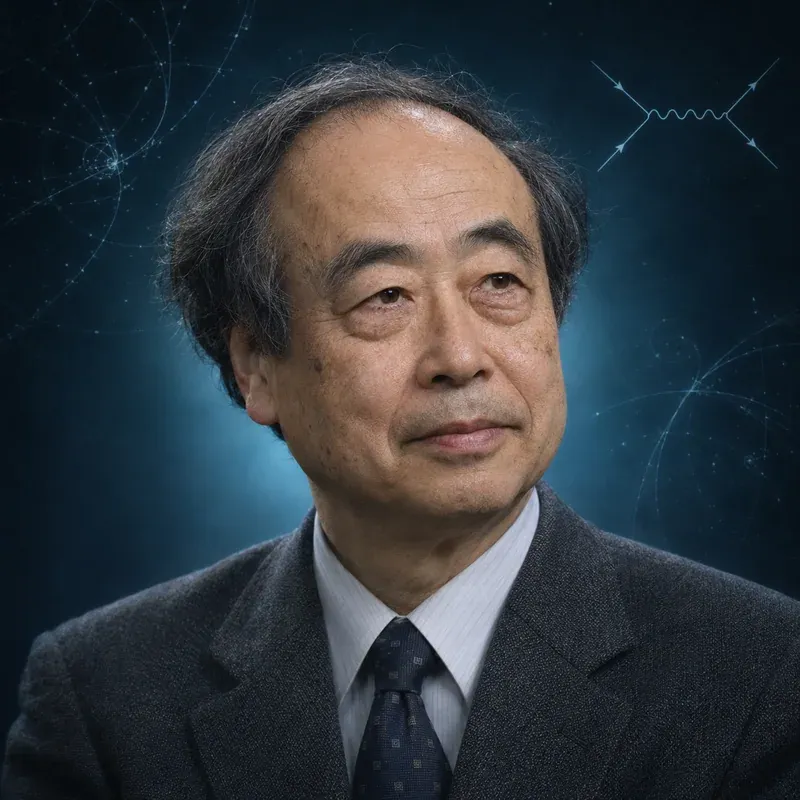
 Illustration
Makoto Kobayashi
With Toshihide Maskawa, Kobayashi showed in 1973 that a single irreducible complex phase in the mixing matrix of three quark generations can produce CP violation within the Standard Model. The neutrino mixing matrix (PMNS) inherited this structure: its Dirac phase δCP plays the role of the Kobayashi–Maskawa phase, and leptonic CP violation would appear as a difference between neutrino and antineutrino oscillations. Kobayashi spent most of his career at KEK, the laboratory whose Belle experiment confirmed the quark-sector predictions and whose J-PARC facility sends the T2K neutrino beam to Super-Kamiokande to search for the leptonic phase.
- Born
- 7 April 1944
Nagoya, Japan - Nationality
- Japanese
- Field
- Theoretical particle physics
- Nobel Prize
- Physics 2008 (one quarter each with Makoto Kobayashi and Toshihide Maskawa; one half to Yoichiro Nambu) – for the discovery of the origin of the broken symmetry which predicts the existence of at least three families of quarks in nature
- Institutions
- Nagoya University, Kyoto University, KEK (High Energy Accelerator Research Organization), Japan Society for the Promotion of Science
Education
Makoto Kobayashi was born in Nagoya in 1944. He studied at Nagoya University, graduating in 1967, and received his doctorate there in 1972 in the elementary particle group of Shoichi Sakata, the school that had also produced the Maki–Nakagawa–Sakata description of neutrino mixing. Immediately afterwards he became a research associate at Kyoto University, where he began working with Toshihide Maskawa, four years his senior and also a Sakata student.
The Kobayashi–Maskawa paper
Their joint paper, submitted in 1972 and published in Progress of Theoretical Physics in 1973, asked how CP violation, observed in kaon decays since 1964, could fit into the new renormalizable theory of the weak interaction. They showed that four quarks are not enough, and that with six quarks the mixing matrix contains an unremovable complex phase that violates CP. The argument is described in more detail on the page of Toshihide Maskawa. The matrix, which extends the mixing angle of Nicola Cabibbo, is now called the Cabibbo–Kobayashi–Maskawa (CKM) matrix.
From prediction to test at KEK
In 1979 Kobayashi moved to KEK, Japan's national high-energy physics laboratory in Tsukuba, where he became professor in 1985 and director of its Institute of Particle and Nuclear Studies in 2003. KEK built the asymmetric electron-positron collider KEKB and the Belle detector to test his theory. Around 2001 Belle and the BaBar experiment at SLAC observed large CP-violating asymmetries in B-meson decays, in quantitative agreement with the Kobayashi–Maskawa phase. The Nobel committee cited these results when it awarded Kobayashi and Maskawa one quarter each of the 2008 Nobel Prize in Physics.
Relevance for neutrino physics
The PMNS matrix of neutrino mixing has the same mathematical form as the CKM matrix, with three angles and one Dirac phase δCP. The two matrices nevertheless look very different: quark mixing angles are small, while two of the three neutrino angles are large, a contrast discussed under CKM vs PMNS. Measuring leptonic CP violation has become a central aim of neutrino physics, and in Japan it is pursued with the J-PARC neutrino beam, operated jointly by KEK and the Japan Atomic Energy Agency, which serves T2K and will serve Hyper-Kamiokande. In 2020 T2K reported that some values of δCP were disfavoured at three standard deviations.
Later roles
Kobayashi became professor emeritus at KEK in 2006 and from 2009 served as a trustee of the Japan Society for the Promotion of Science. Besides the Nobel Prize he received the Sakurai Prize with Maskawa in 1985.
Known for
- Kobayashi–Maskawa theory of CP violation (1973)
- Prediction of a third generation of quarks
- Director of KEK's Institute of Particle and Nuclear Studies (2003–2006)
- Nobel Prize in Physics 2008
Chronology
- 1972Doctorate at Nagoya University; research associate at Kyoto University
- 1973Kobayashi–Maskawa paper on CP violation
- 1979Joins KEK
- 1985Sakurai Prize, with Maskawa
- 2003Director of KEK's Institute of Particle and Nuclear Studies
- 2008Nobel Prize in Physics
Original papers
- M. Kobayashi, T. Maskawa, CP-violation in the renormalizable theory of weak interaction, Prog. Theor. Phys. 49, 652 (1973)DOI 10.1143/PTP.49.652
Experiments
- Belle
- T2K
Connected people
Frequently asked questions
What did Makoto Kobayashi discover?
With Toshihide Maskawa he showed in 1973 that CP violation arises naturally if there are three generations of quarks, predicting the bottom and top quarks before they were found.
Is there a Kobayashi–Maskawa phase for neutrinos?
Yes, in the sense that the neutrino mixing matrix has an analogous Dirac phase, δCP. Its value is being measured by T2K, NOvA and future experiments such as DUNE and Hyper-Kamiokande.
Mentioned in 7 pages
Last updated: · Editorial standard
Cite this page
Text
Neutrino Atlas (2026). “Makoto Kobayashi”. Retrieved 22 November 2026, from https://neutrino-atlas.com/people/makoto-kobayashi/BibTeX
@misc{neutrinoatlas2026peoplemakotokobayashi,
  title        = {Makoto Kobayashi},
  author       = {{Neutrino Atlas}},
  year         = {2026},
  url          = {https://neutrino-atlas.com/people/makoto-kobayashi/},
  note         = {Accessed 2026-11-22},
  language     = {english}
}