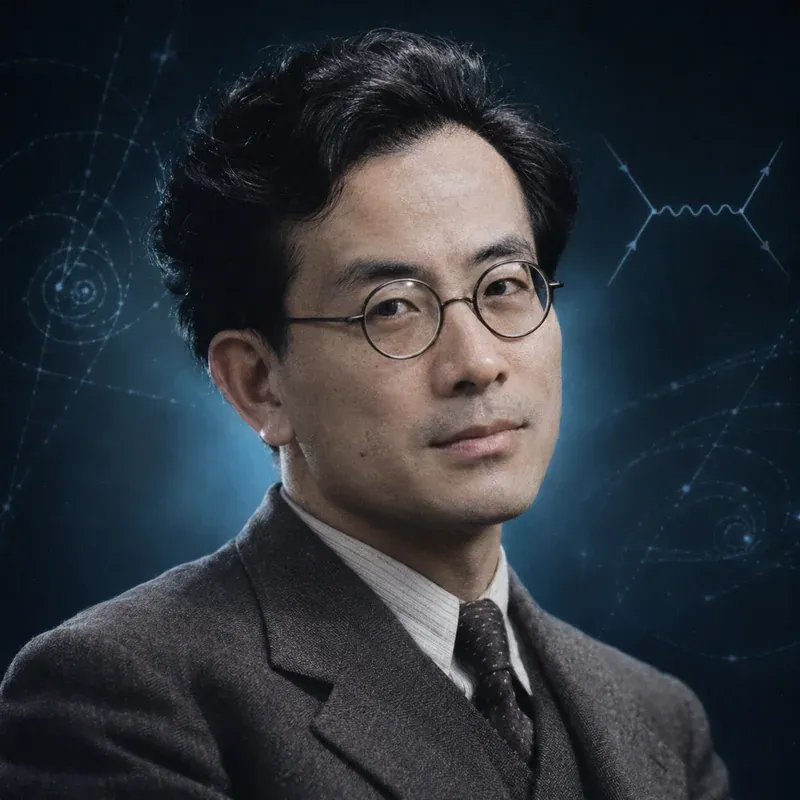
 Illustration
Shoichi Sakata
Sakata led the Nagoya group whose 1962 paper with Maki and Nakagawa introduced mixing between neutrino flavour and mass states, the basis of the PMNS matrix. His composite (Sakata/Nagoya) models linked baryons and leptons, which motivated the lepton–baryon correspondence underlying the mixing idea.
- Born
- 18 January 1911
Tokyo, Japan - Died
- 16 October 1970
Nagoya, Japan - Nationality
- Japanese
- Field
- Theoretical particle physics
- Institutions
- RIKEN, Osaka Imperial University, Nagoya University
Early life and education
Shoichi Sakata was born in Tokyo in 1911. At secondary school in Kōnan he came into contact with the physicists Bunsaku Arakatsu and Jun Ishiwara, and in 1930 he entered Kyoto Imperial University. There he attended lectures on the new quantum mechanics given by Yoshio Nishina, a relative by marriage, and met the two young theorists who would shape Japanese physics, Hideki Yukawa and Sin-Itiro Tomonaga.
In 1933 he joined Nishina and Tomonaga at RIKEN in Tokyo, and in 1934 he moved to Osaka Imperial University to work with Yukawa, who was then developing his meson theory of the nuclear force. Sakata became one of Yukawa’s closest collaborators on the series of papers that extended the theory. In October 1942 he was appointed professor at Nagoya Imperial University, where he remained until his death.
From mesons to composite models
In 1942, with Takesi Inoue, Sakata proposed the two-meson theory: the particle seen in cosmic rays was not Yukawa’s nuclear-force meson but a lighter particle produced in its decay. The idea correctly anticipated the spin and decay of the muon, and it was confirmed when the pion was discovered in 1947. Because of the war, the work became known in the West only later, and Robert Marshak and Hans Bethe proposed a similar hypothesis independently in 1947.
In 1956 Sakata proposed that the proton, the neutron and the lambda hyperon are the fundamental building blocks of all strongly interacting particles, with the other hadrons as composites of them and their antiparticles. In 1959 Ikeda, Ogawa and Ohnuki, and independently Yamaguchi, showed that the Sakata model has a U(3) symmetry. This line of work was a direct precursor of the quark model of Murray Gell-Mann and George Zweig, in which the proton, neutron and lambda are replaced by the up, down and strange quarks.
Key contributions to neutrino physics
Sakata noticed a parallel between the three Sakata baryons and the three light leptons then known: the electron, the muon and the neutrino. In 1960, with Ziro Maki, Masami Nakagawa and Yoshio Ohnuki, he proposed the Nagoya model, in which the baryons arise from a hypothetical ‘B-matter’ bound to leptons. The lepton–baryon correspondence later guided the step to neutrino mixing.
In 1962, after the Brookhaven experiment had shown that the neutrino produced with a muon differs from the one produced with an electron (see two-neutrino experiment), Maki, Nakagawa and Sakata published ‘Remarks on the unified model of elementary particles’ in Progress of Theoretical Physics. To keep the correspondence with four baryons, they assumed that the electron neutrino and the muon neutrino that take part in the weak interaction are superpositions, rotated by a mixing angle, of two ‘true’ neutrinos with definite masses. This is the first statement of two-flavour neutrino mixing between flavour and mass eigenstates. The authors also noted that a neutrino created as one flavour could later produce the other, the essence of neutrino oscillation.
Today the three-flavour version of this mixing is described by the PMNS matrix, named after Bruno Pontecorvo, Maki, Nakagawa and Sakata. Pontecorvo had arrived at oscillations by a different route, by analogy with the mixing of neutral kaons. The prediction was confirmed when Super-Kamiokande observed atmospheric neutrino oscillations in 1998 and SNO resolved the solar neutrino problem in 2001–2002.
Influence and outlook
Sakata was a Marxist who drew on Engels’ ‘Dialectics of Nature’ and believed that matter has an endless series of layers, each made of more fundamental constituents. This philosophy explicitly motivated his search for composite models. After the Second World War he reorganised his Nagoya group on democratic, non-hierarchical lines, and he campaigned for the peaceful use of nuclear energy and for the responsibility of scientists.
The Nagoya school produced Makoto Kobayashi and Toshihide Maskawa, who in 1973 showed that a third generation of quarks allows CP violation in the quark sector (see CKM and PMNS); their work drew partly on the four-particle Nagoya model. Sakata received the Asahi Prize in 1948 and the Imperial Prize of the Japan Academy in 1950. He died in Nagoya in October 1970, aged 59, after a long illness, decades before the experiments that confirmed neutrino mixing.
Known for
- Two-meson theory (1942)
- Sakata model of hadrons (1956)
- Nagoya model (1960)
- Maki–Nakagawa–Sakata mixing (1962)
Chronology
- 1942Two-meson theory with Takesi Inoue
- 1956Sakata model (p, n, Λ as fundamental)
- 1960Nagoya model including leptons
- 1962MNS neutrino mixing paper
Original papers
- Z. Maki, M. Nakagawa, S. Sakata, Remarks on the unified model of elementary particles, Prog. Theor. Phys. 28, 870 (1962)DOI 10.1143/PTP.28.870
Connected people
Frequently asked questions
What is Shoichi Sakata known for?
For the two-meson theory (1942), the Sakata model of hadrons (1956), which anticipated the quark model, and the 1962 Maki–Nakagawa–Sakata paper that introduced neutrino mixing.
Why is the S in PMNS Sakata?
The PMNS matrix describes how neutrino flavour states are combinations of mass states. It is named after Pontecorvo, Maki, Nakagawa and Sakata, whose 1962 paper first wrote down such a mixing between two neutrino types.
Did Sakata receive a Nobel Prize?
No. He died in 1970, long before neutrino oscillations were observed. He was honoured in Japan with the Asahi Prize and the Imperial Prize of the Japan Academy.
On the timeline
Mentioned in 21 pages
Milestones 3
People 8
Last updated: · Editorial standard
Cite this page
Text
Neutrino Atlas (2026). “Shoichi Sakata”. Retrieved 22 November 2026, from https://neutrino-atlas.com/people/shoichi-sakata/BibTeX
@misc{neutrinoatlas2026peopleshoichisakata,
  title        = {Shoichi Sakata},
  author       = {{Neutrino Atlas}},
  year         = {2026},
  url          = {https://neutrino-atlas.com/people/shoichi-sakata/},
  note         = {Accessed 2026-11-22},
  language     = {english}
}