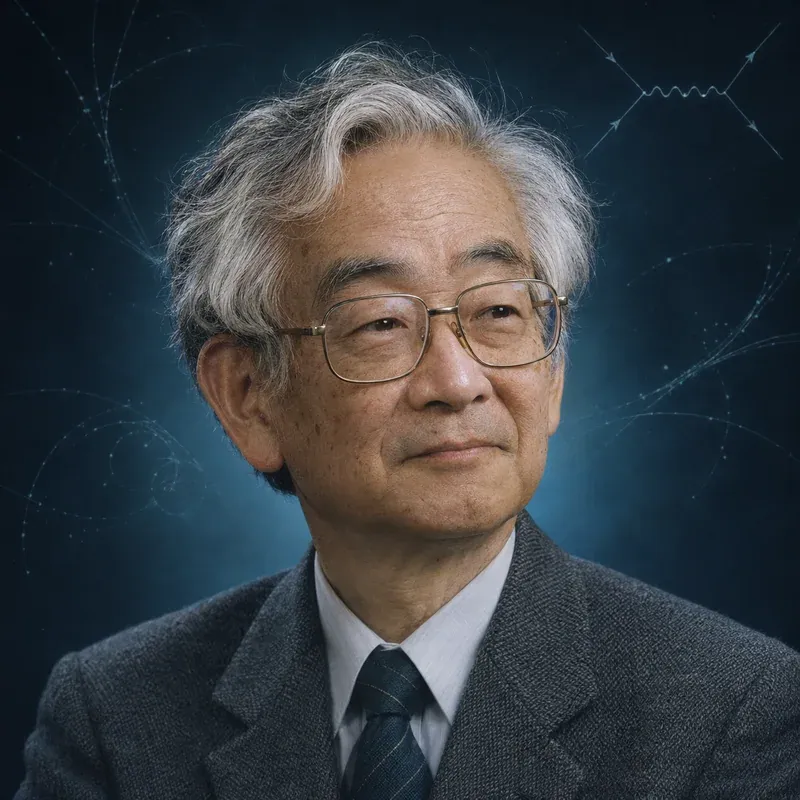
 Illustration
Toshihide Maskawa
Maskawa's 1973 paper with Makoto Kobayashi showed that CP violation can arise naturally in the weak interaction if there are three generations of quarks, through a single complex phase in the 3×3 mixing matrix. The lepton mixing matrix of neutrinos, the PMNS matrix, has exactly the same structure, so its Dirac phase δCP is the leptonic counterpart of the Kobayashi–Maskawa phase. Measuring that phase is a main goal of T2K, NOvA, Hyper-Kamiokande and DUNE. Maskawa came from the Nagoya school of Shoichi Sakata, where Maki, Nakagawa and Sakata had introduced neutrino mixing in 1962.
- Born
- 7 February 1940
Nagoya, Japan - Died
- 23 July 2021
Kyoto, Japan - Nationality
- Japanese
- Field
- Theoretical particle physics
- Nobel Prize
- Physics 2008 (one quarter each with Makoto Kobayashi and Toshihide Maskawa; one half to Yoichiro Nambu) – for the discovery of the origin of the broken symmetry which predicts the existence of at least three families of quarks in nature
- Institutions
- Nagoya University, Kyoto University, Yukawa Institute for Theoretical Physics (director 1997–2003), Kyoto Sangyo University
Early life and education
Toshihide Maskawa was born in Nagoya in 1940. He graduated from Nagoya University in 1962 and received his doctorate there in 1967 in the group of Shoichi Sakata. Sakata's school treated elementary particles as real building blocks whose structure could be modelled, and in 1962 Sakata, Ziro Maki and Masami Nakagawa had written down the mixing of two neutrino types that underlies neutrino oscillations. In 1970 Maskawa moved to Kyoto University, where he was joined in 1972 by the younger Nagoya graduate Makoto Kobayashi.
Three generations and CP violation
CP violation had been observed in neutral kaon decays in 1964, but no one knew where it came from. In 1973 the renormalizable gauge theory of the weak interaction had just been established, and Kobayashi and Maskawa asked whether it could accommodate CP violation. With four quarks, the 2×2 mixing matrix of the GIM scheme can always be made real by redefining the phases of the quark fields, so it cannot violate CP. With six quarks, three generations, the 3×3 unitary mixing matrix has three angles and one phase that cannot be removed. That phase violates CP. At the time only three quarks were established; their paper therefore predicted two complete new generations' worth of quarks before charm itself had been found.
The prediction was borne out step by step: charm in 1974, the tau lepton in 1975, the bottom quark in 1977 and the top quark in 1995. Around 2001 the B factories BaBar at SLAC and Belle at KEK measured large CP-violating asymmetries in the decays of B mesons in agreement with the Kobayashi–Maskawa picture, which led to the 2008 Nobel Prize.
The leptonic counterpart
Once neutrinos were found to oscillate, the same counting applied to leptons. With three neutrino flavours, the PMNS matrix has three angles and one Dirac phase, δCP, the direct analogue of the Kobayashi–Maskawa phase; if neutrinos are Majorana particles, two further Majorana phases appear. The comparison of the two matrices is described under CKM vs PMNS. Leptonic CP violation would show up as a difference between neutrino and antineutrino oscillations, and its size is measured by the Jarlskog invariant.
Later career
Maskawa later worked at the Institute for Nuclear Study of the University of Tokyo and returned to Kyoto, where he was director of the Yukawa Institute for Theoretical Physics from 1997 to 2003. He then taught at Kyoto Sangyo University and directed the Kobayashi-Maskawa Institute at Nagoya University. He received the Sakurai Prize and the Japan Academy Prize in 1985 and shared the Nobel Prize with Kobayashi and Yoichiro Nambu in 2008. He died at his home in Kyoto in 2021.
Known for
- Kobayashi–Maskawa theory of CP violation (1973)
- Prediction of a third generation of quarks
- Cabibbo–Kobayashi–Maskawa (CKM) quark mixing matrix
- Nobel Prize in Physics 2008
Chronology
- 1967PhD at Nagoya University under Shoichi Sakata
- 1973Kobayashi–Maskawa paper on CP violation with six quarks
- 1977Discovery of the bottom quark supports the third generation
- 1985Sakurai Prize and Japan Academy Prize
- 1997Director of the Yukawa Institute for Theoretical Physics
- 2008Nobel Prize in Physics
Original papers
- M. Kobayashi, T. Maskawa, CP-violation in the renormalizable theory of weak interaction, Prog. Theor. Phys. 49, 652 (1973)DOI 10.1143/PTP.49.652
Experiments
- Belle
- BaBar
Connected people
Frequently asked questions
Why does the Kobayashi–Maskawa theory need three generations?
Only with at least three generations does the quark mixing matrix contain a complex phase that cannot be removed by redefining the quark fields, and that phase is what violates CP.
How is Maskawa's work related to neutrinos?
The neutrino mixing matrix has the same structure, with a Dirac phase δCP. Long-baseline experiments such as T2K, NOvA and DUNE are measuring this leptonic counterpart of the Kobayashi–Maskawa phase.
Mentioned in 6 pages
Last updated: · Editorial standard
Cite this page
Text
Neutrino Atlas (2026). “Toshihide Maskawa”. Retrieved 22 November 2026, from https://neutrino-atlas.com/people/toshihide-maskawa/BibTeX
@misc{neutrinoatlas2026peopletoshihidemaskawa,
  title        = {Toshihide Maskawa},
  author       = {{Neutrino Atlas}},
  year         = {2026},
  url          = {https://neutrino-atlas.com/people/toshihide-maskawa/},
  note         = {Accessed 2026-11-22},
  language     = {english}
}