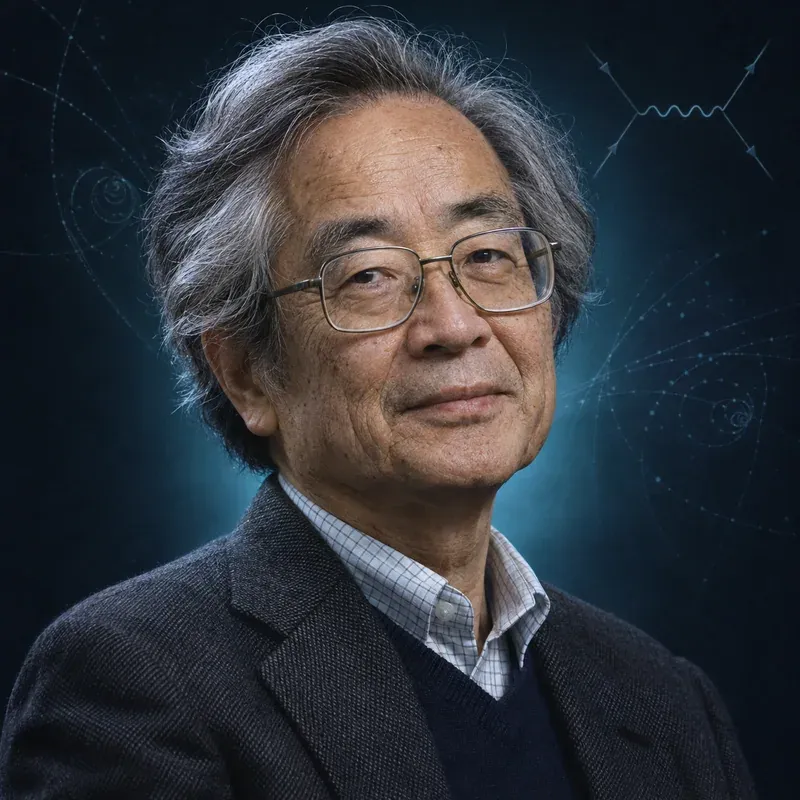
 Illustration
Masami Nakagawa
Nakagawa co-authored the 1962 Maki–Nakagawa–Sakata paper, which, after the Brookhaven two-neutrino discovery, modified the Nagoya model to include two neutrinos and described νe and νμ as mixtures of mass states with a mixing angle. In 1998 he gave the opening address 'Birth of Neutrino Oscillation' at the NOW'98 workshop, reviewing this history.
- Nationality
- Japanese
- Field
- Theoretical particle physics
- Institutions
- Nagoya University, Meijo University
The Nagoya school
Masami Nakagawa belonged to the group of theoretical physicists that Shoichi Sakata built up at Nagoya University after the Second World War. Little has been published about his life; what is known comes mainly from his scientific papers and from his own historical reviews. In the late 1990s he was a member of the physics department of Meijo University in Nagoya.
Sakata's group combined model building with a distinctive philosophy. Sakata held that the elementary particles of each era are only a stage in an endless hierarchy of matter, and he distrusted assumptions adopted only for convenience or simplicity. In his 1998 review Nakagawa recalled that Sakata had always been sceptical of the conventional assumptions that neutrinos are massless and that the neutrinos emitted with electrons and with muons are identical. In 1956 Sakata had proposed that all hadrons are built from the proton, neutron and lambda particle, the Sakata model, a forerunner of the quark model.
From the Nagoya model to neutrino mixing
In 1960 Nakagawa, together with Ziro Maki, Yoshio Ohnuki and Sakata, proposed the 'Nagoya model'. It extended Sakata's model to leptons: the three basic baryons were imagined as bound states of a strongly interacting substance with the three leptons then known, the electron, the neutrino and the muon. This lepton–baryon correspondence was meant to explain why leptons and hadrons show parallel patterns in weak interactions.
In 1962 the Brookhaven two-neutrino experiment of Leon Lederman, Melvin Schwartz and Jack Steinberger showed that the neutrino produced with a muon is different from the one produced with an electron. The Nagoya model then needed four leptons and, by correspondence, a fourth basic baryon. In 'Remarks on the unified model of elementary particles', published in Progress of Theoretical Physics in November 1962, Maki, Nakagawa and Sakata made a step that went beyond the model itself.
Key contributions
The three authors distinguished between two kinds of neutrinos. The neutrinos that appear in weak interactions, the electron neutrino and the muon neutrino, are not the particles with definite mass. Instead, they are mixtures of two 'true neutrinos', ν₁ and ν₂, which do have definite masses. The relation between the two descriptions is a rotation by a mixing angle, the first appearance of what is now called neutrino mixing between mass eigenstates and flavour states.
They also noted the physical consequence: if the masses of ν₁ and ν₂ differ, a neutrino created as a muon neutrino does not stay one, but can turn into an electron neutrino over time. In modern language this is flavour oscillation, as observed decades later. The idea differed from Bruno Pontecorvo's earlier proposal of 1957–58, which concerned transitions between neutrinos and antineutrinos; Pontecorvo himself formulated oscillations between flavours in 1967.
In Nakagawa's later account, the mixing in the baryon sector of their model reproduced the structure of the weak current that Nicola Cabibbo introduced in 1963, and the fourth baryon of the model later came to be seen as a forerunner of the charm quark.
Later work and legacy
Nakagawa reviewed the history of these ideas several times. At the NOW'98 neutrino workshop in Amsterdam in September 1998, a few months after Super-Kamiokande announced evidence for oscillations of atmospheric neutrinos, he gave the opening address 'Birth of neutrino oscillation'. In it he traced the concept to two sources: questioning the conservation laws for leptons, and building models that unify leptons and hadrons.
Today the matrix that connects neutrino flavour and mass states is called the PMNS matrix, after Pontecorvo, Maki, Nakagawa and Sakata. Its three mixing angles, θ₁₂, θ₂₃ and θ₁₃, and the phase δCP are among the main measurement targets of current oscillation experiments. The page on CKM vs. PMNS compares lepton mixing with the quark mixing that grew out of Cabibbo's work.
Known for
- Maki–Nakagawa–Sakata lepton mixing
- Nagoya model
Chronology
- 1960Co-author of the Nagoya model
- 1962MNS paper on neutrino mixing
- 1998Historical address 'Birth of Neutrino Oscillation' at NOW'98
Original papers
- Z. Maki, M. Nakagawa, S. Sakata, Remarks on the unified model of elementary particles, Prog. Theor. Phys. 28, 870 (1962)DOI 10.1143/PTP.28.870
- M. Nakagawa, Birth of neutrino oscillation, NOW'98 opening address, arXiv:hep-ph/9811358 (1998)arXiv:hep-ph/9811358
Connected people
Frequently asked questions
What does the N in PMNS stand for?
It stands for Masami Nakagawa, co-author of the 1962 Maki–Nakagawa–Sakata paper that first described the weak-interaction neutrinos as mixtures of neutrinos with definite masses.
Did Maki, Nakagawa and Sakata predict neutrino oscillations?
Their 1962 paper introduced flavour mixing between the electron and muon neutrino and noted that it leads to transitions between them if the masses differ. It is therefore regarded as the origin of flavour oscillation, alongside Pontecorvo's work.
What was the Nagoya model?
A 1960 model by Maki, Nakagawa, Ohnuki and Sakata that linked the basic baryons of the Sakata model to the leptons. Its 1962 revision for two neutrinos contained the mixing idea.
On the timeline
Mentioned in 17 pages
Milestones 3
Last updated: · Editorial standard
Cite this page
Text
Neutrino Atlas (2026). “Masami Nakagawa”. Retrieved 22 November 2026, from https://neutrino-atlas.com/people/masami-nakagawa/BibTeX
@misc{neutrinoatlas2026peoplemasaminakagawa,
  title        = {Masami Nakagawa},
  author       = {{Neutrino Atlas}},
  year         = {2026},
  url          = {https://neutrino-atlas.com/people/masami-nakagawa/},
  note         = {Accessed 2026-11-22},
  language     = {english}
}