1957Theory
Pontecorvo proposes neutrino oscillations
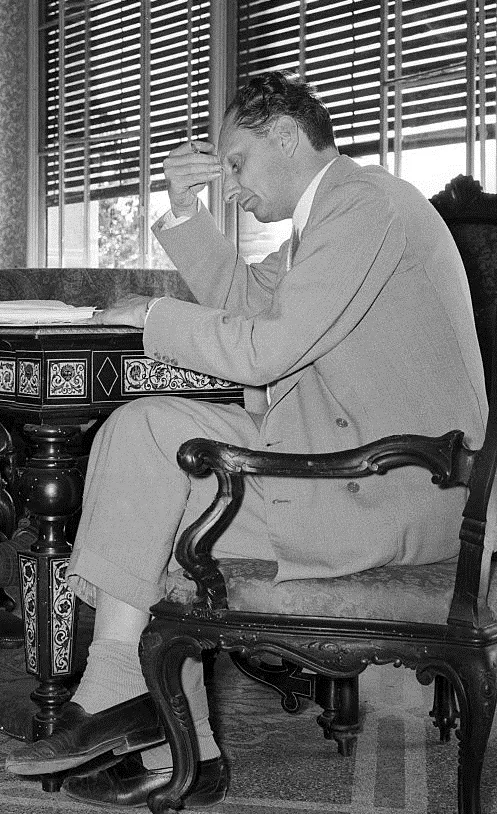
Bruno Pontecorvo, by then working in Dubna, suggested by analogy with neutral kaon mixing that neutrinos and antineutrinos might transform into one another as they travel. His 1957 and 1958 papers introduced the idea of neutrino oscillations. Although the specific neutrino-antineutrino version is not what nature realises, the concept was later recast as oscillation between flavours. It became the key to the solar and atmospheric neutrino anomalies.
- Date
- 1957
- Kind of event
- Theory
- People involved
- Bruno Pontecorvo
The situation before
In 1955 Murray Gell-Mann and Abraham Pais had shown that the neutral kaon and its antiparticle are not the states of definite mass and lifetime. Instead, the observed particles are quantum mixtures of the two, and a beam of neutral kaons changes its composition as it travels. Bruno Pontecorvo, who had moved from Britain to the Soviet Union in 1950 and was working at the laboratory in Dubna, asked whether other neutral particles could behave the same way. At the time only one kind of neutrino was known, and the two-component theory of early 1957 held that it was massless.
What happened
In a 1957 paper in the Soviet Journal of Experimental and Theoretical Physics, mainly about transitions between muonium and antimuonium, Pontecorvo remarked that if lepton charge were not strictly conserved, transitions between neutrino and antineutrino in vacuum would in principle be possible. A second paper, "Inverse beta processes and nonconservation of lepton charge", developed the idea. It was prompted by a rumour that Raymond Davis had seen argon production by reactor antineutrinos, which conventional theory forbade.
Pontecorvo proposed that the antineutrino emitted by a reactor is a mixture of two states with different masses, so that on its way to the detector it partly turns into a particle that can induce the chlorine reaction. The other component would be a non-interacting state, an idea he later called "sterile". He predicted that the reactor antineutrino flux measured by inverse beta decay should then appear reduced, and he expected the effect to be too small for laboratory distances but possibly important on astronomical scales.
Reaction
The Davis events did not survive further analysis, and the specific neutrino-antineutrino version found little following. The underlying concept, neutrino mixing of mass states, proved durable. After the muon neutrino was discovered at Brookhaven in 1962, Ziro Maki, Masami Nakagawa and Shoichi Sakata formulated mixing between neutrino flavours the same year. In 1967 Pontecorvo applied flavour oscillations to solar neutrinos and predicted that the measured flux could be about half the expected one, before Davis's Homestake results appeared. With Vladimir Gribov he worked out the two-flavour vacuum oscillation formula in 1969.
Why it matters
Pontecorvo's papers introduced the idea that neutrinos can change identity as they travel, the key to two great puzzles of later decades. The deficit of solar neutrinos and the anomaly of atmospheric neutrinos were both explained by oscillations, established by Super-Kamiokande in 1998 and SNO in 2001–2002. The mixing matrix that describes them is today named after Pontecorvo, Maki, Nakagawa and Sakata. Pontecorvo died in 1993, before oscillations were confirmed; the 2015 Nobel Prize went to Takaaki Kajita and Arthur McDonald for their discovery.
Frequently asked questions
Who first proposed neutrino oscillations?
Bruno Pontecorvo, in papers of 1957 and 1958, by analogy with the mixing of neutral kaons.
Was his original idea correct?
Not in detail: he considered transitions between neutrino and antineutrino. The modern picture involves transitions between neutrino flavours, but rests on his idea of mixing between states of different mass.
Original papers
- TheoryB. Pontecorvo, Mesonium and anti-mesonium, Zh. Eksp. Teor. Fiz. 33, 549 (1957) [Sov. Phys. JETP 6, 429 (1957)]
- TheoryB. Pontecorvo, Inverse beta processes and nonconservation of lepton charge, Zh. Eksp. Teor. Fiz. 34, 247 (1957) [Sov. Phys. JETP 7, 172 (1958)]
Concepts
Mentioned in 2 pages
Last updated: · Editorial standard
Cite this page
Text
Neutrino Atlas (2026). “1957: Pontecorvo proposes neutrino oscillations”. Retrieved 22 November 2026, from https://neutrino-atlas.com/timeline/1957-pontecorvo-oscillation-idea/BibTeX
@misc{neutrinoatlas2026ontecorvooscillationidea,
  title        = {1957: Pontecorvo proposes neutrino oscillations},
  author       = {{Neutrino Atlas}},
  year         = {2026},
  url          = {https://neutrino-atlas.com/timeline/1957-pontecorvo-oscillation-idea/},
  note         = {Accessed 2026-11-22},
  language     = {english}
}