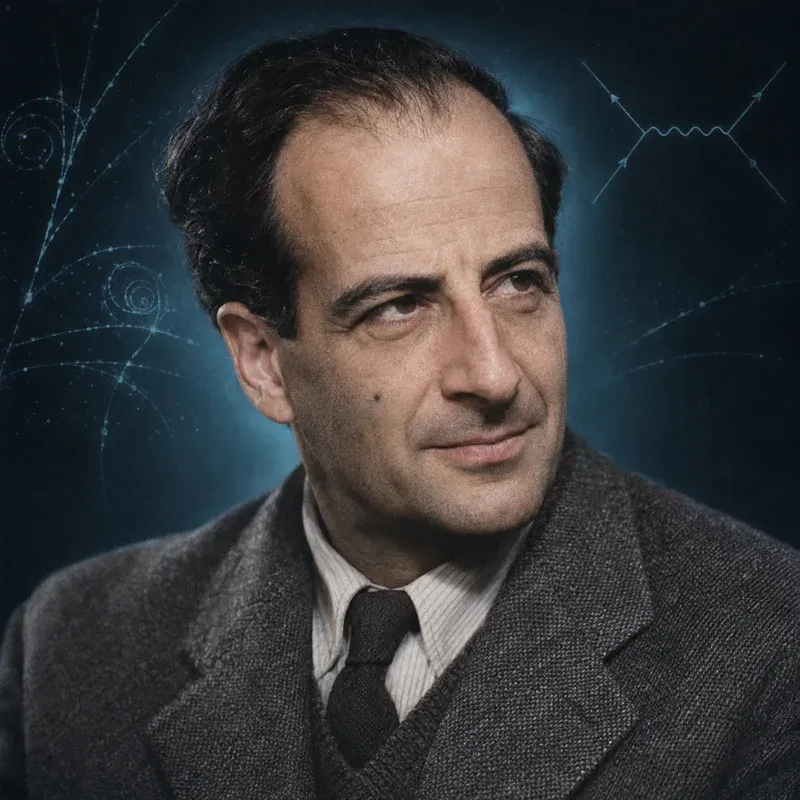
 Illustration
Bruno Pontecorvo
In a 1946 Chalk River report Pontecorvo proposed detecting neutrinos radiochemically through the reaction Cl-37 + neutrino -> Ar-37 + e-, the method Raymond Davis later used at reactors and in the Homestake solar-neutrino experiment. In 1947 he proposed the universality of weak interactions of muons and electrons. In 1957-58, by analogy with neutral kaon mixing, he first proposed neutrino oscillations (initially neutrino-antineutrino transitions), and in 1959 he argued that electron and muon neutrinos are distinct and proposed accelerator neutrino experiments; in 1967-68 he applied oscillations to the solar neutrino deficit.
- Born
- 22 August 1913
Marina di Pisa, Italy - Died
- 24 September 1993
Dubna, Russia - Nationality
- Italian (later British, Soviet)
- Field
- nuclear and particle physics (theory and experiment)
- Institutions
- Sapienza University of Rome, Collège de France, Chalk River Laboratories (Canada), AERE Harwell
Early life and education
Bruno Pontecorvo was born on 22 August 1913 in Marina di Pisa, the fourth of eight children of a Jewish textile-industrialist family; his brothers included the geneticist Guido Pontecorvo and the film director Gillo Pontecorvo. He began studying engineering at Pisa, switched to physics in 1931 and moved to Rome, where at 18 he was admitted to the third year of the physics course under Enrico Fermi. As the youngest member of Fermi's group in Via Panisperna he took part in the 1934 discovery that slow neutrons are captured far more readily than fast ones.
Paris, Oklahoma and Chalk River
In 1936 Pontecorvo went to Paris to work with Irène and Frédéric Joliot-Curie at the Collège de France on nuclear isomerism. When German troops approached Paris in June 1940 he fled south by bicycle and reached the United States from Lisbon in August. In Tulsa, Oklahoma, he worked for the company Well Surveys and developed neutron well-logging, a method of prospecting for oil with neutron sources. In 1943 he joined the Anglo-Canadian nuclear project in Montreal and then at Chalk River, where the ZEEP reactor went critical in 1945 and the more powerful NRX reactor in 1947.
The chlorine–argon method
At Chalk River, Pontecorvo saw that reactors and the Sun are strong neutrino sources and asked how one might detect them. In report PD-205, "Inverse beta process" (1946), he proposed using the reaction in which an electron neutrino turns chlorine-37 into radioactive argon-37 and an electron. Chlorine is cheap and available in large quantities, for example as cleaning fluid; argon is a noble gas that can be swept out of tonnes of liquid, and argon-37 decays with a half-life of about 35 days, long enough to collect and count its atoms. This radiochemical method, refined by Luis Alvarez, is the one Raymond Davis Jr. used in the Homestake experiment, which from 1968 found fewer solar neutrinos than predicted.
In 1947 Pontecorvo noted that muon capture by nuclei and electron capture have a similar strength, an early statement of the universality of the weak interaction for muons and electrons. In 1949 he moved to the Atomic Energy Research Establishment at Harwell in England.
Move to the Soviet Union
On 1 September 1950 Pontecorvo flew with his wife and three sons from Rome to Stockholm and on 2 September entered the Soviet Union via Finland. His reasons and any involvement in intelligence work remain debated. He settled in Dubna, the later Joint Institute for Nuclear Research, where he first worked on pion physics at the synchrocyclotron and then increasingly on neutrino theory. He received the Stalin Prize in 1953, was elected to the USSR Academy of Sciences in 1958 and received the Lenin Prize in 1964.
Neutrino oscillations and two neutrinos
In 1957, by analogy with the mixing of neutral kaons, Pontecorvo suggested that neutrinos might oscillate into antineutrinos as they travel. This was the first idea of neutrino oscillation. In 1959 he argued that the neutrino emitted with a muon may differ from that emitted with an electron and that an accelerator beam of neutrinos from pion decays could test this. The Brookhaven experiment of 1962 by Leon Lederman, Melvin Schwartz and Jack Steinberger confirmed the existence of a distinct muon neutrino and opened the era of accelerator neutrinos.
Once two flavours existed, oscillations between them became possible, and in 1962 Ziro Maki, Masami Nakagawa and Shoichi Sakata introduced flavour mixing. In 1967 Pontecorvo pointed out that oscillations could reduce the flux of solar electron neutrinos at Earth by about a factor of two, before Davis's first results showed a deficit. With Vladimir Gribov he analysed solar neutrinos with two-flavour mixing in 1969, and with Samoil Bilenky he developed the general theory of lepton mixing, including Dirac and Majorana cases, summarised in their 1978 review. The PMNS matrix that describes neutrino mixing bears the initials of Pontecorvo, Maki, Nakagawa and Sakata.
Legacy
Pontecorvo died in Dubna on 24 September 1993, five years before Super-Kamiokande announced evidence for atmospheric neutrino oscillations. Half of his ashes were buried in the Protestant Cemetery in Rome and half in Dubna. In 1995 JINR established the Bruno Pontecorvo Prize in his memory. Few physicists have shaped so many lines of neutrino research: the radiochemical detection of solar neutrinos, the idea of distinct flavours, accelerator neutrino beams and the oscillations that showed neutrinos have mass.
Known for
- Muon–electron universality (1947)
- Distinct electron and muon neutrinos (1959)
- Accelerator neutrino beams
- Chlorine–argon radiochemical neutrino detection method
- Proposal of neutrino oscillations
- Gribov–Pontecorvo solar oscillation analysis
- Lepton mixing theory with Bilenky
Chronology
- 1946Report PD-205 'Inverse beta process' proposes Cl-Ar method (13 Nov)
- 1946Chalk River report proposing the chlorine–argon method
- 1947Muon–electron universality
- 1950Moves to the USSR, joins Dubna
- 1957First paper on neutrino–antineutrino oscillations
- 1959Electron and muon neutrinos as distinct particles; accelerator neutrino proposal
- 1964Lenin Prize
- 1967Discusses oscillations and lepton-charge non-conservation for solar neutrinos
- 1969Gribov–Pontecorvo paper on neutrino astronomy and lepton charge
- 1978Bilenky–Pontecorvo review of lepton mixing and oscillations
Original papers
- B. Pontecorvo, Inverse beta process, Report PD-205, National Research Council of Canada, Chalk River (1946)
- B. Pontecorvo, Nuclear capture of mesons and the meson decay, Phys. Rev. 72, 246 (1947)DOI 10.1103/PhysRev.72.246
- B. Pontecorvo, Inverse beta processes and nonconservation of lepton charge, Zh. Eksp. Teor. Fiz. 34, 247 (1957) [Sov. Phys. JETP 7, 172 (1958)]
- B. Pontecorvo, Electron and muon neutrinos, Zh. Eksp. Teor. Fiz. 37, 1751 (1959) [Sov. Phys. JETP 10, 1236 (1960)]
- B. Pontecorvo, Inverse beta processes, Chalk River Report PD-205 (1946)
- B. Pontecorvo, Mesonium and anti-mesonium, Sov. Phys. JETP 6, 429 (1957)
- B. Pontecorvo, Neutrino experiments and the problem of conservation of leptonic charge, Sov. Phys. JETP 26, 984 (1968) [Zh. Eksp. Teor. Fiz. 53, 1717 (1967)]
- V. Gribov, B. Pontecorvo, Neutrino astronomy and lepton charge, Phys. Lett. B 28, 493 (1969)
- S. M. Bilenky, B. Pontecorvo, Lepton mixing and neutrino oscillations, Phys. Rep. 41, 225 (1978)
Experiments
- Homestake Chlorine Experiment
- Davis reactor chlorine experiments
- Sanford Underground Research Facility (SURF)
- Brookhaven Two-Neutrino Experiment
- Super-Kamiokande
- SN 1987A detections
Connected people
- Enrico Fermi
- John Norris Bahcall
- Luis W. Alvarez
- Raymond Davis Jr.
- Samoil Mikhelevich Bilenky
- Vladimir Naumovich Gribov
- Ziro Maki
- Ettore Majorana
- Masami Nakagawa
- Antonino Zichichi
- Gerald Feinberg
- Lev Borisovich Okun
Frequently asked questions
What did Bruno Pontecorvo contribute to neutrino physics?
He proposed the chlorine–argon detection method (1946) later used at Homestake, first suggested neutrino oscillations (1957), argued that electron and muon neutrinos are different and could be tested with accelerator beams (1959), and developed the theory of lepton mixing with Gribov and Bilenky.
Did Pontecorvo win a Nobel Prize?
No. He received the Stalin Prize (1953) and the Lenin Prize (1964). He died in 1993, before the experimental confirmation of oscillations in 1998, and the 1988 Nobel Prize for the two-neutrino experiment went to Lederman, Schwartz and Steinberger.
Why is the neutrino mixing matrix called PMNS?
It is named after Pontecorvo, who introduced neutrino oscillations, and Maki, Nakagawa and Sakata, who wrote down flavour mixing between electron and muon neutrinos in 1962.
On the timeline
- 1946Pontecorvo proposes the chlorine-argon detector
- 1957Pontecorvo proposes neutrino oscillations
- 1960Proposals for accelerator neutrino beams
- 1962Maki, Nakagawa and Sakata introduce neutrino mixing
- 1969Oscillations proposed to explain the solar deficit
Mentioned in 82 pages
Lessons 7
FAQ 5
Comparisons 1
Milestones 12
- 1946 · Pontecorvo proposes the chlorine-argon detector
- 1955 · Davis shows antineutrinos do not make argon
- 1957 · Pontecorvo proposes neutrino oscillations
- 1960 · Proposals for accelerator neutrino beams
- 1962 · Brookhaven experiment discovers the muon neutrino
- 1962 · Maki, Nakagawa and Sakata introduce neutrino mixing
- 1964 · Bahcall and Davis propose a solar neutrino test
- 1968 · Homestake finds too few solar neutrinos
People 39
- Alexander Dmitrievich Dolgov
- Alexei Yuryevich Smirnov
- Antonino Zichichi
- Atsuto Suzuki
- Eligio Lisi
- Enrico Fermi
- Ettore Fiorini
- Ettore Majorana
31 more
- Francis Halzen
- Georgy Timofeyevich Zatsepin
- Gerald Feinberg
- Gianluigi Fogli
- Gianpaolo Bellini
- Grigory Vladimirovich Domogatsky
- John Norris Bahcall
- Kimio Niwa
- Klaus Winter
- Kōichirō Nishikawa
- Lev Borisovich Okun
- Lincoln Wolfenstein
- Luciano Maiani
- Luis W. Alvarez
- Masami Nakagawa
- Melvin Schwartz
- Moisey Alexandrovich Markov
- Nicholas P. Samios
- Raymond Davis Jr.
- Samoil Mikhelevich Bilenky
- Semyon Solomonovich Gershtein
- Serguey Todorov Petcov
- Shoichi Sakata
- Soo-Bong Kim
- Stanislav Pavlovich Mikheyev
- Stanley Wojcicki
- Ugo Amaldi
- Vladimir Mikhailovich Lobashev
- Vladimir Naumovich Gribov
- Yōichirō Suzuki
- Ziro Maki
Terms 18
Last updated: · Editorial standard
Cite this page
Text
Neutrino Atlas (2026). “Bruno Pontecorvo”. Retrieved 22 November 2026, from https://neutrino-atlas.com/people/bruno-pontecorvo/BibTeX
@misc{neutrinoatlas2026peoplebrunopontecorvo,
  title        = {Bruno Pontecorvo},
  author       = {{Neutrino Atlas}},
  year         = {2026},
  url          = {https://neutrino-atlas.com/people/bruno-pontecorvo/},
  note         = {Accessed 2026-11-22},
  language     = {english}
}