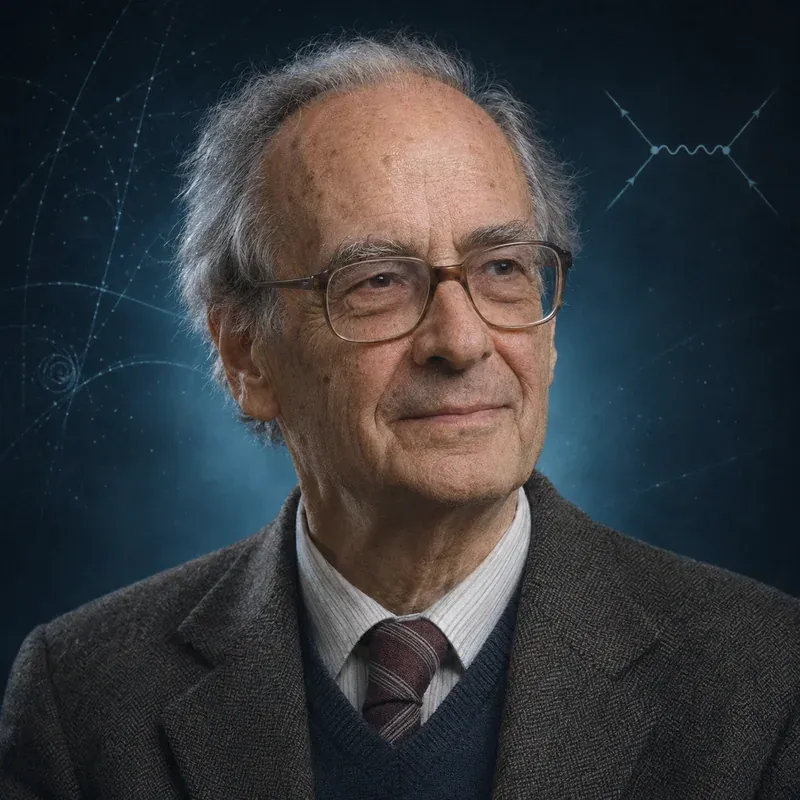
 Illustration
Ugo Amaldi
In 1975 Amaldi co-founded with Klaus Winter the CHARM collaboration at CERN, whose neutrino-scattering experiments measured neutral-current interactions and the weak mixing angle. In 1987 he was lead author of a comprehensive global analysis of all weak-neutral-current data, much of it from neutrino experiments, that tested the electroweak theory at the level of radiative corrections. As spokesman of DELPHI he helped build one of the four LEP experiments whose Z-boson measurements fixed the number of light neutrino species at three. He received the first Bruno Pontecorvo Prize in 1995 for a series of experimental results on the physics of weak interactions.
- Born
- 26 August 1934
- Nationality
- Italian
- Field
- Experimental particle physics; medical physics
- Institutions
- University of Rome (degree 1957), Istituto Superiore di Sanità, Rome, CERN (staff 1973–1999), Universities of Florence and Milan (1990–2006)
Background
Ugo Amaldi was born on 26 August 1934, the son of the physicist Edoardo Amaldi, one of the founders of CERN, and of the physicist Ginestra Giovene Amaldi. He graduated in physics from the University of Rome in 1957 and began his career at the Istituto Superiore di Sanità, Italy's national health institute, combining nuclear and particle physics with radiation physics. From 1968 he led an institute group at CERN and joined the CERN staff in 1973. In the early 1970s his group co-discovered the rise of the proton–proton total cross-section at the Intersecting Storage Rings.
Neutrinos and the weak neutral current
After the discovery of neutral currents at Gargamelle in 1973, the next task was to measure them precisely. In 1975 Amaldi and Klaus Winter founded the CHARM collaboration, whose fine-grained calorimeter detector at CERN studied deep-inelastic neutrino scattering and determined the weak mixing angle from the ratio of neutral- to charged-current events (see CHARM and CHARM II).
In 1987 Amaldi and a group of experimentalists and theorists published a comprehensive analysis of all available neutral-current data, from neutrino–quark and neutrino–electron scattering to electron–quark interactions. Including radiative corrections, it extracted a single value of the mixing angle, compared it with the measured W and Z masses and set limits on additional neutral bosons.
DELPHI and unification
Amaldi initiated DELPHI, one of the four experiments at CERN's LEP collider, and was its spokesman from 1980 to 1993. In 1989 the LEP experiments measured the width of the Z resonance and showed that there are three light neutrino species. In 1991, with Wim de Boer and Hermann Fürstenau, he used the LEP coupling constants to test grand unification: the three couplings fail to meet in the minimal Standard Model but converge near 10¹⁶ GeV if supersymmetric partners exist at about 1 TeV.
From 1991 Amaldi turned to cancer therapy with proton and carbon-ion beams, founding the TERA Foundation in 1992, which played a central role in the design of Italy's CNAO centre in Pavia.
Known for
- Co-founder of the CHARM neutrino collaboration (1975, with K. Winter)
- Spokesman of the DELPHI experiment at LEP (1980–1993)
- Global analysis of weak-neutral-current data (1987)
- Test of gauge-coupling unification with LEP data (1991)
- Hadron therapy and the TERA Foundation
- First Bruno Pontecorvo Prize (1995)
Chronology
- 1957Physics degree, University of Rome
- 1973Joins CERN staff
- 1975Co-founds the CHARM collaboration with Klaus Winter
- 1980Becomes spokesman of DELPHI
- 1987Global analysis of neutral-current data
- 1991Coupling-unification analysis with de Boer and Fürstenau
- 1992Founds the TERA Foundation
- 1995First Bruno Pontecorvo Prize
Original papers
- U. Amaldi et al., Comprehensive analysis of data pertaining to the weak neutral current and the intermediate-vector-boson masses, Phys. Rev. D 36, 1385 (1987)DOI 10.1103/PhysRevD.36.1385
- U. Amaldi, W. de Boer, H. Fürstenau, Comparison of grand unified theories with electroweak and strong coupling constants measured at LEP, Phys. Lett. B 260, 447 (1991)DOI 10.1016/0370-2693(91)91641-8
Experiments
- CHARM / CHARM-II
- DELPHI
Connected people
Frequently asked questions
What did Ugo Amaldi contribute to neutrino physics?
He co-founded the CHARM neutrino experiment at CERN and led the 1987 global analysis of weak-neutral-current data; for this work on weak interactions he received the first Pontecorvo Prize.
Is he related to Edoardo Amaldi?
Yes, he is the son of Edoardo Amaldi, the Italian physicist who was a member of Fermi's Rome group and one of the founders of CERN.
Mentioned in 1 page
People 1
Last updated: · Editorial standard
Cite this page
Text
Neutrino Atlas (2026). “Ugo Amaldi”. Retrieved 22 November 2026, from https://neutrino-atlas.com/people/ugo-amaldi/BibTeX
@misc{neutrinoatlas2026peopleugoamaldi,
  title        = {Ugo Amaldi},
  author       = {{Neutrino Atlas}},
  year         = {2026},
  url          = {https://neutrino-atlas.com/people/ugo-amaldi/},
  note         = {Accessed 2026-11-22},
  language     = {english}
}