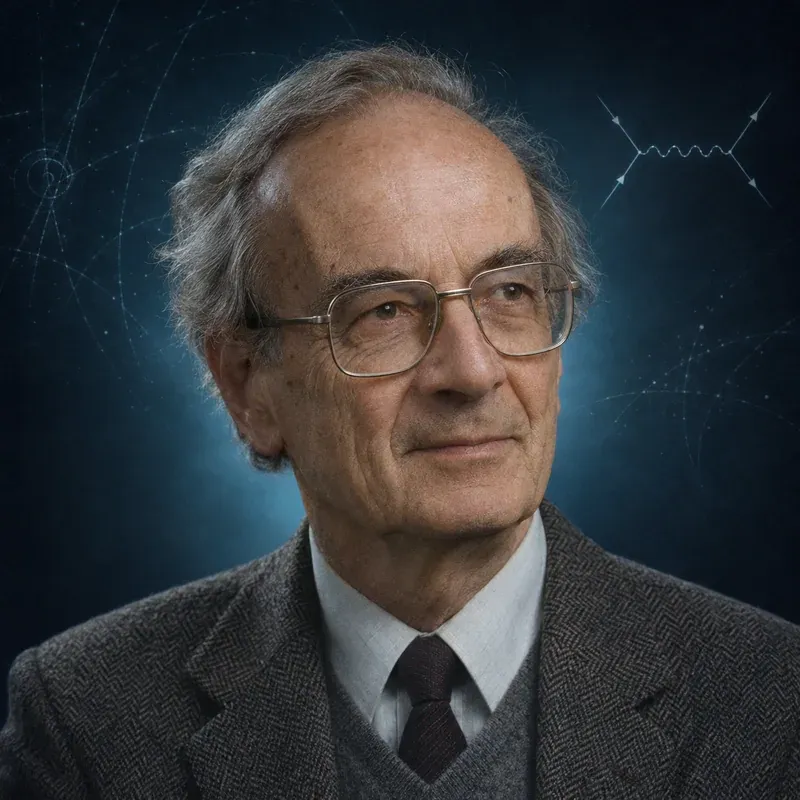
 Illustration
Klaus Winter
From 1976 Winter's research centred on the neutrino beams of CERN's Super Proton Synchrotron. He co-led the CHARM experiment, whose fine-grained marble calorimeter measured neutral-current neutrino interactions, and then led CHARM II, which recorded thousands of muon-neutrino scatterings on electrons and used them to determine the weak mixing angle without hadronic uncertainties. He was a driving force behind CHORUS, a hybrid emulsion detector that searched for muon-to-tau neutrino oscillations in the 1990s and set strict limits at small mass differences. He received the Bruno Pontecorvo Prize in 1997 for experimental research in accelerator neutrino physics.
- Born
- 1930
Hamburg, Germany - Died
- 9 February 2015
- Nationality
- German
- Field
- Experimental particle physics
- Institutions
- University of Hamburg, Collège de France, CERN
Early life and education
Klaus Winter was born in Hamburg in 1930 and took his physics diploma at the University of Hamburg in 1955. He then spent three years in Paris on a scholarship at the Collège de France, where he completed a doctorate in nuclear physics under Francis Perrin, one of the first physicists to argue from the beta spectrum that the neutrino must be very light. In 1958 he joined CERN, where he spent the rest of his career.
From meson decays to neutrino beams
Winter's early CERN work concerned the decays of charged pions and neutral kaons at the Proton Synchrotron. He later became spokesperson of the CHOV collaboration at the Intersecting Storage Rings, the world's first hadron collider. From 1976 his attention turned to the high-energy neutrino beams of the new Super Proton Synchrotron, which fed several large detectors in CERN's West Area.
CHARM and CHARM II
With Ugo Amaldi, Winter led CHARM, a CERN–Hamburg–Amsterdam–Rome–Moscow collaboration whose target calorimeter used large plates of Carrara marble as absorber. The light, fine-grained material made it possible to measure the energy of hadron showers and the direction of the outgoing particles in neutral-current events, and so to test the electroweak theory a few years after the neutral current had been discovered at Gargamelle.
The successor, CHARM II, was designed for one of the cleanest but rarest processes in neutrino physics: elastic scattering of muon neutrinos on electrons. Because no nucleus is involved, the cross-section depends only on the electroweak couplings. Its target, several hundred tonnes of glass plates interleaved with tracking detectors, recorded data from 1987 to 1991. Comparing neutrino and antineutrino scattering, the collaboration determined the weak mixing angle as sin²θW = 0.2324 ± 0.0083, one of the most precise purely leptonic values of its time.
CHORUS and the tau neutrino
In the early 1990s many physicists expected the tau neutrino to be heavy enough to explain dark matter, which would imply muon-to-tau oscillations at short distance. Winter was a driving force behind CHORUS, which combined a large target of nuclear emulsion, able to see the millimetre-long track of a tau lepton, with electronic detectors. Running in parallel with NOMAD from 1994 to 1997, it found no tau neutrinos and excluded oscillations with mixing above about 10⁻⁴ for large mass differences. The atmospheric results of 1998 later showed that the relevant mass difference is far smaller.
Legacy
Winter edited 'Neutrino Physics' for Cambridge University Press (first edition 1991, second 2000), a collection of review chapters that became a standard reference. He received the Bruno Pontecorvo Prize of the Joint Institute for Nuclear Research in 1997. He died in February 2015 after a long illness.
Known for
- Leadership of the CHARM and CHARM II neutrino experiments at the CERN SPS
- Precision electroweak tests in neutrino-electron scattering
- CHORUS search for muon-to-tau neutrino oscillations
- Editor of the reference book 'Neutrino Physics'
Chronology
- 1955Physics diploma at the University of Hamburg
- 1958Doctorate under Francis Perrin in Paris; joins CERN
- 1976Turns to experiments with the SPS neutrino beam
- 1987CHARM II begins taking data
- 1994CHORUS starts its oscillation run
- 1997Bruno Pontecorvo Prize
Original papers
- CHARM II Collaboration (P. Vilain et al.), Precision measurement of electroweak parameters from the scattering of muon-neutrinos on electrons, Phys. Lett. B 335, 246 (1994)DOI 10.1016/0370-2693(94)91421-4
- CHORUS Collaboration (E. Eskut et al.), Final results on νμ → ντ oscillation from the CHORUS experiment, Nucl. Phys. B 793, 326 (2008)arXiv:0710.3361
Experiments
Connected people
Frequently asked questions
What did Klaus Winter measure with CHARM II?
Elastic scattering of muon neutrinos and antineutrinos on electrons, from which the collaboration extracted the weak mixing angle with no uncertainty from nuclear structure.
Did CHORUS find neutrino oscillations?
No. It set limits on muon-to-tau oscillations at large mass differences. Tau-neutrino appearance from oscillations was later observed by OPERA at much longer baseline.
Mentioned in 3 pages
People 1
Last updated: · Editorial standard
Cite this page
Text
Neutrino Atlas (2026). “Klaus Winter”. Retrieved 22 November 2026, from https://neutrino-atlas.com/people/klaus-winter/BibTeX
@misc{neutrinoatlas2026peopleklauswinter,
  title        = {Klaus Winter},
  author       = {{Neutrino Atlas}},
  year         = {2026},
  url          = {https://neutrino-atlas.com/people/klaus-winter/},
  note         = {Accessed 2026-11-22},
  language     = {english}
}