CERN West Area Neutrino Facility (WANF)
CERN's SPS neutrino beamline from 1977 to 1998, which fed CDHS, CHARM, BEBC, CHARM-II, NOMAD and CHORUS.
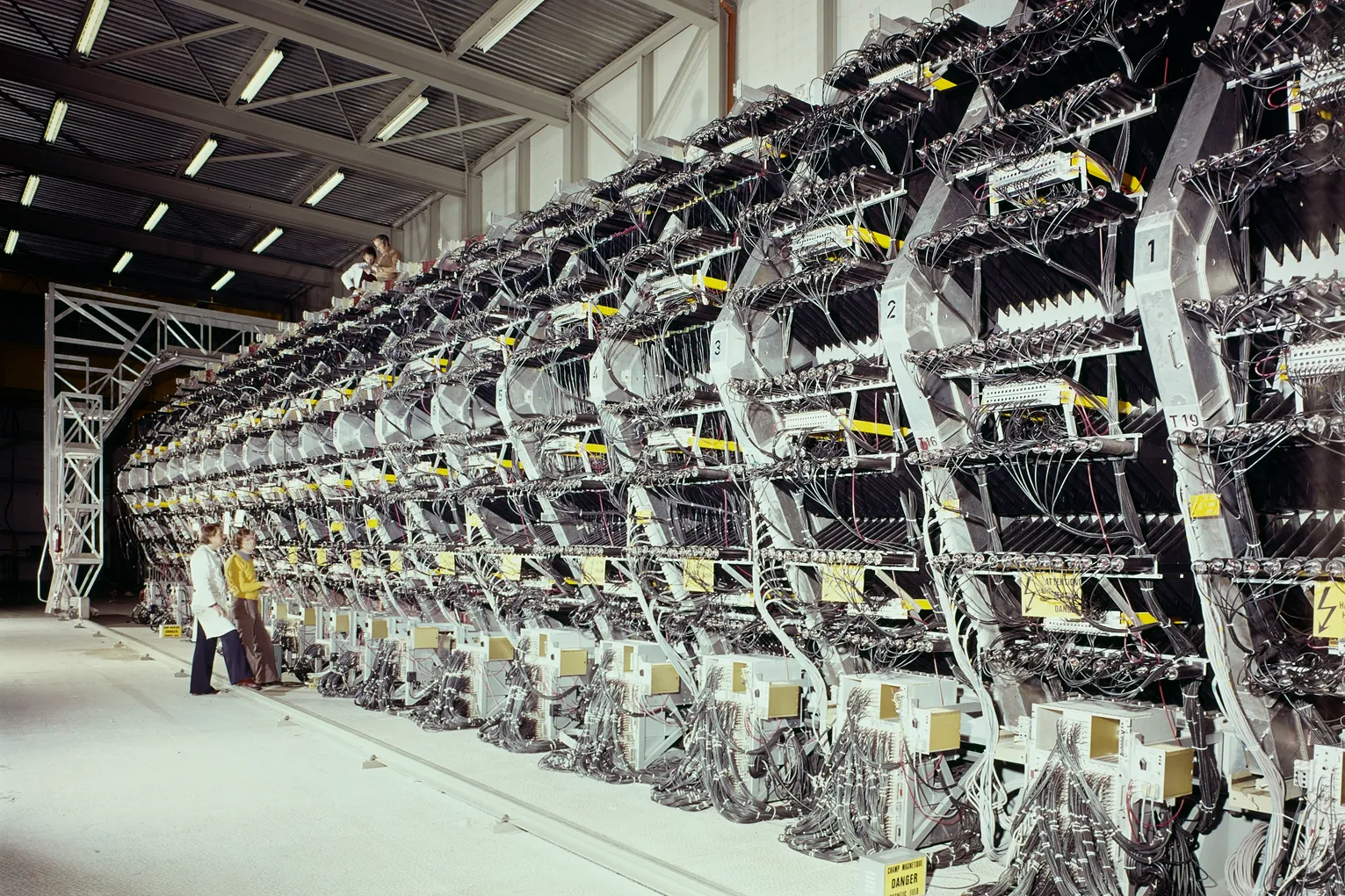
The West Area Neutrino Facility took protons from the 450 GeV SPS onto a beryllium target and offered wide-band horn-focused, narrow-band and beam-dump neutrino beams. It served bubble chambers and electronic detectors for two decades, delivering electroweak, structure-function and oscillation results, and closed in September 1998 after NOMAD and CHORUS. It was succeeded by CNGS.
Compare all experiments → · World map →
In plain words
When the Super Proton Synchrotron started up in 1976, CERN moved its neutrino programme from the older Proton Synchrotron to the new machine's West Area. For the next two decades a single beamline there supplied neutrinos to a succession of detectors, from giant bubble chambers to fine-grained electronic experiments.
How the beam worked
Extracted SPS protons struck a beryllium target; in the 1990s it consisted of eleven thin rods spaced along the beam axis. A magnetic horn and a second focusing element, the reflector, gathered the charged pions and kaons, which then decayed in a long tunnel. Four kinds of beam were offered: wide-band beams for maximum intensity, narrow-band beams in which the parent momentum was selected so that each neutrino's energy could be inferred from its position in the detector, beam-dump configurations in which most pions were absorbed before decaying, and low-energy beams from the PS. By the late 1990s the line delivered up to about 3 × 10¹³ protons per 14.4 s cycle.
Experiments and results
- Gargamelle moved to the SPS beam in 1977, joined by BEBC, CDHS led by Jack Steinberger, and CHARM from 1978.
- CDHS and CHARM measured the weak mixing angle and nucleon structure functions; beam-dump runs revealed prompt neutrinos from charm decays.
- CHARM-II (1983–1991) studied neutrino–electron scattering; a 1983–1984 near-station oscillation search found no signal.
- After a 1992–1993 rebuild, NOMAD and CHORUS searched for νμ→ντ oscillations, excluding mixing down to about 10⁻⁴ for Δm² above 1 eV².
Legacy
The facility closed in September 1998. CERN's neutrino work then moved to the long-baseline CNGS beam to Gran Sasso.
Frequently asked questions
Why did WANF offer narrow-band beams?
Selecting the momentum of the parent pions and kaons fixes the neutrino energy as a function of the angle to the beam axis, allowing cross-sections and structure functions to be measured with known neutrino energies.
Original papers
- MeasurementP. Astier et al. (NOMAD Collaboration), Prediction of neutrino fluxes in the NOMAD experiment, Nucl. Instrum. Meth. A 515, 800 (2003)arXiv:hep-ex/0306022
Related terms
People
Mentioned in 3 pages
Last updated: · Editorial standard
Cite this page
Text
Neutrino Atlas (2026). “CERN West Area Neutrino Facility (WANF)”. Retrieved 22 November 2026, from https://neutrino-atlas.com/terms/cern-wanf/BibTeX
@misc{neutrinoatlas2026termscernwanf,
  title        = {CERN West Area Neutrino Facility (WANF)},
  author       = {{Neutrino Atlas}},
  year         = {2026},
  url          = {https://neutrino-atlas.com/terms/cern-wanf/},
  note         = {Accessed 2026-11-22},
  language     = {english}
}