LBNF (Long-Baseline Neutrino Facility)
The facility under construction to send a megawatt neutrino beam 1300 km from Fermilab to South Dakota.
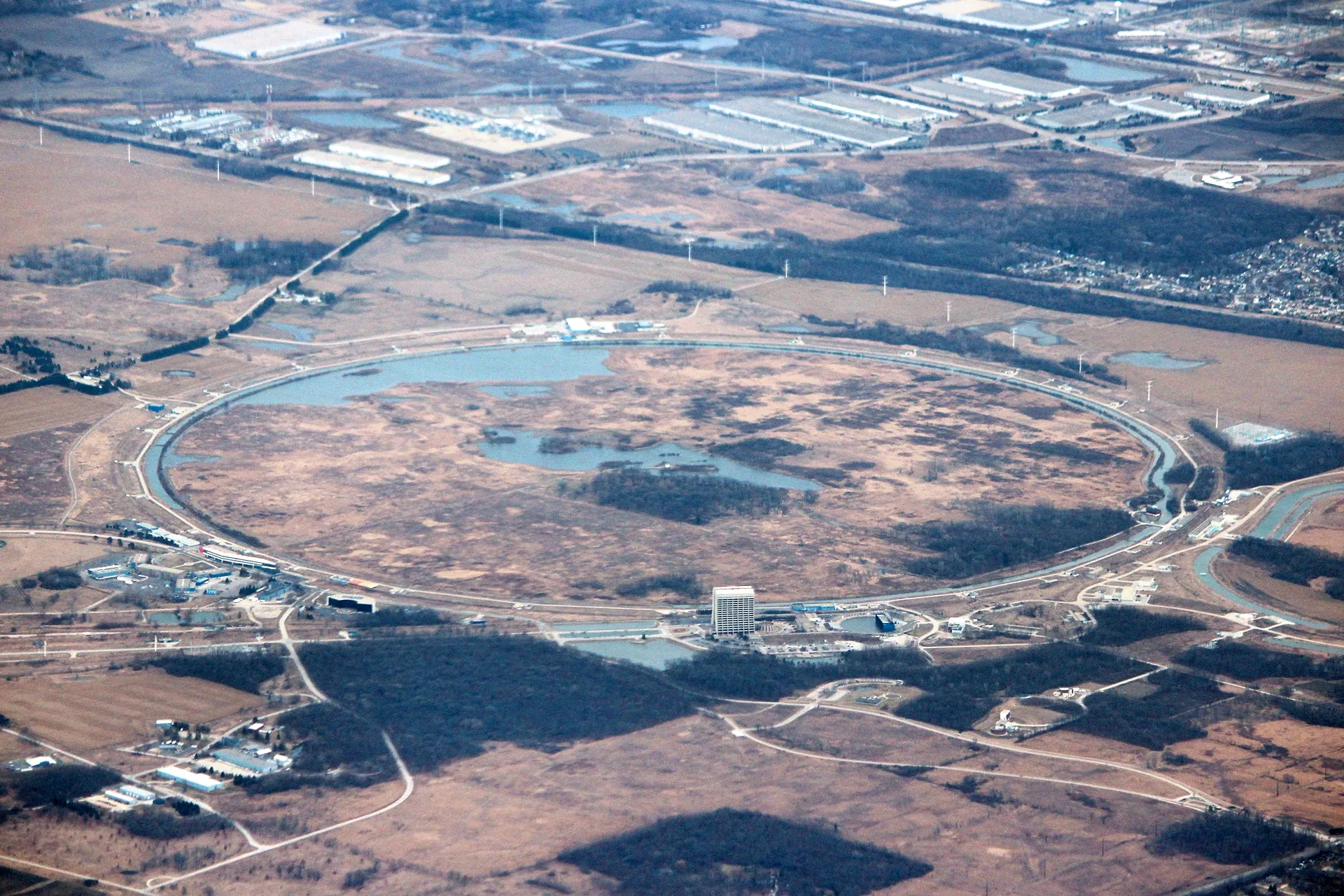
LBNF will deliver a wide-band beam from 60–120 GeV protons powered by the PIP-II linac upgrade, initially at about 1.2 MW, together with the underground caverns at SURF that host DUNE's far detectors. Cavern excavation at about 1.5 km depth was completed in early 2024.
Compare all experiments → · World map →
In plain words
The Long-Baseline Neutrino Facility is the infrastructure behind DUNE: a new beamline at Fermilab near Chicago and huge caverns 1.5 km underground at SURF in Lead, South Dakota. Neutrinos made at Fermilab will cross 1300 km of rock in about four milliseconds before reaching the far detectors.
In detail
Protons of 60 to 120 GeV from the Main Injector, fed by the new PIP-II superconducting linac, will strike a target inside a set of magnetic horns. The beamline climbs an artificial hill at Fermilab and then points downward at about 6° towards South Dakota. The beam is on axis and wide-band, covering roughly 0.5 to 5 GeV, so DUNE sees both the first and second oscillation maxima. The initial design power is about 1.2 MW, with a planned path to about 2.4 MW. A near-detector hall at Fermilab will host DUNE's near detector.
Status today
Excavation of the far-site caverns at SURF, which removed some 800,000 tons of rock, was completed in early 2024, and outfitting and installation of the first far-detector modules is under way. Beam operations are planned for the early 2030s.
Why it matters
The long baseline makes Earth matter effects large, which lets DUNE determine the mass ordering and separate it from CP violation. Combined with the wide-band beam, this complements the shorter, off-axis approach of the J-PARC beam and Hyper-Kamiokande.
Frequently asked questions
What is the difference between LBNF and DUNE?
LBNF is the facility: beamline, conventional facilities and caverns. DUNE is the international experiment, with its near and far detectors, that uses them.
Why is the beam on axis rather than off axis?
A wide energy spectrum lets DUNE map the oscillation pattern over more than one maximum, which helps untangle the effects of CP violation and the mass ordering.
Original papers
- ProposalR. Acciarri et al. (DUNE Collaboration), Long-Baseline Neutrino Facility (LBNF) and Deep Underground Neutrino Experiment (DUNE) Conceptual Design Report, Volume 1: The LBNF and DUNE Projects (2016)arXiv:1601.05471
Related terms
People
Latest research on this topic
- LBNF/DUNE Liquid Argon RoadmapMaciazka, Matt, Adamowski, Mark, Bremer, Johan et al. · 2026
- Horn Location Sensors for LBNFGanguly, Sudeshna, Johnson, Todd, Krokosz, Dakota et al. · 27 October 2025
On the timeline
- 2017Groundbreaking for LBNF and DUNE
- 2024DUNE's underground caverns are completed
- 2026DUNE begins installing detector support structures
Mentioned in 23 pages
FAQ 1
Milestones 3
Last updated: · Editorial standard
Cite this page
Text
Neutrino Atlas (2026). “LBNF (Long-Baseline Neutrino Facility)”. Retrieved 22 November 2026, from https://neutrino-atlas.com/terms/lbnf/BibTeX
@misc{neutrinoatlas2026termslbnf,
  title        = {LBNF (Long-Baseline Neutrino Facility)},
  author       = {{Neutrino Atlas}},
  year         = {2026},
  url          = {https://neutrino-atlas.com/terms/lbnf/},
  note         = {Accessed 2026-11-22},
  language     = {english}
}