Booster Neutrino Beam (BNB)
Fermilab's 8 GeV proton beamline producing neutrinos of roughly 0.8 GeV for short-baseline studies.
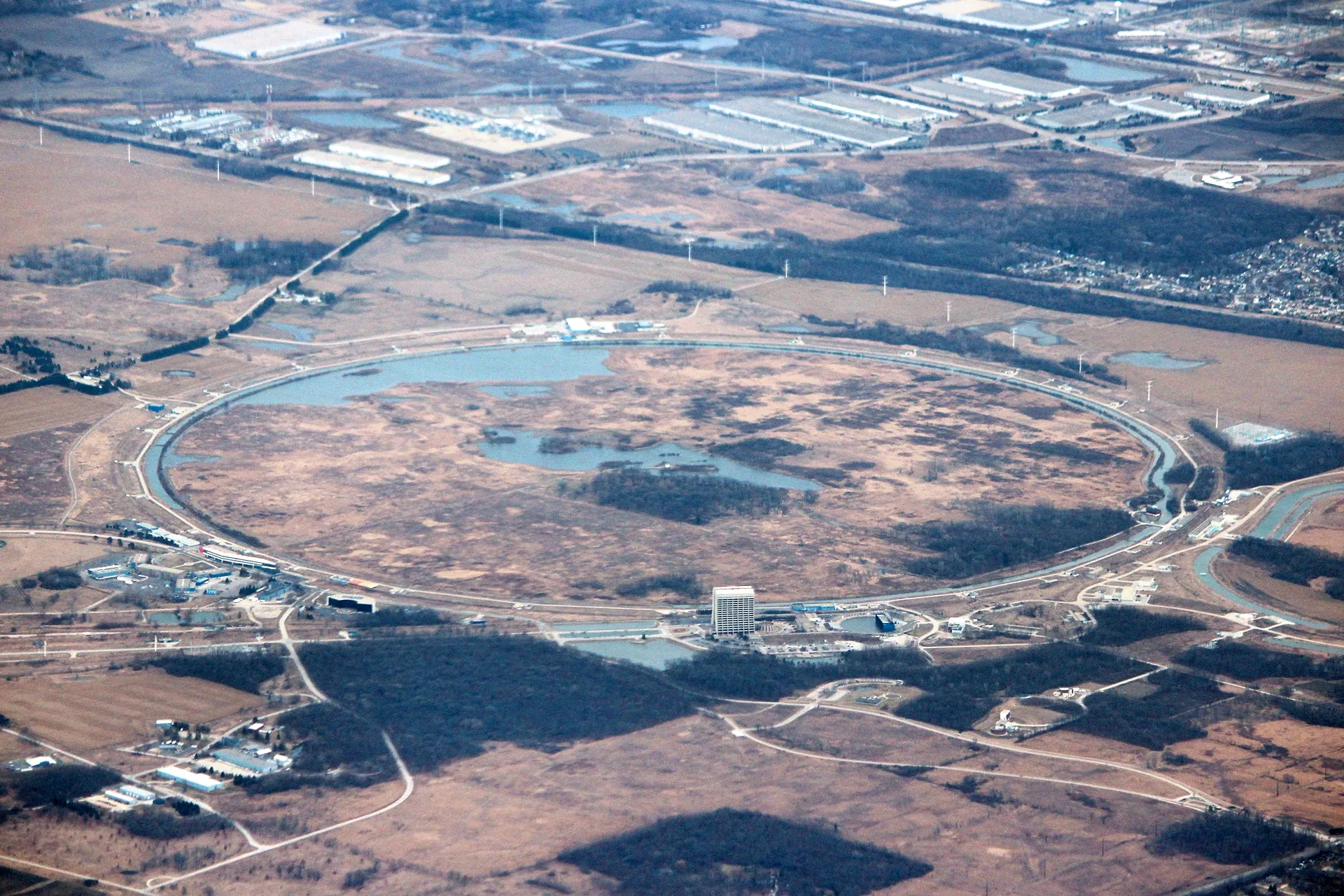
Protons from the Booster hit a beryllium target inside a single horn, followed by a 50 m decay pipe. The BNB has served MiniBooNE, SciBooNE, MicroBooNE, SBND and ICARUS within the Short-Baseline Neutrino program.
Compare all experiments → · World map →
In plain words
The Booster Neutrino Beam is Fermilab's low-energy neutrino source. It uses protons from the Booster, a smaller ring that also feeds the Main Injector, and makes neutrinos of below 1 GeV. Its detectors sit only a few hundred metres away, which is short enough to test whether neutrinos change flavour much faster than the three-flavour picture predicts.
In detail
Protons of 8 GeV kinetic energy strike a 71 cm beryllium target inside a single aluminium magnetic horn. The focused mesons decay in a 50 m decay pipe, giving a beam that is about 99.5% muon flavour in neutrino mode with a mean energy near 0.8 GeV. The beam started in 2002 for MiniBooNE and has since delivered more than 10²¹ protons on target.
Experiments served
- MiniBooNE (2002–2019), a 800-ton mineral-oil Cherenkov detector 541 m from the target, reported an excess of low-energy electron-like events.
- SciBooNE (2007–2008) measured cross sections close to the target.
- MicroBooNE (2015–2021) used a liquid-argon TPC at 470 m to look at that excess with better electron–photon separation.
- SBND at 110 m and ICARUS at 600 m form the Short-Baseline Neutrino program with MicroBooNE.
Why it matters
The BNB is the main laboratory for the short-baseline anomalies: it tests the LSND and MiniBooNE hints of a sterile neutrino with a well-known, low-energy flux and several detectors at different distances.
Frequently asked questions
Why is the BNB so low in energy?
It uses 8 GeV Booster protons instead of 120 GeV Main Injector protons, and a single horn and short decay pipe, so the neutrinos come out below about 1 GeV.
Is the MiniBooNE excess explained?
Not fully. MicroBooNE found no excess of the electron-neutrino type in its tested channels, but the origin of the MiniBooNE excess is still debated.
Original papers
- MeasurementA. A. Aguilar-Arevalo et al. (MiniBooNE Collaboration), The Neutrino Flux prediction at MiniBooNE, Phys. Rev. D 79, 072002 (2009)DOI 10.1103/PhysRevD.79.072002arXiv:0806.1449
Related terms
People
Latest research on this topic
On the timeline
- 2007MiniBooNE tests LSND and finds a low-energy excess
- 2021MicroBooNE finds no electron-neutrino excess
- 2025MicroBooNE finds no evidence for a sterile neutrino
- 2026SBND releases its first neutrino results
Mentioned in 17 pages
Lessons 1
Milestones 5
Last updated: · Editorial standard
Cite this page
Text
Neutrino Atlas (2026). “Booster Neutrino Beam (BNB)”. Retrieved 22 November 2026, from https://neutrino-atlas.com/terms/bnb/BibTeX
@misc{neutrinoatlas2026termsbnb,
  title        = {Booster Neutrino Beam (BNB)},
  author       = {{Neutrino Atlas}},
  year         = {2026},
  url          = {https://neutrino-atlas.com/terms/bnb/},
  note         = {Accessed 2026-11-22},
  language     = {english}
}