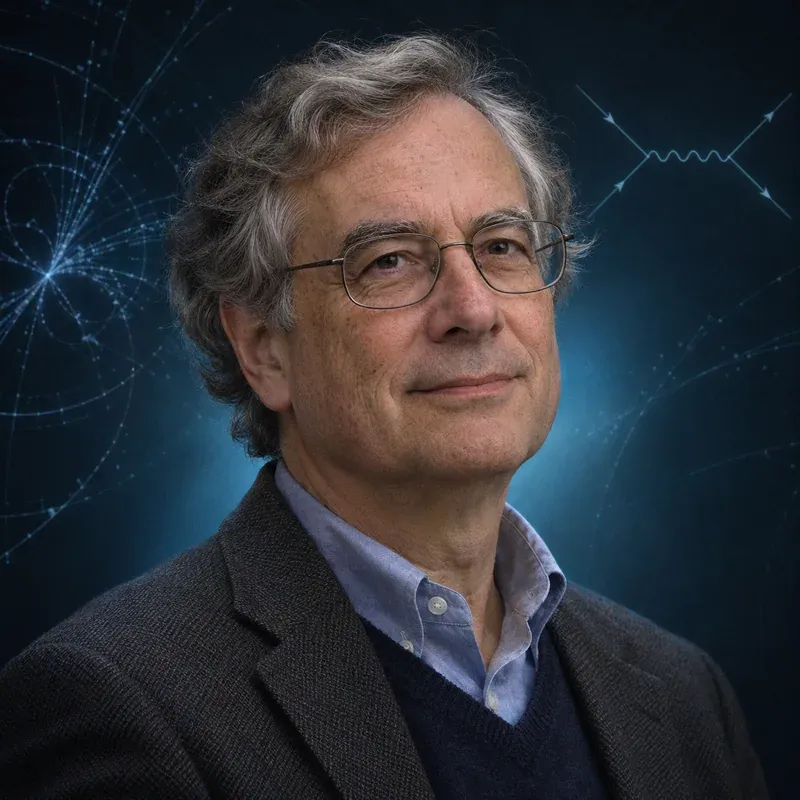
 Illustration
William C. Louis
Louis was spokesperson of LSND at Los Alamos, whose excess of electron antineutrinos in a muon-antineutrino beam in the 1990s suggested oscillations at Δm² ~ 1 eV², incompatible with three-flavour mixing. LSND triggered MiniBooNE at Fermilab, of which he was co-spokesperson for its first ten years; MiniBooNE saw an excess consistent with LSND. He continues in Fermilab's Short-Baseline Neutrino programme.
- Nationality
- American
- Field
- Experimental neutrino physics
- Institutions
- University of Michigan (PhD 1978), Rutherford Laboratory, Princeton University, Los Alamos National Laboratory
Career
William Charles Louis III received his PhD in physics from the University of Michigan in 1978. He was a research associate at the Rutherford Laboratory in England and an assistant professor at Princeton University before joining Los Alamos National Laboratory as a staff member in 1987. From 2004 to 2009 he managed the laboratory's nuclear physics programme. He was named a Los Alamos Fellow in 2011 and a Fellow of the American Association for the Advancement of Science in 2016, cited for distinguished contributions to fundamental neutrino measurements.
LSND
Louis was spokesperson of the Liquid Scintillator Neutrino Detector (LSND) at the LAMPF proton accelerator in Los Alamos. The experiment used the decay-at-rest technique: protons stopped in a target produce positive pions and then muons, whose decays at rest yield a well-understood flux of muon antineutrinos but almost no electron antineutrinos. A tank of mineral oil with a small admixture of scintillator, viewed by photomultipliers, looked for electron antineutrinos through inverse beta decay on protons, identified by a positron followed by the gamma ray from neutron capture.
In the 1990s LSND found an excess of such events. Interpreted as the appearance of electron antineutrinos through oscillation, it pointed to a mass-squared difference of the order of 1 eV², far larger than the values later measured for solar and atmospheric neutrinos. Three neutrino flavours cannot accommodate three independent mass-squared differences of such different size, so the result suggested an additional sterile neutrino. The similar KARMEN experiment at the ISIS facility saw no excess but could not exclude the whole LSND region.
MiniBooNE and after
To test LSND with a different beam, energy and distance but a similar ratio of distance to energy, the MiniBooNE experiment was built at Fermilab's Booster Neutrino Beam. Louis was co-spokesperson, with Janet Conrad, for its first ten years. MiniBooNE began taking data in 2002 and also observed an excess of electron-like events, particularly at low energy, in both neutrino and antineutrino mode. These results are part of the short-baseline anomalies. Louis continues to work on Fermilab's Short-Baseline Neutrino programme, whose detectors SBND, MicroBooNE and ICARUS use liquid-argon technology to examine the origin of these excesses.
Known for
- Spokesperson of LSND
- LSND evidence for ν̄μ→ν̄e oscillations
- Co-spokesperson of MiniBooNE (first 10 years)
- Short-baseline anomaly / sterile neutrinos
Chronology
- 1978PhD, University of Michigan
- 1987Staff member at Los Alamos
- 1995LSND first evidence for oscillation
- 2002MiniBooNE begins data-taking
- 2007First MiniBooNE oscillation results
- 2011LANL Fellow
- 2016AAAS Fellow
Original papers
- C. Athanassopoulos et al. (LSND), Evidence for anti-νμ → anti-νe oscillations from the LSND experiment at LAMPF, Phys. Rev. Lett. 77, 3082 (1996)DOI 10.1103/PhysRevLett.77.3082
Experiments
Connected people
Frequently asked questions
What did the LSND experiment find?
An excess of electron antineutrino events in a beam of muon antineutrinos from muon decay at rest. Read as oscillation, it implied a mass-squared difference near 1 eV², which does not fit the three-flavour picture and pointed to a possible sterile neutrino.
Has the LSND signal been confirmed?
Not unambiguously. MiniBooNE saw an excess consistent with LSND, KARMEN did not, and global fits find tension between appearance and disappearance data. Fermilab's Short-Baseline Neutrino programme is designed to settle the question.
On the timeline
- 1995LSND reports an unexpected oscillation signal
- 2007MiniBooNE tests LSND and finds a low-energy excess
- 2018MiniBooNE's excess grows to 4.8σ
- 2025MicroBooNE finds no evidence for a sterile neutrino
Mentioned in 12 pages
Milestones 4
People 2
Last updated: · Editorial standard
Cite this page
Text
Neutrino Atlas (2026). “William C. Louis”. Retrieved 22 November 2026, from https://neutrino-atlas.com/people/william-louis/BibTeX
@misc{neutrinoatlas2026peoplewilliamlouis,
  title        = {William C. Louis},
  author       = {{Neutrino Atlas}},
  year         = {2026},
  url          = {https://neutrino-atlas.com/people/william-louis/},
  note         = {Accessed 2026-11-22},
  language     = {english}
}